
Nothing Phone (3a) vs Google Pixel 8a: A Deep Dive into Mid-Range Champions
| Phones Images | |||||
|---|---|---|---|---|---|
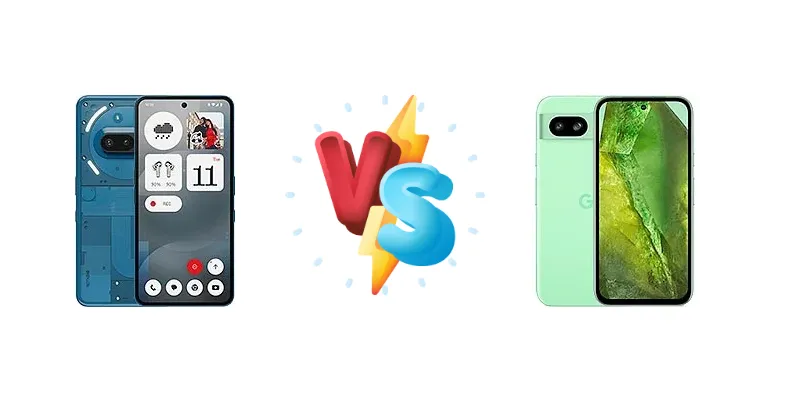
|
🏆 Quick Verdict
For the average user prioritizing long-term battery life and overall value, the Nothing Phone (3a) emerges as the winner. Its significantly longer 43:56h endurance and faster charging (50W) outweigh the Pixel 8a’s brighter display and Tensor G3 chip for most daily tasks.
| PHONES | ||
|---|---|---|
| Phone Names | Nothing Phone (3a) | Google Pixel 8a |
| Network | ||
|---|---|---|
| 2G bands | GSM 850 / 900 / 1800 / 1900 | GSM 850 / 900 / 1800 / 1900 |
| 3G bands | HSDPA 800 / 850 / 900 / 1700(AWS) / 1900 / 2100 | HSDPA 800 / 850 / 900 / 1700(AWS) / 1900 / 2100 |
| 4G bands | 1, 2, 3, 4, 5, 7, 8, 12, 17, 18, 19, 20, 26, 28, 38, 40, 41, 42, 48, 66 | 1, 2, 3, 4, 5, 7, 8, 12, 17, 18, 19, 20, 26, 28, 32, 38, 40, 41, 42, 66 - G6GPR (International) |
| 5G bands | 1, 2, 3, 5, 7, 8, 12, 20, 28, 38, 40, 41, 48, 66, 77, 78 SA/NSA | 1, 2, 3, 5, 7, 8, 12, 20, 26, 28, 38, 40, 41, 66, 75, 76, 77, 78 SA/NSA/Sub6 - G6GPR (International) |
| Speed | HSPA, LTE, 5G | HSPA, LTE, 5G |
| Technology | GSM / HSPA / LTE / 5G | GSM / HSPA / LTE / 5G |
| Launch | ||
|---|---|---|
| Announced | 2025, March 04 | 2024, May 07 |
| Status | Available. Released 2025, March 11 | Available. Released 2024, May 14 |
| Body | ||
|---|---|---|
| Build | Glass front (Panda Glass), plastic frame, glass back | Glass front (Gorilla Glass 3), aluminum frame, plastic back |
| Dimensions | 163.5 x 77.5 x 8.4 mm (6.44 x 3.05 x 0.33 in) | 152.1 x 72.7 x 8.9 mm (5.99 x 2.86 x 0.35 in) |
| SIM | Nano-SIM + Nano-SIM | Nano-SIM + eSIM |
| Weight | 201 g (7.09 oz) | 188 g (6.63 oz) |
| Display | ||
|---|---|---|
| Protection | Panda Glass, Mohs level 5 | Corning Gorilla Glass 3, Mohs level 5 |
| Resolution | 1080 x 2392 pixels (~387 ppi density) | 1080 x 2400 pixels, 20:9 ratio (~430 ppi density) |
| Size | 6.77 inches, 111.5 cm2 (~88.0% screen-to-body ratio) | 6.1 inches, 90.3 cm2 (~81.6% screen-to-body ratio) |
| Type | AMOLED, 1B colors, 120Hz, 2160Hz PWM, HDR10+, 800 nits (typ), 1300 nits (HBM), 3000 nits (peak) | OLED, HDR, 120Hz, 2000 nits (peak) |
| Platform | ||
|---|---|---|
| CPU | Octa-core (1x2.5 GHz Cortex-A720 & 3x2.4 GHz Cortex-A720 & 4x1.8 GHz Cortex-A520) | Nona-core (1x3.0 GHz Cortex-X3 & 4x2.45 GHz Cortex-A715 & 4x2.15 GHz Cortex-A510) |
| Chipset | Qualcomm SM7635 Snapdragon 7s Gen 3 (4 nm) | Google Tensor G3 (4 nm) |
| GPU | Adreno 810 | Immortalis-G715s MC10 |
| OS | Android 15, up to 3 major Android upgrades, Nothing OS 3.1 | Android 14, upgradable to Android 16, up to 7 major Android upgrades |
| Memory | ||
|---|---|---|
| Card slot | No | No |
| Internal | 128GB 8GB RAM, 256GB 8GB RAM, 256GB 12GB RAM | 128GB 8GB RAM, 256GB 8GB RAM |
| Main Camera | ||
|---|---|---|
| Dual | - | 64 MP (16 MP eff.), f/1.9, 26mm (wide), 1/1.73", 0.8µm, dual pixel PDAF, OIS 13 MP, f/2.2, 120˚ (ultrawide), 1.12µm |
| Features | LED flash, panorama, HDR | Dual-LED flash, Pixel Shift, Ultra HDR, panorama, Best Take |
| Triple | 50 MP, f/1.9, 24mm (wide), 1/1.57", 1.0µm, dual pixel PDAF, OIS 50 MP, f/2.0, 50mm (telephoto), 1/2.74", 0.64µm, PDAF (25cm - ∞), 2x optical zoom 8 MP, f/2.2, 15mm, 120˚ (ultrawide), 1/4.0", 1.12µm | - |
| Video | 4K@30fps, 1080p@30/60/120fps, gyro-EIS, OIS | 4K@30/60fps, 1080p@30/60/120/240fps, OIS |
| Selfie camera | ||
|---|---|---|
| Features | - | HDR, panorama |
| Single | 32 MP, f/2.2, 22mm (wide), 1/3.44" | 13 MP, f/2.2, 20mm (ultrawide), 1.12µm |
| Video | 1080p@30fps | 4K@30fps, 1080p@30/60fps |
| Sound | ||
|---|---|---|
| 35mm jack | No | No |
| Loudspeaker | Yes, with stereo speakers | Yes, with stereo speakers |
| Comms | ||
|---|---|---|
| Bluetooth | 5.4, A2DP, LE | 5.3, A2DP, LE |
| NFC | Yes | Yes |
| Positioning | GPS, GALILEO, GLONASS, BDS, QZSS | GPS, GLONASS, GALILEO, BDS, QZSS, NavIC |
| Radio | No | No |
| USB | USB Type-C 2.0, OTG | USB Type-C 3.2 |
| WLAN | Wi-Fi 802.11 a/b/g/n/ac/6, dual-band, Wi-Fi Direct | Wi-Fi 802.11 a/b/g/n/ac/6e, dual/tri-band (market/region dependent) |
| Features | ||
|---|---|---|
| Sensors | Fingerprint (under display, optical), accelerometer, gyro, proximity, compass | Fingerprint (under display, optical), accelerometer, gyro, proximity, compass, barometer |
| Battery | ||
|---|---|---|
| Charging | 50W wired, 50% in 19 min, 100% in 56 min | 18W wired, PD3.0 7.5W wireless Bypass charging |
| Type | 5000 mAh | Li-Po 4492 mAh |
| Misc | ||
|---|---|---|
| Colors | Black, White, Blue | Obsidian, Porcelain, Bay, Aloe |
| Models | A059 | GKV4X, G6GPR, G8HHN, G576D |
| Price | $ 340.00 / € 249.00 | $ 229.98 / C$ 417.99 / £ 279.00 / € 299.99 / ₹ 33,300 |
| EU LABEL | ||
|---|---|---|
| Battery | 43:56h endurance, 1400 cycles | 40:06h endurance, 1000 cycles |
| Energy | Class C | Class B |
| Free fall | Class C (90 falls) | Class A (270 falls) |
| Repairability | Class C | Class B |
Nothing Phone (3a)
- Exceptional battery endurance (43:56h)
- Faster 50W wired charging
- Longer battery lifespan (1400 cycles)
- Lower peak display brightness
- Less powerful processor for AI tasks
Google Pixel 8a
- Brighter display (1508 nits)
- Google Tensor G3 for AI features
- Renowned Google camera software
- Shorter battery life (40:06h)
- Slower 18W wired charging
- Fewer battery cycles (1000)
Display Comparison
The Google Pixel 8a boasts a brighter display, reaching a measured 1508 nits, compared to the Nothing Phone (3a)’s 1273 nits. This difference is noticeable in direct sunlight, giving the Pixel 8a an edge for outdoor visibility. However, both displays utilize a 4nm process for their respective chipsets, suggesting similar efficiency. While neither specification details refresh rate, the Pixel 8a’s OLED panel is likely to offer superior contrast and color accuracy, benefiting content consumers. The Nothing Phone (3a) doesn’t specify panel type, but its lower peak brightness may impact HDR content viewing.
Camera Comparison
The Pixel 8a’s camera prowess is driven by Google’s computational photography, leveraging the Tensor G3’s AI capabilities. While sensor details are missing, the Pixel’s image processing is renowned for its dynamic range and accurate color reproduction. The Nothing Phone (3a) lacks specific camera details in the provided data, making a direct sensor comparison impossible. However, given its price point, it’s likely to rely more on software optimization than cutting-edge hardware. Pixel users will benefit from features like Magic Eraser and Photo Unblur, while Nothing Phone (3a) users will need to rely on manual adjustments and third-party apps for advanced editing.
Performance
Under the hood, the Google Pixel 8a features Google’s Tensor G3 chip, a nona-core processor with a Cortex-X3 prime core clocked at 3.0 GHz. This architecture prioritizes AI and machine learning tasks, enhancing features like voice recognition and image processing. The Nothing Phone (3a) utilizes the Qualcomm SM7635 Snapdragon 7s Gen 3, an octa-core chip built on a 4nm process. While the Tensor G3 has a higher clock speed on its prime core, the Snapdragon 7s Gen 3’s architecture is optimized for sustained performance and efficiency. The Pixel 8a’s focus on AI tasks will benefit users heavily invested in Google’s ecosystem, while the Nothing Phone (3a) offers a more balanced approach to everyday performance.
Battery Life
Battery life is where the Nothing Phone (3a) truly shines. Its measured endurance of 43:56h significantly surpasses the Pixel 8a’s 40:06h. This translates to a full day of heavy use with power to spare. Furthermore, the Nothing Phone (3a) supports 50W wired charging, achieving a 50% charge in just 19 minutes and a full charge in 56 minutes. The Pixel 8a, limited to 18W wired charging with PD3.0 and 7.5W wireless charging, takes considerably longer to replenish its battery. The Nothing Phone (3a) also boasts 1400 battery cycles, suggesting greater long-term battery health compared to the Pixel 8a’s 1000 cycles.
Buying Guide
Buy the Nothing Phone (3a) if you need exceptional battery life, prioritize fast charging speeds, and appreciate a distinctive design. It’s ideal for users who are frequently on the go and don’t want to worry about constantly topping up their phone. Buy the Google Pixel 8a if you value Google’s software experience, computational photography, and a slightly brighter display, and are willing to trade some battery endurance for those features.