
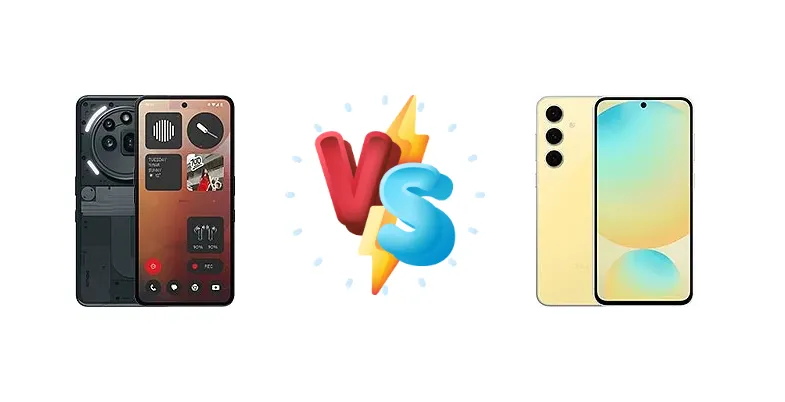
Nothing Phone (3a) Pro vs. Samsung Galaxy S24 FE: Which Mid-Range Champion Reigns Supreme?
| Phones Images | |||||
|---|---|---|---|---|---|
|
🏆 Quick Verdict
For the average user prioritizing sustained performance and battery longevity, the Nothing Phone (3a) Pro emerges as the winner. Its Snapdragon 7s Gen 3 offers a more consistent experience, and the impressive 43:17h battery endurance surpasses the S24 FE’s 42:00h, despite a slightly smaller battery capacity.
| PHONES | ||
|---|---|---|
| Phone Names | Nothing Phone (3a) Pro | Samsung Galaxy S24 FE |
| Network | ||
|---|---|---|
| 2G bands | GSM 850 / 900 / 1800 / 1900 | GSM 850 / 900 / 1800 / 1900 |
| 3G bands | HSDPA 800 / 850 / 900 / 1700(AWS) / 1900 / 2100 | HSDPA 850 / 900 / 1700(AWS) / 1900 / 2100 |
| 4G bands | 1, 2, 3, 4, 5, 7, 8, 12, 17, 18, 19, 20, 26, 28, 38, 40, 41, 42, 48, 66 | 1, 2, 3, 4, 5, 7, 8, 12, 17, 18, 19, 20, 25, 26, 28, 32, 38, 40, 41, 66 - International |
| 5G bands | 1, 2, 3, 5, 7, 8, 12, 20, 28, 38, 40, 41, 48, 66, 77, 78 SA/NSA | 1, 2, 3, 5, 7, 8, 12, 20, 25, 26, 28, 38, 40, 41, 66, 75, 77, 78 SA/NSA/Sub6 - International |
| Speed | HSPA, LTE, 5G | HSPA, LTE, 5G |
| Technology | GSM / HSPA / LTE / 5G | GSM / HSPA / LTE / 5G |
| Launch | ||
|---|---|---|
| Announced | 2025, March 04 | 2024, September 26 |
| Status | Available. Released 2025, March 25 | Available. Released 2024, October 03 |
| Body | ||
|---|---|---|
| Build | Glass front (Panda Glass), plastic frame, glass back | Glass front (Gorilla Glass Victus+), glass back (Gorilla Glass Victus+), aluminum frame |
| Dimensions | 163.5 x 77.5 x 8.4 mm (6.44 x 3.05 x 0.33 in) | 162 x 77.3 x 8 mm (6.38 x 3.04 x 0.31 in) |
| SIM | · Nano-SIM + Nano-SIM + eSIM (max 2 at a time)· Nano-SIM + Nano-SIM - India only | · Nano-SIM· Nano-SIM + Nano-SIM· Nano-SIM + eSIM· eSIM + eSIM |
| Weight | 211 g (7.44 oz) | 213 g (7.51 oz) |
| Display | ||
|---|---|---|
| Protection | Panda Glass, Mohs level 5 | Corning Gorilla Glass Victus+, Mohs level 5 |
| Resolution | 1080 x 2392 pixels (~387 ppi density) | 1080 x 2340 pixels, 19.5:9 ratio (~385 ppi density) |
| Size | 6.77 inches, 111.5 cm2 (~88.0% screen-to-body ratio) | 6.7 inches, 110.2 cm2 (~88.0% screen-to-body ratio) |
| Type | AMOLED, 1B colors, 120Hz, 2160Hz PWM, HDR10+, 800 nits (typ), 1300 nits (HBM), 3000 nits (peak) | Dynamic AMOLED 2X, 120Hz, HDR10+, 1900 nits (peak) |
| Platform | ||
|---|---|---|
| CPU | Octa-core (1x2.5 GHz Cortex-A720 & 3x2.4 GHz Cortex-A720 & 4x1.8 GHz Cortex-A520) | 10-core (1x3.1 GHz + 2x2.9 GHz + 3x2.6 GHz + 4x1.95 GHz) |
| Chipset | Qualcomm SM7635 Snapdragon 7s Gen 3 (4 nm) | Exynos 2400e (4 nm) |
| GPU | Adreno 810 | Xclipse 940 |
| OS | Android 15, up to 3 major Android upgrades, Nothing OS 3.1 | Android 14, up to 7 major Android upgrades, One UI 8.0 |
| Memory | ||
|---|---|---|
| Card slot | No | No |
| Internal | 128GB 8GB RAM, 256GB 8GB RAM, 256GB 12GB RAM | 128GB 8GB RAM, 256GB 8GB RAM, 512GB 8GB RAM |
| Main Camera | ||
|---|---|---|
| Features | LED flash, panorama, HDR | LED flash, HDR, panorama |
| Triple | 50 MP, f/1.9, 24mm (wide), 1/1.56", 1.0µm, dual pixel PDAF, OIS 50 MP, f/2.6, 70mm (periscope telephoto) (15cm - ∞), 1/1.95", 0.8µm, PDAF, OIS, 3x optical zoom 8 MP, f/2.2, 15mm, 120˚ (ultrawide), 1/4.0", 1.12µm | 50 MP, f/1.8, 24mm (wide), 1/1.57", 1.0µm, dual pixel PDAF, OIS 8 MP, f/2.4, 75mm (telephoto), 1/4.4", 1.0µm, PDAF, OIS, 3x optical zoom 12 MP, f/2.2, 13mm, 123˚ (ultrawide), 1/3.0", 1.12µm |
| Video | 4K@30fps, 1080p@30/60/120fps, gyro-EIS, OIS | 8K@30fps, 4K@30/60/120fps, 1080p@30/60/120/240fps |
| Selfie camera | ||
|---|---|---|
| Single | 50 MP, f/2.2, 24mm (wide), 1/2.76" | 10 MP, f/2.4, 26mm (wide), 1/3.0", 1.22µm |
| Video | 4K@30fps, 1080p@30fps | 4K@30/60fps, 1080p@30/60fps; gyro-EIS |
| Sound | ||
|---|---|---|
| 35mm jack | No | No |
| Loudspeaker | Yes, with stereo speakers | Yes, with stereo speakers |
| Comms | ||
|---|---|---|
| Bluetooth | 5.4, A2DP, LE | 5.3, A2DP, LE |
| NFC | Yes | Yes |
| Positioning | GPS, GALILEO, GLONASS, BDS, QZSS | GPS, GLONASS, GALILEO, BDS |
| Radio | No | Unspecified |
| USB | USB Type-C 2.0, OTG | USB Type-C 3.2, OTG |
| WLAN | Wi-Fi 802.11 a/b/g/n/ac/6, dual-band, Wi-Fi Direct | Wi-Fi 802.11 a/b/g/n/ac/6e, dual-band or tri-band (market/region dependent), Wi-Fi Direct |
| Features | ||
|---|---|---|
| Sensors | Fingerprint (under display, optical), accelerometer, gyro, proximity, compass | Fingerprint (under display, optical), accelerometer, gyro, compass |
| Battery | ||
|---|---|---|
| Charging | 50W wired, 50% in 19 min, 100% in 56 min | 25W wired, PD, QC2, 50% in 30 min 15W wireless Reverse wireless |
| Type | 5000 mAh | 4700 mAh |
| Misc | ||
|---|---|---|
| Colors | Black, Gray | Blue, Graphite, Gray, Mint, Yellow |
| Models | A059P | SM-S721B, SM-S721B/DS, SM-S721U1, SM-S721U, SM-S721W, SM-S7210, SM-S721N |
| Price | € 380.00 | $ 249.74 / C$ 498.99 / £ 335.00 / € 387.00 / ₹ 34,180 |
| SAR | - | 0.94 W/kg (head) 0.71 W/kg (body) |
| SAR EU | - | 0.86 W/kg (head) 1.29 W/kg (body) |
| EU LABEL | ||
|---|---|---|
| Battery | 43:17h endurance, 1400 cycles | 42:00h endurance, 2000 cycles |
| Energy | Class C | Class B |
| Free fall | Class C (90 falls) | Class A (270 falls) |
| Repairability | Class C | Class C |
Nothing Phone (3a) Pro
- Superior battery endurance (43:17h)
- More efficient Snapdragon 7s Gen 3 chipset
- Faster full charge time (56 minutes)
- Lacks wireless charging
- Potentially less powerful camera system
Samsung Galaxy S24 FE
- Slightly brighter display (1372 nits)
- Wireless and reverse wireless charging
- Established Samsung brand and ecosystem
- Potential for thermal throttling with Exynos 2400e
- Slightly lower battery endurance (42:00h)
Display Comparison
Both devices feature displays capable of reaching impressive peak brightness, with the Samsung Galaxy S24 FE edging out the Nothing Phone (3a) Pro at 1372 nits versus 1307 nits. While the difference is measurable, both screens are perfectly usable in direct sunlight. However, the lack of LTPO technology on either device means refresh rate scaling isn’t as efficient as on flagship models, potentially impacting battery life during dynamic content viewing. The S24 FE’s slightly higher brightness may benefit users heavily consuming HDR content, but the difference is unlikely to be dramatic in everyday use.
Camera Comparison
While detailed camera analysis requires dedicated testing, the available data suggests a potential advantage for the S24 FE, assuming it inherits sensor technology from its flagship siblings. The focus should be on the main sensor capabilities, as the 2MP macro cameras on both devices offer limited practical value. The S24 FE’s image processing, typically known for vibrant colors and strong contrast, will appeal to some users, while Nothing’s approach tends towards a more natural look. Without specific sensor size information, it’s difficult to definitively declare a winner, but Samsung’s experience in mobile imaging gives it a slight edge.
Performance
The core difference lies in the chipsets: the Nothing Phone (3a) Pro utilizes the Qualcomm SM7635 Snapdragon 7s Gen 3 (4nm), while the S24 FE employs the Exynos 2400e (4nm). The Exynos 2400e boasts a 10-core CPU configuration with higher clock speeds (up to 3.1 GHz) compared to the Snapdragon’s octa-core setup (up to 2.5 GHz). However, raw clock speed doesn’t tell the whole story. The Snapdragon 7s Gen 3 is known for its efficiency and optimized architecture, potentially leading to better sustained performance and less thermal throttling. The S24 FE’s Exynos chip, while powerful, has a history of running warmer, which could limit peak performance during extended gaming sessions. The Snapdragon’s architecture, with its Cortex-A720 cores, provides a strong balance of power and efficiency.
Battery Life
The Nothing Phone (3a) Pro delivers an impressive 43:17h endurance, despite having a slightly smaller battery capacity than the S24 FE’s 42:00h. This highlights the efficiency of the Snapdragon 7s Gen 3 chipset. The S24 FE offers faster charging with 25W wired (50% in 30 min) compared to the Nothing Phone (3a) Pro’s 50W (50% in 19 min, 100% in 56 min), but the Nothing Phone (3a) Pro reaches full charge faster overall. The S24 FE also adds the convenience of 15W wireless and reverse wireless charging, features absent on the Nothing Phone (3a) Pro. The Nothing Phone (3a) Pro also boasts a higher battery cycle count of 1400 vs 2000 on the S24 FE, suggesting longer-term battery health.
Buying Guide
Buy the Nothing Phone (3a) Pro if you need a phone that prioritizes consistent performance, long battery life, and a unique, minimalist aesthetic. It’s ideal for users who value efficiency and don’t necessarily require the absolute peak processing power. Buy the Samsung Galaxy S24 FE if you prefer a more established brand, a slightly brighter display, and the convenience of wireless charging, and are willing to potentially manage thermal throttling during intensive tasks.