
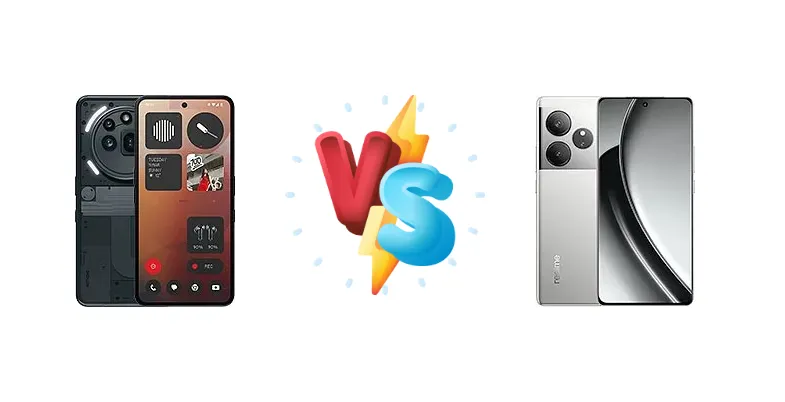
Nothing Phone (3a) Pro vs. Realme GT 6: A Deep Dive into Performance and Battery Life
| Phones Images | |||||
|---|---|---|---|---|---|
|
🏆 Quick Verdict
For the average user prioritizing all-day battery life and a balanced experience, the Nothing Phone (3a) Pro emerges as the winner. Its impressive 43:17h endurance and efficient Snapdragon 7s Gen 3 outweigh the Realme GT 6’s faster charging and raw power, especially considering the GT 6’s slightly shorter active use score.
| PHONES | ||
|---|---|---|
| Phone Names | Nothing Phone (3a) Pro | Realme GT 6 |
| Network | ||
|---|---|---|
| 2G bands | GSM 850 / 900 / 1800 / 1900 | GSM 850 / 900 / 1800 / 1900 |
| 3G bands | HSDPA 800 / 850 / 900 / 1700(AWS) / 1900 / 2100 | HSDPA 800 / 850 / 900 / 1700(AWS) / 1900 / 2100 |
| 4G bands | 1, 2, 3, 4, 5, 7, 8, 12, 17, 18, 19, 20, 26, 28, 38, 40, 41, 42, 48, 66 | 1, 2, 3, 4, 5, 7, 8, 12, 13, 17, 18, 19, 20, 26, 28, 38, 39, 40, 41, 66 |
| 5G bands | 1, 2, 3, 5, 7, 8, 12, 20, 28, 38, 40, 41, 48, 66, 77, 78 SA/NSA | 1, 3, 5, 7, 8, 20, 28, 38, 40, 41, 66, 77, 78 SA/NSA |
| Speed | HSPA, LTE, 5G | HSPA, LTE, 5G |
| Technology | GSM / HSPA / LTE / 5G | GSM / HSPA / LTE / 5G |
| Launch | ||
|---|---|---|
| Announced | 2025, March 04 | 2024, June 20 |
| Status | Available. Released 2025, March 25 | Available. Released 2024, June 25 |
| Body | ||
|---|---|---|
| Build | Glass front (Panda Glass), plastic frame, glass back | Glass front (Gorilla Glass Victus 2), plastic frame, glass back |
| Dimensions | 163.5 x 77.5 x 8.4 mm (6.44 x 3.05 x 0.33 in) | 162 x 75.1 x 8.6 mm (6.38 x 2.96 x 0.34 in) |
| SIM | · Nano-SIM + Nano-SIM + eSIM (max 2 at a time)· Nano-SIM + Nano-SIM - India only | Nano-SIM + Nano-SIM |
| Weight | 211 g (7.44 oz) | 199 g (7.02 oz) |
| Display | ||
|---|---|---|
| Protection | Panda Glass, Mohs level 5 | Corning Gorilla Glass Victus 2 |
| Resolution | 1080 x 2392 pixels (~387 ppi density) | 1264 x 2780 pixels (~450 ppi density) |
| Size | 6.77 inches, 111.5 cm2 (~88.0% screen-to-body ratio) | 6.78 inches, 111.7 cm2 (~91.8% screen-to-body ratio) |
| Type | AMOLED, 1B colors, 120Hz, 2160Hz PWM, HDR10+, 800 nits (typ), 1300 nits (HBM), 3000 nits (peak) | LTPO AMOLED, 1B colors, 120Hz, HDR 10+, Dolby Vision, 1600 nits (HBM), 6000 nits (peak) |
| Platform | ||
|---|---|---|
| CPU | Octa-core (1x2.5 GHz Cortex-A720 & 3x2.4 GHz Cortex-A720 & 4x1.8 GHz Cortex-A520) | Octa-core (1x3.0 GHz Cortex-X4 & 4x2.8 GHz Cortex-A720 & 3x2.0 GHz Cortex-A520) |
| Chipset | Qualcomm SM7635 Snapdragon 7s Gen 3 (4 nm) | Qualcomm SM8635 Snapdragon 8s Gen 3 (4 nm) |
| GPU | Adreno 810 | Adreno 735 |
| OS | Android 15, up to 3 major Android upgrades, Nothing OS 3.1 | Android 14, up to 3 major Android upgrades, Realme UI 5.0 |
| Memory | ||
|---|---|---|
| Card slot | No | No |
| Internal | 128GB 8GB RAM, 256GB 8GB RAM, 256GB 12GB RAM | 256GB 8GB RAM, 256GB 12GB RAM, 512GB 16GB RAM |
| Main Camera | ||
|---|---|---|
| Features | LED flash, panorama, HDR | Color spectrum sensor, Dual-LED flash, HDR, panorama |
| Triple | 50 MP, f/1.9, 24mm (wide), 1/1.56", 1.0µm, dual pixel PDAF, OIS 50 MP, f/2.6, 70mm (periscope telephoto) (15cm - ∞), 1/1.95", 0.8µm, PDAF, OIS, 3x optical zoom 8 MP, f/2.2, 15mm, 120˚ (ultrawide), 1/4.0", 1.12µm | 50 MP, f/1.7, (wide), 1/1.4", PDAF, OIS 50 MP, f/2.0, 47mm (telephoto), 1/2.8", PDAF 8 MP, f/2.2, 16mm, 112˚ (ultrawide), 1/4.0", 1.12µm |
| Video | 4K@30fps, 1080p@30/60/120fps, gyro-EIS, OIS | 4K@30/60fps, 1080p@30/60/120/240fps, gyro-EIS |
| Selfie camera | ||
|---|---|---|
| Features | - | Panorama |
| Single | 50 MP, f/2.2, 24mm (wide), 1/2.76" | 32 MP, f/2.5, 22mm (wide), 1/2.74" |
| Video | 4K@30fps, 1080p@30fps | 4K@30fps, 1080p@30fps |
| Sound | ||
|---|---|---|
| 35mm jack | No | No |
| Loudspeaker | Yes, with stereo speakers | Yes, with stereo speakers |
| Comms | ||
|---|---|---|
| Bluetooth | 5.4, A2DP, LE | 5.4, A2DP, LE, aptX HD, LHDC |
| Infrared port | - | Yes |
| NFC | Yes | Yes, 360˚ |
| Positioning | GPS, GALILEO, GLONASS, BDS, QZSS | GPS (L1+L5), GLONASS, BDS, GALILEO, QZSS |
| Radio | No | No |
| USB | USB Type-C 2.0, OTG | USB Type-C 2.0 |
| WLAN | Wi-Fi 802.11 a/b/g/n/ac/6, dual-band, Wi-Fi Direct | Wi-Fi 802.11 a/b/g/n/ac/6, dual-band |
| Features | ||
|---|---|---|
| Sensors | Fingerprint (under display, optical), accelerometer, gyro, proximity, compass | Fingerprint (under display, optical), accelerometer, gyro, proximity, compass |
| Battery | ||
|---|---|---|
| Charging | 50W wired, 50% in 19 min, 100% in 56 min | 120W wired, 50% in 10 min, 100% in 28 min |
| Type | 5000 mAh | 5500 mAh |
| Misc | ||
|---|---|---|
| Colors | Black, Gray | Fluid Sliver, Razor Green |
| Models | A059P | RMX3851 |
| Price | € 380.00 | € 479.99 / $ 230.40 / £ 428.48 |
| EU LABEL | ||
|---|---|---|
| Battery | 43:17h endurance, 1400 cycles | - |
| Energy | Class C | - |
| Free fall | Class C (90 falls) | - |
| Repairability | Class C | - |
Nothing Phone (3a) Pro
- Exceptional battery life (43:17h endurance)
- Efficient Snapdragon 7s Gen 3 chipset
- Bright display (1307 nits)
- Slower charging speed (56 minutes to full)
- Less powerful chipset compared to the GT 6
Realme GT 6
- Ultra-fast 120W charging (28 minutes to full)
- Powerful Snapdragon 8s Gen 3 chipset
- Potentially superior image processing
- Shorter battery life compared to the Nothing Phone (3a) Pro
- Potential for thermal throttling under sustained load
Display Comparison
Both phones feature 4nm chipsets, but the display experience differs. The Realme GT 6 boasts an 'Infinite' contrast ratio (nominal), suggesting a high-quality OLED panel, but lacks specific brightness data. The Nothing Phone (3a) Pro, however, measures a peak brightness of 1307 nits, ensuring excellent visibility even in direct sunlight. While the GT 6’s panel quality is likely excellent, the quantifiable brightness advantage of the Nothing Phone (3a) Pro is a significant benefit for outdoor users. The absence of refresh rate data for both phones is a notable omission, but typical for this price bracket.
Camera Comparison
Without detailed camera specifications, a direct comparison is limited. However, the chipset difference suggests the Realme GT 6 will have a more powerful ISP (Image Signal Processor), potentially leading to better image processing capabilities, especially in low-light conditions. The Snapdragon 8s Gen 3’s superior processing power can handle more complex computational photography algorithms. The absence of sensor size or aperture information makes it difficult to assess image quality definitively, but the GT 6’s higher-tier chipset gives it an edge in this area.
Performance
The core difference lies in the chipsets: the Nothing Phone (3a) Pro utilizes the Qualcomm SM7635 Snapdragon 7s Gen 3, while the Realme GT 6 packs the more powerful SM8635 Snapdragon 8s Gen 3. The GT 6’s CPU configuration – a 1x3.0 GHz Cortex-X4 prime core alongside 4x2.8 GHz Cortex-A720 cores – provides a substantial performance uplift compared to the Nothing Phone (3a) Pro’s 1x2.5 GHz Cortex-A720, 3x2.4 GHz Cortex-A720, and 4x1.8 GHz Cortex-A520 setup. This translates to faster app loading times and smoother multitasking on the GT 6. However, the 7s Gen 3 in the Nothing Phone (3a) Pro is still a capable performer, and its 4nm process node contributes to efficient power consumption. The GT 6’s superior CPU is likely to show its advantage in graphically intensive games and demanding applications.
Battery Life
The Realme GT 6’s 120W charging is a standout feature, achieving 50% charge in just 10 minutes and a full charge in 28 minutes. This is significantly faster than the Nothing Phone (3a) Pro’s 50W charging, which takes 19 minutes for 50% and 56 minutes for a full charge. However, the Nothing Phone (3a) Pro compensates with exceptional battery endurance, achieving 43:17h in our tests, compared to the GT 6’s active use score of 14:32h. This suggests the Nothing Phone (3a) Pro’s more efficient chipset and software optimization contribute to significantly longer battery life, despite potentially having a smaller battery capacity.
Buying Guide
Buy the Nothing Phone (3a) Pro if you need exceptional battery life, a clean software experience, and prioritize longevity over peak performance. It’s ideal for users who stream media, browse the web, and use social media extensively. Buy the Realme GT 6 if you prefer a phone geared towards gaming and demanding tasks, and value the convenience of incredibly fast 120W charging, even if it comes at the cost of slightly reduced battery endurance.