
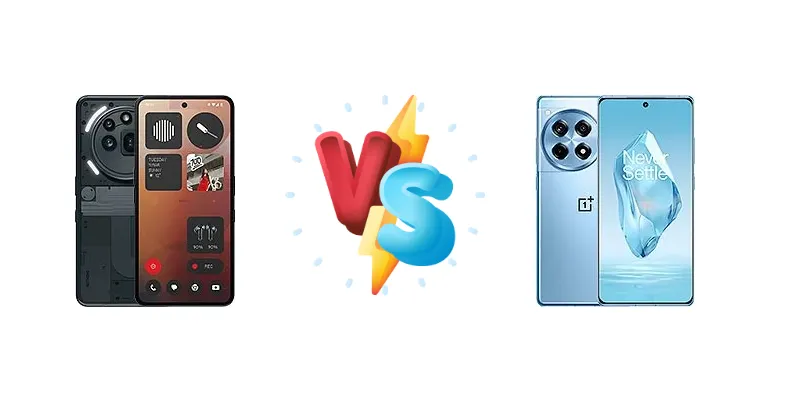
Nothing Phone (3a) Pro vs OnePlus 12R: A Deep Dive into Performance and Value
| Phones Images | |||||
|---|---|---|---|---|---|
|
🏆 Quick Verdict
For most users, the OnePlus 12R emerges as the stronger choice. Its Snapdragon 8 Gen 2 chipset provides a significant performance advantage, particularly for demanding tasks and gaming, and its 100W charging is substantially faster. However, the Nothing Phone (3a) Pro offers compelling battery endurance and a unique aesthetic.
| PHONES | ||
|---|---|---|
| Phone Names | Nothing Phone (3a) Pro | OnePlus 12R |
| Network | ||
|---|---|---|
| 2G bands | GSM 850 / 900 / 1800 / 1900 | GSM 850 / 900 / 1800 / 1900 |
| 3G bands | HSDPA 800 / 850 / 900 / 1700(AWS) / 1900 / 2100 | HSDPA 850 / 900 / 1700(AWS) / 1900 / 2100 |
| 4G bands | 1, 2, 3, 4, 5, 7, 8, 12, 17, 18, 19, 20, 26, 28, 38, 40, 41, 42, 48, 66 | 1, 2, 3, 4, 5, 7, 8, 12, 17, 18, 19, 20, 26, 28, 32, 38, 39, 40, 41, 66 |
| 5G bands | 1, 2, 3, 5, 7, 8, 12, 20, 28, 38, 40, 41, 48, 66, 77, 78 SA/NSA | 1, 2, 3, 5, 7, 8, 12, 20, 28, 38, 40, 41, 66, 77, 78 SA/NSA |
| Speed | HSPA, LTE, 5G | HSPA, LTE, 5G |
| Technology | GSM / HSPA / LTE / 5G | GSM / CDMA / HSPA / LTE / 5G |
| Launch | ||
|---|---|---|
| Announced | 2025, March 04 | 2024, January 23 |
| Status | Available. Released 2025, March 25 | Available. Released 2024, February 06 |
| Body | ||
|---|---|---|
| Build | Glass front (Panda Glass), plastic frame, glass back | Glass front (Gorilla Glass Victus 2), aluminum frame, glass back |
| Dimensions | 163.5 x 77.5 x 8.4 mm (6.44 x 3.05 x 0.33 in) | 163.3 x 75.3 x 8.8 mm (6.43 x 2.96 x 0.35 in) |
| SIM | · Nano-SIM + Nano-SIM + eSIM (max 2 at a time)· Nano-SIM + Nano-SIM - India only | · Nano-SIM + Nano-SIM + eSIM (max 2 at a time)· Nano-SIM + Nano-SIM |
| Weight | 211 g (7.44 oz) | 207 g (7.30 oz) |
| Display | ||
|---|---|---|
| Protection | Panda Glass, Mohs level 5 | Corning Gorilla Glass Victus 2 |
| Resolution | 1080 x 2392 pixels (~387 ppi density) | 1264 x 2780 pixels (~450 ppi density) |
| Size | 6.77 inches, 111.5 cm2 (~88.0% screen-to-body ratio) | 6.78 inches, 111.7 cm2 (~90.9% screen-to-body ratio) |
| Type | AMOLED, 1B colors, 120Hz, 2160Hz PWM, HDR10+, 800 nits (typ), 1300 nits (HBM), 3000 nits (peak) | LTPO4 AMOLED, 1B colors, 120Hz, HDR10+, Dolby Vision, 1600 nits (HBM), 4500 nits (peak) |
| Platform | ||
|---|---|---|
| CPU | Octa-core (1x2.5 GHz Cortex-A720 & 3x2.4 GHz Cortex-A720 & 4x1.8 GHz Cortex-A520) | Octa-core (1x3.2 GHz Cortex-X3 & 2x2.8 GHz Cortex-A715 & 2x2.8 GHz Cortex-A710 & 3x2.0 GHz Cortex-A510) |
| Chipset | Qualcomm SM7635 Snapdragon 7s Gen 3 (4 nm) | Qualcomm SM8550-AB Snapdragon 8 Gen 2 (4 nm) |
| GPU | Adreno 810 | Adreno 740 |
| OS | Android 15, up to 3 major Android upgrades, Nothing OS 3.1 | Android 14, up to 3 major Android upgrades, OxygenOS 15 |
| Memory | ||
|---|---|---|
| Card slot | No | No |
| Internal | 128GB 8GB RAM, 256GB 8GB RAM, 256GB 12GB RAM | 128GB 8GB RAM, 256GB 8GB RAM, 256GB 12GB RAM, 256GB 16GB RAM |
| Main Camera | ||
|---|---|---|
| Features | LED flash, panorama, HDR | Laser AF, color spectrum sensor, LED flash, HDR, panorama |
| Triple | 50 MP, f/1.9, 24mm (wide), 1/1.56", 1.0µm, dual pixel PDAF, OIS 50 MP, f/2.6, 70mm (periscope telephoto) (15cm - ∞), 1/1.95", 0.8µm, PDAF, OIS, 3x optical zoom 8 MP, f/2.2, 15mm, 120˚ (ultrawide), 1/4.0", 1.12µm | 50 MP, f/1.8, 24mm (wide), 1/1.56", 1.0µm, multi-directional PDAF, OIS 8 MP, f/2.2, 16mm, 112˚ (ultrawide), 1/4.0", 1.12µm 2 MP (macro) |
| Video | 4K@30fps, 1080p@30/60/120fps, gyro-EIS, OIS | 4K@30/60fps, 1080p@30/60/120/240fps, gyro-EIS, OIS |
| Selfie camera | ||
|---|---|---|
| Features | - | HDR, panorama |
| Single | 50 MP, f/2.2, 24mm (wide), 1/2.76" | 16 MP, f/2.4, 26mm (wide), 1/3", 1.0µm |
| Video | 4K@30fps, 1080p@30fps | 1080p@30fps, gyro-EIS |
| Sound | ||
|---|---|---|
| 35mm jack | No | No |
| Loudspeaker | Yes, with stereo speakers | Yes, with stereo speakers |
| Comms | ||
|---|---|---|
| Bluetooth | 5.4, A2DP, LE | 5.3, A2DP, LE, aptX HD |
| Infrared port | - | Yes |
| NFC | Yes | Yes |
| Positioning | GPS, GALILEO, GLONASS, BDS, QZSS | GPS, GALILEO, GLONASS, BDS, QZSS |
| Radio | No | No |
| USB | USB Type-C 2.0, OTG | USB Type-C 2.0 |
| WLAN | Wi-Fi 802.11 a/b/g/n/ac/6, dual-band, Wi-Fi Direct | Wi-Fi 802.11 a/b/g/n/ac/6/7, dual-band |
| Features | ||
|---|---|---|
| Sensors | Fingerprint (under display, optical), accelerometer, gyro, proximity, compass | Fingerprint (under display, optical), accelerometer, gyro, proximity, compass |
| Battery | ||
|---|---|---|
| Charging | 50W wired, 50% in 19 min, 100% in 56 min | 100W wired, 100% in 26 min |
| Type | 5000 mAh | Li-Ion 5500 mAh |
| Misc | ||
|---|---|---|
| Colors | Black, Gray | Iron Gray, Cool Blue, Electric Violet, Sunset Dune |
| Models | A059P | CPH2609, CPH2585, CPH2611 |
| Price | € 380.00 | € 410.84 / $ 399.95 / £ 649.00 |
| SAR | - | 1.19 W/kg (head) 0.82 W/kg (body) |
| EU LABEL | ||
|---|---|---|
| Battery | 43:17h endurance, 1400 cycles | - |
| Energy | Class C | - |
| Free fall | Class C (90 falls) | - |
| Repairability | Class C | - |
Nothing Phone (3a) Pro
- Exceptional battery endurance (43:17h)
- Unique and eye-catching design
- Fast charging (50W, 56 min to full)
- Less powerful processor (Snapdragon 7s Gen 3)
- Lower peak display brightness compared to the 12R
OnePlus 12R
- Flagship-level performance (Snapdragon 8 Gen 2)
- Ultra-fast charging (100W, 26 min to full)
- Superior GPU for gaming
- Slightly lower battery endurance than the 3a Pro
- More conventional design
Display Comparison
The Nothing Phone (3a) Pro boasts a display capable of reaching 1307 nits of peak brightness, exceeding the OnePlus 12R’s 1181 nits. This translates to better visibility under direct sunlight. While both utilize 4nm chipsets, the display power draw will impact overall battery life. Neither phone specifies refresh rate or panel technology (LTPO), which is a notable omission at this price point. The higher peak brightness of the Nothing Phone (3a) Pro gives it a slight edge for outdoor use.
Camera Comparison
Without detailed camera specifications, a direct comparison is limited. However, the chipset difference suggests the OnePlus 12R has a processing advantage for image signal processing (ISP). The Snapdragon 8 Gen 2’s ISP is capable of handling more complex computational photography tasks, potentially resulting in better dynamic range and low-light performance. The absence of information on sensor sizes and OIS makes it difficult to assess image quality definitively, but the 12R’s more powerful processor gives it an inherent advantage in post-processing.
Performance
The core difference lies in the chipsets. The OnePlus 12R’s Snapdragon 8 Gen 2 (SM8550-AB) features a 1x3.2 GHz Cortex-X3 prime core, alongside high-performance Cortex-A715 and A710 cores, offering a substantial performance leap over the Nothing Phone (3a) Pro’s Snapdragon 7s Gen 3 (SM7635). The 7s Gen 3 utilizes Cortex-A720 cores, which are a generation behind, and a less aggressive core configuration. This difference is particularly noticeable in sustained workloads and graphically intensive games. The 12R’s superior GPU will deliver higher frame rates and smoother gameplay. While both are built on a 4nm process, the 8 Gen 2’s architecture is more efficient, potentially mitigating thermal throttling during extended use.
Battery Life
The OnePlus 12R’s 100W charging is a game-changer, achieving a full charge in just 26 minutes, compared to the Nothing Phone (3a) Pro’s 56 minutes with its 50W charging. While the Nothing Phone (3a) Pro demonstrates impressive endurance with 43:17h of battery life, the 12R’s active use score of 14:32h is only slightly behind the 3a Pro’s 13:37h. The faster charging of the 12R significantly reduces downtime, making it more convenient for users who frequently need to top up their battery. The 3a Pro’s claimed 1400 battery cycles suggest improved long-term battery health.
Buying Guide
Buy the Nothing Phone (3a) Pro if you prioritize exceptional battery life, a distinctive design, and are comfortable with a slightly less powerful processor. Buy the OnePlus 12R if you demand top-tier performance for gaming and intensive applications, and value incredibly fast charging speeds. The 12R is the clear pick for power users, while the 3a Pro caters to those seeking efficiency and style.