
Nothing Phone (3a) Pro vs Motorola Edge 50 Pro: A Deep Dive into Mid-Range Champions
| Phones Images | |||||
|---|---|---|---|---|---|
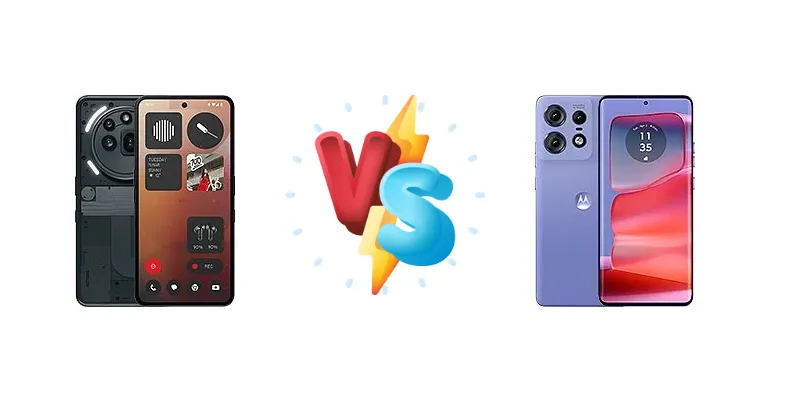
|
🏆 Quick Verdict
For the average user prioritizing longevity, the Nothing Phone (3a) Pro is the better choice. Its significantly longer 43:17h battery endurance, coupled with a respectable 50W charging speed, outweighs the Motorola Edge 50 Pro’s faster 125W charging, given the latter’s shorter active use score of 11:59h.
| PHONES | ||
|---|---|---|
| Phone Names | Nothing Phone (3a) Pro | Motorola Edge 50 Pro |
| Network | ||
|---|---|---|
| 2G bands | GSM 850 / 900 / 1800 / 1900 | GSM 850 / 900 / 1800 / 1900 |
| 3G bands | HSDPA 800 / 850 / 900 / 1700(AWS) / 1900 / 2100 | HSDPA 850 / 900 / 1700(AWS) / 1900 / 2100 |
| 4G bands | 1, 2, 3, 4, 5, 7, 8, 12, 17, 18, 19, 20, 26, 28, 38, 40, 41, 42, 48, 66 | 1, 2, 3, 4, 5, 7, 8, 12, 13, 17, 18, 19, 20, 26, 28, 32, 38, 39, 40, 41, 43, 48, 66 |
| 5G bands | 1, 2, 3, 5, 7, 8, 12, 20, 28, 38, 40, 41, 48, 66, 77, 78 SA/NSA | 1, 2, 3, 5, 7, 8, 20, 26, 28, 38, 40, 41, 66, 77, 78 SA/NSA/Sub6 |
| Speed | HSPA, LTE, 5G | HSPA, LTE, 5G |
| Technology | GSM / HSPA / LTE / 5G | GSM / HSPA / LTE / 5G |
| Launch | ||
|---|---|---|
| Announced | 2025, March 04 | 2024, April 03 |
| Status | Available. Released 2025, March 25 | Available. Released 2024, April 08 |
| Body | ||
|---|---|---|
| Build | Glass front (Panda Glass), plastic frame, glass back | Glass front, plastic back or silicone polymer back (eco leather), aluminum frame |
| Dimensions | 163.5 x 77.5 x 8.4 mm (6.44 x 3.05 x 0.33 in) | 161.2 x 72.4 x 8.2 mm (6.35 x 2.85 x 0.32 in) |
| SIM | · Nano-SIM + Nano-SIM + eSIM (max 2 at a time)· Nano-SIM + Nano-SIM - India only | · Nano-SIM + eSIM· Nano-SIM + Nano-SIM |
| Weight | 211 g (7.44 oz) | 186 g (6.56 oz) |
| Display | ||
|---|---|---|
| Protection | Panda Glass, Mohs level 5 | Corning Gorilla Glass (unspecified version) |
| Resolution | 1080 x 2392 pixels (~387 ppi density) | 1220 x 2712 pixels, 20:9 ratio (~446 ppi density) |
| Size | 6.77 inches, 111.5 cm2 (~88.0% screen-to-body ratio) | 6.7 inches, 107.4 cm2 (~92.0% screen-to-body ratio) |
| Type | AMOLED, 1B colors, 120Hz, 2160Hz PWM, HDR10+, 800 nits (typ), 1300 nits (HBM), 3000 nits (peak) | P-OLED, 1B colors, 144Hz, HDR10+, 2000 nits (peak) |
| Platform | ||
|---|---|---|
| CPU | Octa-core (1x2.5 GHz Cortex-A720 & 3x2.4 GHz Cortex-A720 & 4x1.8 GHz Cortex-A520) | Octa-core (1x2.63 GHz Cortex-A715 & 4x2.4 GHz Cortex-A715 & 3x1.8 GHz Cortex-A510) |
| Chipset | Qualcomm SM7635 Snapdragon 7s Gen 3 (4 nm) | Qualcomm SM7550-AB Snapdragon 7 Gen 3 (4 nm) |
| GPU | Adreno 810 | Adreno 720 |
| OS | Android 15, up to 3 major Android upgrades, Nothing OS 3.1 | Android 14, up to 3 major Android upgrades |
| Memory | ||
|---|---|---|
| Card slot | No | No |
| Internal | 128GB 8GB RAM, 256GB 8GB RAM, 256GB 12GB RAM | 128GB 8GB RAM, 256GB 8GB RAM, 256GB 12GB RAM, 512GB 12GB RAM |
| Main Camera | ||
|---|---|---|
| Features | LED flash, panorama, HDR | Laser AF, LED flash, panorama, HDR |
| Triple | 50 MP, f/1.9, 24mm (wide), 1/1.56", 1.0µm, dual pixel PDAF, OIS 50 MP, f/2.6, 70mm (periscope telephoto) (15cm - ∞), 1/1.95", 0.8µm, PDAF, OIS, 3x optical zoom 8 MP, f/2.2, 15mm, 120˚ (ultrawide), 1/4.0", 1.12µm | 50 MP, f/1.4, 25mm (wide), 1/1.55", 1.0µm, multi-directional PDAF, OIS 10 MP, f/2.0, 67mm (telephoto), 1/3.94", 1.0µm, PDAF, OIS, 3x optical zoom 13 MP, f/2.2, 16mm, 120˚ (ultrawide), 1/3.0", 1.12µm, PDAF |
| Video | 4K@30fps, 1080p@30/60/120fps, gyro-EIS, OIS | 4K@30fps, 1080p@30/60/120/240fps, 10-bit HDR10+, gyro-EIS |
| Selfie camera | ||
|---|---|---|
| Features | - | HDR |
| Single | 50 MP, f/2.2, 24mm (wide), 1/2.76" | 50 MP, f/1.9, 21mm (wide), 0.64µm, AF |
| Video | 4K@30fps, 1080p@30fps | 4K@30fps, 1080p@30/60fps |
| Sound | ||
|---|---|---|
| 35mm jack | No | No |
| Loudspeaker | Yes, with stereo speakers | Yes, with stereo speakers |
| Comms | ||
|---|---|---|
| Bluetooth | 5.4, A2DP, LE | 5.4, A2DP, LE |
| NFC | Yes | Yes |
| Positioning | GPS, GALILEO, GLONASS, BDS, QZSS | GPS, GLONASS, GALILEO, BDS, QZSS, NavIC |
| Radio | No | No |
| USB | USB Type-C 2.0, OTG | USB Type-C 3.1, OTG, DisplayPort 1.4 |
| WLAN | Wi-Fi 802.11 a/b/g/n/ac/6, dual-band, Wi-Fi Direct | Wi-Fi 802.11 a/b/g/n/ac/6e, tri-band, Wi-Fi Direct |
| Features | ||
|---|---|---|
| Sensors | Fingerprint (under display, optical), accelerometer, gyro, proximity, compass | Fingerprint (under display, optical), accelerometer, gyro, proximity, compass |
| Battery | ||
|---|---|---|
| Charging | 50W wired, 50% in 19 min, 100% in 56 min | 125W wired, 100% in 18 min 50W wireless 10W reverse wireless |
| Type | 5000 mAh | Li-Po 4500 mAh |
| Misc | ||
|---|---|---|
| Colors | Black, Gray | Luxe Lavender, Black Beauty, Moonlight Pearl, Vanilla Cream |
| Models | A059P | XT2403-2 |
| Price | € 380.00 | € 410.57 / $ 399.00 / £ 369.99 / ₹ 22,995 |
| SAR | - | 1.08 W/kg (head) 1.08 W/kg (body) |
| EU LABEL | ||
|---|---|---|
| Battery | 43:17h endurance, 1400 cycles | - |
| Energy | Class C | - |
| Free fall | Class C (90 falls) | - |
| Repairability | Class C | - |
Nothing Phone (3a) Pro
- Exceptional battery life (43:17h endurance)
- Potentially better multi-core performance with Snapdragon 7s Gen 3 CPU
- Long-term battery health with 1400 cycles
- Slower charging speed compared to Motorola Edge 50 Pro
- Limited camera specification details
Motorola Edge 50 Pro
- Blazing-fast 125W wired charging (0-100% in 18 min)
- 50W wireless and 10W reverse wireless charging
- Clean, near-stock Android experience
- Significantly shorter battery life (11:59h active use)
- Snapdragon 7 Gen 3 may offer less multi-core performance
Display Comparison
Both the Nothing Phone (3a) Pro and Motorola Edge 50 Pro feature displays capable of reaching approximately 1300 nits of peak brightness – the Nothing Phone (3a) Pro hitting 1307 nits and the Motorola Edge 50 Pro at 1295 nits. This ensures excellent visibility even in direct sunlight. While neither specification sheet indicates LTPO technology, the comparable brightness levels suggest similar panel quality. The focus here isn’t on display tech differences, but on consistent high brightness for outdoor usability.
Camera Comparison
Unfortunately, detailed camera specifications are absent. However, given the market positioning, it’s reasonable to expect both phones to feature capable main sensors. The focus will likely be on computational photography and software processing. Without sensor size or aperture data, a direct comparison is impossible, but the Motorola Edge 50 Pro’s brand history suggests a stronger emphasis on camera features and image quality. We'll need independent testing to determine which phone delivers superior photos and videos.
Performance
The Motorola Edge 50 Pro utilizes the Qualcomm SM7550-AB Snapdragon 7 Gen 3, while the Nothing Phone (3a) Pro employs the SM7635 Snapdragon 7s Gen 3. Although both are 4nm chipsets, the Snapdragon 7s Gen 3 in the Nothing Phone (3a) Pro features a more complex CPU configuration – an octa-core setup with a 1x2.5 GHz Cortex-A720, 3x2.4 GHz Cortex-A720, and 4x1.8 GHz Cortex-A520 – compared to the Edge 50 Pro’s 1x2.63 GHz Cortex-A715, 4x2.4 GHz Cortex-A715, and 3x1.8 GHz Cortex-A510. This suggests the Nothing Phone (3a) Pro may offer slightly better multi-core performance, though real-world differences will depend on software optimization. The Edge 50 Pro’s higher clocked A715 core may provide a small edge in single-core tasks.
Battery Life
The Nothing Phone (3a) Pro boasts a significant advantage in battery endurance, achieving a remarkable 43:17h score. This is substantially higher than the Motorola Edge 50 Pro’s 11:59h active use score. While the Edge 50 Pro compensates with incredibly fast 125W wired charging (0-100% in 18 minutes) and adds 50W wireless and 10W reverse wireless charging, the Nothing Phone (3a) Pro’s 50W wired charging (50% in 19 min, 100% in 56 min) is sufficient for most users, especially considering the longer battery life. The Nothing Phone (3a) Pro also claims 1400 battery cycles, suggesting greater long-term battery health.
Buying Guide
Buy the Nothing Phone (3a) Pro if you need a phone that will comfortably last through a full day and beyond, even with heavy usage, and appreciate a distinctive aesthetic. Buy the Motorola Edge 50 Pro if you prioritize the absolute fastest charging speeds and prefer a cleaner, near-stock Android experience, and are willing to compromise on overall battery endurance.