
Nothing Phone (3a) Pro vs. Asus Zenfone 10: A Detailed Comparison
| Phones Images | |||||
|---|---|---|---|---|---|
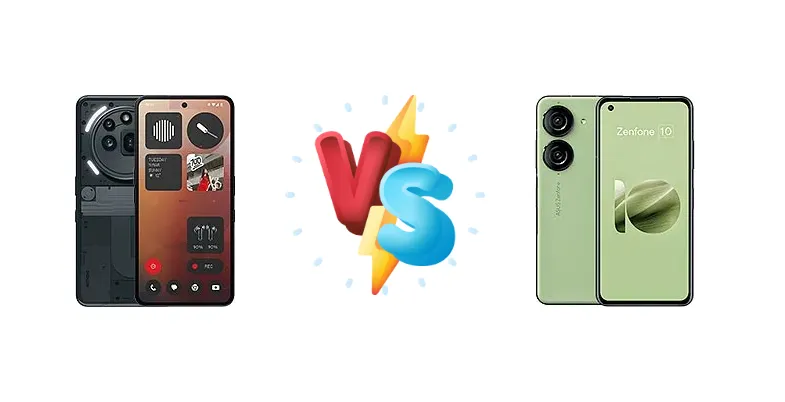
|
🏆 Quick Verdict
For most users, the Nothing Phone (3a) Pro emerges as the stronger all-rounder. Its significantly longer 43:17h battery endurance and brighter 1307 nit display outweigh the Zenfone 10’s superior chipset. However, power users prioritizing peak performance will still find the Zenfone 10 compelling.
| PHONES | ||
|---|---|---|
| Phone Names | Nothing Phone (3a) Pro | Asus Zenfone 10 |
| Network | ||
|---|---|---|
| 2G bands | GSM 850 / 900 / 1800 / 1900 | GSM 850 / 900 / 1800 / 1900 |
| 3G bands | HSDPA 800 / 850 / 900 / 1700(AWS) / 1900 / 2100 | HSDPA 850 / 900 / 1700(AWS) / 1800 / 1900 / 2100 |
| 4G bands | 1, 2, 3, 4, 5, 7, 8, 12, 17, 18, 19, 20, 26, 28, 38, 40, 41, 42, 48, 66 | 1, 2, 3, 4, 5, 7, 8, 12, 17, 18, 19, 20, 26, 28, 34, 38, 39, 40, 41, 42 |
| 5G bands | 1, 2, 3, 5, 7, 8, 12, 20, 28, 38, 40, 41, 48, 66, 77, 78 SA/NSA | 1, 2, 3, 5, 7, 8, 12, 20, 28, 38, 41, 77, 78 SA/NSA |
| Speed | HSPA, LTE, 5G | HSPA, LTE, 5G |
| Technology | GSM / HSPA / LTE / 5G | GSM / HSPA / LTE / 5G |
| Launch | ||
|---|---|---|
| Announced | 2025, March 04 | 2023, June 29 |
| Status | Available. Released 2025, March 25 | Available. Released 2023, July 10 |
| Body | ||
|---|---|---|
| Build | Glass front (Panda Glass), plastic frame, glass back | Glass front, aluminum frame, plastic back |
| Dimensions | 163.5 x 77.5 x 8.4 mm (6.44 x 3.05 x 0.33 in) | 146.5 x 68.1 x 9.4 mm (5.77 x 2.68 x 0.37 in) |
| SIM | · Nano-SIM + Nano-SIM + eSIM (max 2 at a time)· Nano-SIM + Nano-SIM - India only | Nano-SIM + Nano-SIM |
| Weight | 211 g (7.44 oz) | 172 g (6.07 oz) |
| Display | ||
|---|---|---|
| Protection | Panda Glass, Mohs level 5 | Corning Gorilla Glass Victus |
| Resolution | 1080 x 2392 pixels (~387 ppi density) | 1080 x 2400 pixels, 20:9 ratio (~445 ppi density) |
| Size | 6.77 inches, 111.5 cm2 (~88.0% screen-to-body ratio) | 5.92 inches, 84.6 cm2 (~84.8% screen-to-body ratio) |
| Type | AMOLED, 1B colors, 120Hz, 2160Hz PWM, HDR10+, 800 nits (typ), 1300 nits (HBM), 3000 nits (peak) | Super AMOLED, 144Hz, HDR10+, 800 nits (HBM), 1100 nits (peak) |
| Platform | ||
|---|---|---|
| CPU | Octa-core (1x2.5 GHz Cortex-A720 & 3x2.4 GHz Cortex-A720 & 4x1.8 GHz Cortex-A520) | Octa-core (1x3.2 GHz Cortex-X3 & 2x2.8 GHz Cortex-A715 & 2x2.8 GHz Cortex-A710 & 3x2.0 GHz Cortex-A510) |
| Chipset | Qualcomm SM7635 Snapdragon 7s Gen 3 (4 nm) | Qualcomm SM8550-AB Snapdragon 8 Gen 2 (4 nm) |
| GPU | Adreno 810 | Adreno 740 |
| OS | Android 15, up to 3 major Android upgrades, Nothing OS 3.1 | Android 13, up to 2 major Android upgrades |
| Memory | ||
|---|---|---|
| Card slot | No | No |
| Internal | 128GB 8GB RAM, 256GB 8GB RAM, 256GB 12GB RAM | 128GB 8GB RAM, 256GB 8GB RAM, 256GB 16GB RAM, 512GB 16GB RAM |
| Main Camera | ||
|---|---|---|
| Dual | - | 50 MP, f/1.9, 24mm (wide), 1/1.56", 1.0µm, multi-directional PDAF, gimbal OIS 13 MP, f/2.2, 120° (ultrawide), 1/3.06", 1.12µm |
| Features | LED flash, panorama, HDR | LED flash, HDR, panorama |
| Triple | 50 MP, f/1.9, 24mm (wide), 1/1.56", 1.0µm, dual pixel PDAF, OIS 50 MP, f/2.6, 70mm (periscope telephoto) (15cm - ∞), 1/1.95", 0.8µm, PDAF, OIS, 3x optical zoom 8 MP, f/2.2, 15mm, 120˚ (ultrawide), 1/4.0", 1.12µm | - |
| Video | 4K@30fps, 1080p@30/60/120fps, gyro-EIS, OIS | 8K@24fps, 4K@30/60fps, 1080p@30/60fps; gyro-EIS, HDR |
| Selfie camera | ||
|---|---|---|
| Single | 50 MP, f/2.2, 24mm (wide), 1/2.76" | 32 MP, f/2.5, (wide), 1/3.2", 0.7µm |
| Video | 4K@30fps, 1080p@30fps | 1080p@30fps |
| Sound | ||
|---|---|---|
| 35mm jack | No | Yes |
| Loudspeaker | Yes, with stereo speakers | Yes, with stereo speakers |
| Comms | ||
|---|---|---|
| Bluetooth | 5.4, A2DP, LE | 5.3, A2DP, LE, aptX HD, aptX Adaptive, aptX Lossless |
| NFC | Yes | Yes |
| Positioning | GPS, GALILEO, GLONASS, BDS, QZSS | GPS (L1+L5), GLONASS (L1), BDS (B1I+B2a), GALILEO (E1+E5a), QZSS (L1+L5), NavIC (L5) |
| Radio | No | No |
| USB | USB Type-C 2.0, OTG | USB Type-C 2.0, OTG |
| WLAN | Wi-Fi 802.11 a/b/g/n/ac/6, dual-band, Wi-Fi Direct | Wi-Fi 802.11 a/b/g/n/ac/6e/7, tri-band, Wi-Fi Direct |
| Features | ||
|---|---|---|
| Sensors | Fingerprint (under display, optical), accelerometer, gyro, proximity, compass | Fingerprint (side-mounted), accelerometer, gyro, proximity, compass |
| Battery | ||
|---|---|---|
| Charging | 50W wired, 50% in 19 min, 100% in 56 min | 30W wired, PD3.0, PPS, QC4 15W wireless 5W reverse wired |
| Type | 5000 mAh | Li-Po 4300 mAh |
| Misc | ||
|---|---|---|
| Colors | Black, Gray | Starry Blue, Midnight Black, Aurora Green, Eclipse Red, Comet White |
| Models | A059P | AI2302 |
| Price | € 380.00 | About 2300 EUR |
| EU LABEL | ||
|---|---|---|
| Battery | 43:17h endurance, 1400 cycles | - |
| Energy | Class C | - |
| Free fall | Class C (90 falls) | - |
| Repairability | Class C | - |
Nothing Phone (3a) Pro
- Exceptional battery life (43:17h endurance)
- Brighter display (1307 nits)
- Faster wired charging (50W)
- Less powerful chipset than Zenfone 10
- Camera specs currently unknown
Asus Zenfone 10
- Flagship-level performance (Snapdragon 8 Gen 2)
- Compact and pocketable design
- Wireless charging and reverse wired charging
- Significantly shorter battery life
- Dimmer display
Display Comparison
The Nothing Phone (3a) Pro boasts a significantly brighter display, reaching a measured 1307 nits compared to the Zenfone 10’s 807 nits. This translates to superior visibility outdoors under direct sunlight. While both utilize 4nm chipsets, the display brightness difference is substantial. The Zenfone 10’s smaller 5.9-inch screen contributes to its compactness, but the 3a Pro’s larger panel offers a more immersive viewing experience. Details regarding panel technology (LTPO, refresh rate) are missing for the 3a Pro, but the brightness advantage is clear.
Camera Comparison
Context data is limited regarding camera specifics beyond the Zenfone 10’s mention of ‘Photo/Video’. Assuming Asus’s typical approach, the Zenfone 10 likely features a more sophisticated camera system with advanced image processing. The Nothing Phone (3a) Pro’s camera capabilities are currently unknown, but the focus should be on the main sensor and its ability to capture detail and dynamic range. Without sensor size or aperture information, a direct comparison is difficult, but the Zenfone 10’s brand reputation suggests a more feature-rich camera experience.
Performance
The Asus Zenfone 10’s Snapdragon 8 Gen 2 (SM8550-AB) is undeniably the more powerful chipset. Its octa-core CPU, featuring a Cortex-X3 prime core clocked at 3.2 GHz, provides a significant performance uplift over the Nothing Phone (3a) Pro’s Snapdragon 7s Gen 3 (SM7635). The Zenfone 10’s CPU architecture (Cortex-A715/A710) is a generation ahead of the 3a Pro’s (Cortex-A720/A520). However, the 7s Gen 3’s 4nm process node offers excellent efficiency, and the 3a Pro’s performance will be more than adequate for most tasks. The Zenfone 10 will excel in demanding games and multitasking, while the 3a Pro prioritizes sustained performance and thermal management.
Battery Life
Battery life is where the Nothing Phone (3a) Pro truly shines. Its measured endurance of 43:17h is significantly higher than the Zenfone 10’s 109h (old) endurance rating. The 3a Pro also boasts a strong active use score of 13:37h, slightly exceeding the Zenfone 10’s 13:05h. While the Zenfone 10 offers 30W wired, 15W wireless, and 5W reverse wired charging, the 3a Pro’s 50W wired charging (50% in 19 min, 100% in 56 min) is considerably faster. The 3a Pro’s longer battery life and faster charging make it the clear winner for users who prioritize minimizing downtime.
Buying Guide
Buy the Nothing Phone (3a) Pro if you prioritize all-day battery life, a vibrant display for media consumption, and a unique design aesthetic. It’s ideal for everyday users, social media enthusiasts, and those who value longevity. Buy the Asus Zenfone 10 if you demand maximum performance in a pocketable form factor, frequently play demanding games, and appreciate the convenience of wireless charging and a more established software ecosystem.