
Nothing Phone (3a) Lite vs Xiaomi Redmi Note 13 Pro 4G: A Deep Dive Comparison
| Phones Images | |||||
|---|---|---|---|---|---|
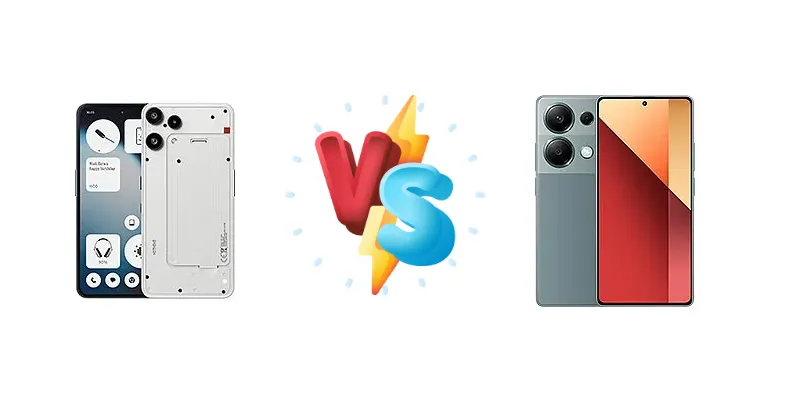
|
🏆 Quick Verdict
For the average user prioritizing sustained performance and longevity, the Nothing Phone (3a) Lite is the better choice. Its Mediatek Dimensity 7300 Pro chipset offers a significant performance advantage over the Redmi Note 13 Pro 4G’s Helio G99 Ultra, coupled with exceptional battery endurance. However, the Redmi Note 13 Pro 4G’s faster charging is a notable advantage for those who need quick top-ups.
| PHONES | ||
|---|---|---|
| Phone Names | Nothing Phone (3a) Lite | Xiaomi Redmi Note 13 Pro 4G |
| Network | ||
|---|---|---|
| 2G bands | GSM 850 / 900 / 1800 / 1900 | GSM 850 / 900 / 1800 / 1900 |
| 3G bands | HSDPA 800 / 850 / 900 / 1700(AWS) / 1900 / 2100 | HSDPA 850 / 900 / 1700(AWS) / 1900 / 2100 |
| 4G bands | 1, 2, 3, 4, 5, 7, 8, 12, 17, 18, 19, 20, 26, 28, 38, 40, 41, 42, 48, 66, 71 | 1, 2, 3, 4, 5, 7, 8, 12, 13, 17, 18, 19, 20, 26, 28, 38, 40, 41, 66 |
| 5G bands | 1, 2, 3, 5, 7, 8, 12, 20, 28, 38, 40, 41, 66, 71, 77, 78 SA/NSA | - |
| Speed | HSPA, LTE, 5G | HSPA, LTE |
| Technology | GSM / HSPA / LTE / 5G | GSM / HSPA / LTE |
| Launch | ||
|---|---|---|
| Announced | 2025, October 29 | 2024, January 15 |
| Status | Available. Released 2025, October 29 | Available. Released 2024, January 15 |
| Body | ||
|---|---|---|
| Build | Glass front (Panda Glass), plastic frame, glass back (Panda Glass) | Glass front (Gorilla Glass 5), plastic frame, plastic back |
| Dimensions | 164 x 78 x 8.3 mm (6.46 x 3.07 x 0.33 in) | 161.1 x 75 x 8 mm (6.34 x 2.95 x 0.31 in) |
| SIM | Nano-SIM + Nano-SIM | Nano-SIM + Nano-SIM |
| Weight | 199 g (7.02 oz) | 188 g (6.63 oz) |
| Display | ||
|---|---|---|
| Protection | Panda Glass, Mohs level 5 | Corning Gorilla Glass 5 |
| Resolution | 1080 x 2392 pixels (~388 ppi density) | 1080 x 2400 pixels, 20:9 ratio (~395 ppi density) |
| Size | 6.77 inches, 110.9 cm2 (~86.7% screen-to-body ratio) | 6.67 inches, 107.4 cm2 (~88.9% screen-to-body ratio) |
| Type | AMOLED, 1B colors, 120Hz, 2160Hz PWM, HDR, 800 nits (typ), 1300 nits (HBM), 3000 nits (peak) | AMOLED, 1B colors, 120Hz, 500 nits (typ), 1000 nits (HBM), 1300 nits (peak) |
| Platform | ||
|---|---|---|
| CPU | Octa-core (4x2.5 GHz Cortex-A78 & 4x2.0 GHz Cortex-A55) | Octa-core (2x2.2 GHz Cortex-A76 & 6x2.0 GHz Cortex-A55) |
| Chipset | Mediatek Dimensity 7300 Pro (4 nm) | Mediatek Helio G99 Ultra |
| GPU | Mali-G615 MC2 | Mali-G57 MC2 |
| OS | Android 15, up to 3 major Android upgrades, Nothing OS 3.5 | Android 13, up to 3 major Android upgrades, HyperOS |
| Memory | ||
|---|---|---|
| Card slot | microSDXC | microSDXC (uses shared SIM slot) |
| Internal | 128GB 8GB RAM, 256GB 8GB RAM | 128GB 8GB RAM, 256GB 8GB RAM, 256GB 12GB RAM, 512GB 8GB RAM, 512GB 12GB RAM |
| Main Camera | ||
|---|---|---|
| Features | LED flash, panorama, HDR | LED flash, HDR, panorama |
| Triple | 50 MP, f/1.9, 24mm (wide), 1/1.57", 1.0µm, dual pixel PDAF, OIS 8 MP, f/2.2, 15mm, 120˚ (ultrawide), 1/4.0", 1.12µm 2 MP (macro) | 200 MP, f/1.7, 23mm (wide), 1/1.4", 0.56µm, multi-directional PDAF, OIS 8 MP, f/2.2, 15mm, 120˚ (ultrawide), 1/4.4", 1.0µm 2 MP (macro) |
| Video | 4K@30fps, 1080p@30/60/120fps, gyro-EIS | 1080p@30/60fps |
| Selfie camera | ||
|---|---|---|
| Single | 16 MP, f/2.5, (wide) | 16 MP, f/2.4, (wide), 1/3.0", 1.0µm |
| Video | 1080p@30fps | 1080p@30/60fps |
| Sound | ||
|---|---|---|
| 35mm jack | No | Yes |
| Loudspeaker | Yes | Yes, with dual speakers |
| Comms | ||
|---|---|---|
| Bluetooth | 5.3, A2DP, LE | 5.2, A2DP, LE |
| Infrared port | - | Yes |
| NFC | Yes | Yes (market/region dependent) |
| Positioning | GPS, GALILEO, GLONASS, BDS, QZSS | GPS, GLONASS, GALILEO, BDS |
| Radio | No | FM radio |
| USB | USB Type-C 2.0, OTG | USB Type-C 2.0, OTG |
| WLAN | Wi-Fi 802.11 a/b/g/n/ac/6, dual-band, Wi-Fi Direct | Wi-Fi 802.11 a/b/g/n/ac, dual-band |
| Features | ||
|---|---|---|
| Sensors | Fingerprint (under display, optical), accelerometer, gyro, proximity, compass | Fingerprint (under display, optical), accelerometer, gyro, compass |
| Battery | ||
|---|---|---|
| Charging | 33W wired, 50% in 20 min 5W reverse wired | 67W wired, 50% in 16 min, 100% in 46 min |
| Type | 5000 mAh | 5000 mAh |
| Misc | ||
|---|---|---|
| Colors | Black, White, Blue | Midnight Black, Lavender Purple, Forest Green |
| Models | A001T | 23117RA68G, 2312FPCA6G |
| Price | About 250 EUR | € 92.00 / $ 269.99 / £ 299.99 |
| SAR | - | 1.09 W/kg (head) 1.09 W/kg (body) |
| SAR EU | 0.98 W/kg (head) 1.28 W/kg (body) | 0.99 W/kg (head) 0.99 W/kg (body) |
| EU LABEL | ||
|---|---|---|
| Battery | 53:56h endurance, 1400 cycles | - |
| Energy | Class A | - |
| Free fall | Class C (90 falls) | - |
| Repairability | Class C | - |
Nothing Phone (3a) Lite
- Superior chipset performance with the Dimensity 7300 Pro
- Exceptional battery life (53:56h endurance)
- Long-term battery health with 1400 charge cycles
- Charging speed is slower than the Redmi Note 13 Pro 4G
- Display brightness likely lower than the Redmi Note 13 Pro 4G
Xiaomi Redmi Note 13 Pro 4G
- Very fast 67W wired charging (full charge in 46 minutes)
- High peak display brightness (1047 nits)
- Potentially more affordable price point
- Inferior chipset performance with the Helio G99 Ultra
- Significantly shorter battery life (11:36h endurance)
Display Comparison
The Xiaomi Redmi Note 13 Pro 4G boasts a significantly brighter display, reaching a measured 1047 nits. This is a clear advantage for outdoor use under direct sunlight. While the Nothing Phone (3a) Lite’s display specs aren’t provided, it’s likely to be dimmer. The Redmi Note 13 Pro 4G’s brightness is a key differentiator, but the Nothing Phone (3a) Lite may compensate with potentially better color accuracy or viewing angles, though this is speculative without further data. Bezels and panel technology (e.g., AMOLED vs. LCD) are unknown for the Nothing Phone (3a) Lite, impacting overall visual quality.
Camera Comparison
Both phones feature cameras, but detailed sensor information is limited. The Redmi Note 13 Pro 4G’s camera is advertised as having photo/video capabilities, but without specifics on sensor size, aperture, or optical image stabilization (OIS), it’s difficult to assess its performance. The Nothing Phone (3a) Lite’s camera specs are also missing. It’s crucial to avoid focusing on the often-underperforming 2MP macro lenses commonly found in this price range and instead prioritize the main sensor’s capabilities. Image processing algorithms will also play a significant role, and without sample images, it’s impossible to determine which phone produces more pleasing results.
Performance
The core difference lies in the chipsets. The Nothing Phone (3a) Lite’s Mediatek Dimensity 7300 Pro (4nm) is architecturally superior to the Redmi Note 13 Pro 4G’s Helio G99 Ultra. The Dimensity 7300 Pro utilizes more efficient Cortex-A78 cores (4x2.5 GHz) alongside Cortex-A55 cores, while the Helio G99 Ultra relies on older Cortex-A76 (2x2.2 GHz) and A55 cores. The 4nm process node of the Dimensity 7300 Pro translates to better thermal efficiency and power consumption, meaning less throttling during sustained workloads like gaming. This will result in smoother multitasking and a more responsive user experience on the Nothing Phone (3a) Lite.
Battery Life
The Nothing Phone (3a) Lite demonstrates exceptional battery endurance, achieving 53:56h in testing, and is rated for 1400 charge cycles, indicating long-term battery health. The Redmi Note 13 Pro 4G, with an active use score of 11:36h, falls significantly behind in endurance. However, the Xiaomi compensates with 67W wired charging, reaching 50% in just 16 minutes and a full charge in 46 minutes, compared to the Nothing’s 33W charging (50% in 20 minutes). The Nothing Phone (3a) Lite prioritizes longevity, while the Redmi Note 13 Pro 4G focuses on speed.
Buying Guide
Buy the Nothing Phone (3a) Lite if you need a phone that will remain responsive for years to come, and value long-term battery health alongside solid performance for demanding apps and moderate gaming. Buy the Xiaomi Redmi Note 13 Pro 4G if you prioritize a very bright display for outdoor visibility and need the fastest possible charging speeds, even if it comes at the cost of some processing power.