
Nothing Phone (3a) Lite vs OnePlus Nord N30 SE: Which Budget Champion Reigns Supreme?
| Phones Images | |||||
|---|---|---|---|---|---|
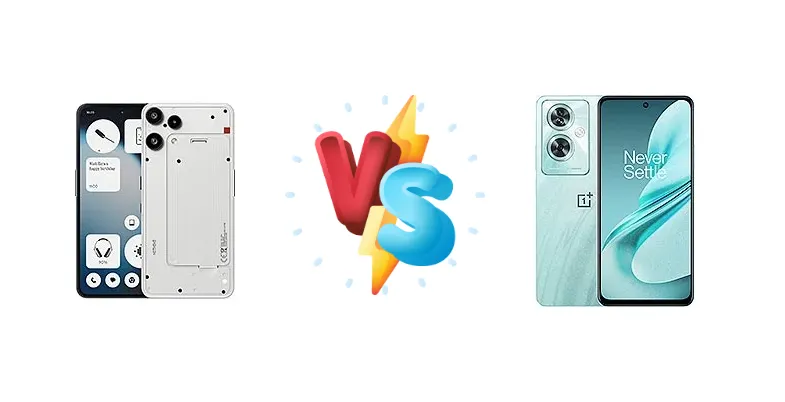
|
🏆 Quick Verdict
For most users, the Nothing Phone (3a) Lite emerges as the stronger choice. Its Mediatek Dimensity 7300 Pro chipset provides a significant performance advantage, translating to smoother multitasking and gaming. While the Nord N30 SE offers respectable performance, the 3a Lite’s superior processing power and battery endurance justify the slight price difference.
| PHONES | ||
|---|---|---|
| Phone Names | Nothing Phone (3a) Lite | OnePlus Nord N30 SE |
| Network | ||
|---|---|---|
| 2G bands | GSM 850 / 900 / 1800 / 1900 | GSM 850 / 900 / 1800 / 1900 |
| 3G bands | HSDPA 800 / 850 / 900 / 1700(AWS) / 1900 / 2100 | HSDPA 850 / 900 / 1700(AWS) / 1900 / 2100 |
| 4G bands | 1, 2, 3, 4, 5, 7, 8, 12, 17, 18, 19, 20, 26, 28, 38, 40, 41, 42, 48, 66, 71 | 1, 2, 3, 4, 5, 7, 8, 12, 13, 17, 18, 19, 20, 26, 28, 38, 39, 40, 41, 66 |
| 5G bands | 1, 2, 3, 5, 7, 8, 12, 20, 28, 38, 40, 41, 66, 71, 77, 78 SA/NSA | 1, 3, 5, 7, 8, 20, 28, 38, 40, 41, 66, 77, 78 SA/NSA |
| Speed | HSPA, LTE, 5G | HSPA, LTE, 5G |
| Technology | GSM / HSPA / LTE / 5G | GSM / HSPA / LTE / 5G |
| Launch | ||
|---|---|---|
| Announced | 2025, October 29 | 2024, January 29 |
| Status | Available. Released 2025, October 29 | Available. Released 2024, January 31 |
| Body | ||
|---|---|---|
| Build | Glass front (Panda Glass), plastic frame, glass back (Panda Glass) | Glass front, plastic frame, plastic back |
| Dimensions | 164 x 78 x 8.3 mm (6.46 x 3.07 x 0.33 in) | 165.6 x 76 x 8 mm (6.52 x 2.99 x 0.31 in) |
| SIM | Nano-SIM + Nano-SIM | Nano-SIM + Nano-SIM |
| Weight | 199 g (7.02 oz) | 193 g (6.81 oz) |
| Display | ||
|---|---|---|
| Protection | Panda Glass, Mohs level 5 | - |
| Resolution | 1080 x 2392 pixels (~388 ppi density) | 1080 x 2400 pixels, 20:9 ratio (~392 ppi density) |
| Size | 6.77 inches, 110.9 cm2 (~86.7% screen-to-body ratio) | 6.72 inches, 109.0 cm2 (~86.6% screen-to-body ratio) |
| Type | AMOLED, 1B colors, 120Hz, 2160Hz PWM, HDR, 800 nits (typ), 1300 nits (HBM), 3000 nits (peak) | IPS LCD |
| Platform | ||
|---|---|---|
| CPU | Octa-core (4x2.5 GHz Cortex-A78 & 4x2.0 GHz Cortex-A55) | Octa-core (2x2.2 GHz Cortex-A76 & 6x2.0 GHz Cortex-A55) |
| Chipset | Mediatek Dimensity 7300 Pro (4 nm) | Mediatek Dimensity 6020 (7 nm) |
| GPU | Mali-G615 MC2 | Mali-G57 MC2 |
| OS | Android 15, up to 3 major Android upgrades, Nothing OS 3.5 | Android 13, OxygenOS 13.1 |
| Memory | ||
|---|---|---|
| Card slot | microSDXC | No |
| Internal | 128GB 8GB RAM, 256GB 8GB RAM | 128GB 4GB RAM |
| Main Camera | ||
|---|---|---|
| Dual | - | 50 MP, f/1.8, (wide), 1/2.76", 0.64µm, PDAF Auxiliary lens |
| Features | LED flash, panorama, HDR | LED flash, HDR, panorama |
| Triple | 50 MP, f/1.9, 24mm (wide), 1/1.57", 1.0µm, dual pixel PDAF, OIS 8 MP, f/2.2, 15mm, 120˚ (ultrawide), 1/4.0", 1.12µm 2 MP (macro) | - |
| Video | 4K@30fps, 1080p@30/60/120fps, gyro-EIS | 1080p@30fps |
| Selfie camera | ||
|---|---|---|
| Single | 16 MP, f/2.5, (wide) | 8 MP, f/2.0, (wide), 1/4.0", 1.12µm |
| Video | 1080p@30fps | 1080p@30fps |
| Sound | ||
|---|---|---|
| 35mm jack | No | Yes |
| Loudspeaker | Yes | Yes, with stereo speakers |
| Comms | ||
|---|---|---|
| Bluetooth | 5.3, A2DP, LE | 5.3, A2DP, LE |
| NFC | Yes | Yes |
| Positioning | GPS, GALILEO, GLONASS, BDS, QZSS | GPS, GALILEO, GLONASS, BDS |
| Radio | No | No |
| USB | USB Type-C 2.0, OTG | USB Type-C 2.0, OTG |
| WLAN | Wi-Fi 802.11 a/b/g/n/ac/6, dual-band, Wi-Fi Direct | Wi-Fi 802.11 a/b/g/n/ac, dual-band |
| Features | ||
|---|---|---|
| Sensors | Fingerprint (under display, optical), accelerometer, gyro, proximity, compass | Fingerprint (side-mounted), accelerometer, gyro, proximity, compass |
| Battery | ||
|---|---|---|
| Charging | 33W wired, 50% in 20 min 5W reverse wired | 33W wired, 51% in 30 min |
| Type | 5000 mAh | 5000 mAh |
| Misc | ||
|---|---|---|
| Colors | Black, White, Blue | Black Satin, Cyan |
| Models | A001T | CPH2605 |
| Price | About 250 EUR | About 510 EUR |
| SAR EU | 0.98 W/kg (head) 1.28 W/kg (body) | - |
| EU LABEL | ||
|---|---|---|
| Battery | 53:56h endurance, 1400 cycles | - |
| Energy | Class A | - |
| Free fall | Class C (90 falls) | - |
| Repairability | Class C | - |
Nothing Phone (3a) Lite
- Significantly faster processor with the Dimensity 7300 Pro
- Faster charging speed (50% in 20 minutes)
- Longer battery endurance (53:56h)
- May be slightly more expensive than the Nord N30 SE
- Software experience is less established than OnePlus
OnePlus Nord N30 SE
- Clean and optimized OxygenOS software
- Potentially longer software support from OnePlus
- Competitive price point
- Less powerful Dimensity 6020 chipset
- Slower charging speed (51% in 30 minutes)
Display Comparison
Neither device boasts a standout display, but the specifics matter. While both likely utilize LCD panels (data not provided), the core difference lies in the processing power driving them. The chipset in the Nothing Phone (3a) Lite has more headroom to handle graphically intensive tasks on the display. We can assume both will have similar 60Hz refresh rates given the price point. Bezels are likely comparable, and without display specs like peak brightness or color gamut coverage, the advantage remains with the 3a Lite due to its superior processing capabilities.
Camera Comparison
Without detailed camera specs, a direct comparison is difficult. However, the chipset’s image signal processor (ISP) plays a crucial role. The Dimensity 7300 Pro in the Nothing Phone (3a) Lite likely has a more advanced ISP, enabling better image processing, noise reduction, and dynamic range. While both phones likely feature a standard main camera and depth/macro sensors, the 3a Lite’s superior processing power will likely result in better overall image quality, especially in challenging lighting conditions. We can expect similar video recording capabilities, limited to 1080p/60fps given the price bracket.
Performance
The performance gap is the most significant differentiator. The Nothing Phone (3a) Lite’s Mediatek Dimensity 7300 Pro (4nm) is a clear upgrade over the OnePlus Nord N30 SE’s Dimensity 6020 (7nm). The 4nm process node is more efficient, leading to better thermal management and sustained performance. The CPU configuration – Octa-core (4x2.5 GHz Cortex-A78 & 4x2.0 GHz Cortex-A55) on the 3a Lite versus (2x2.2 GHz Cortex-A76 & 6x2.0 GHz Cortex-A55) on the N30 SE – further emphasizes this advantage, with the 3a Lite benefiting from faster, more powerful Cortex-A78 cores. This translates to quicker app launches, smoother multitasking, and a more responsive user experience. The N30 SE will be adequate for everyday tasks, but the 3a Lite offers a more future-proof experience.
Battery Life
The Nothing Phone (3a) Lite boasts a remarkable 53:56h endurance, suggesting excellent power efficiency. While the OnePlus Nord N30 SE’s endurance isn’t specified, the less efficient 7nm Dimensity 6020 likely results in shorter battery life. Both support 33W wired charging, but the N30 SE takes 30 minutes to reach 51%, while the 3a Lite hits 50% in just 20 minutes. The 3a Lite also offers 5W reverse wired charging, a convenient feature for topping up accessories. The 1400 charge cycles rating for the 3a Lite also indicates a longer lifespan for the battery itself.
Buying Guide
Buy the Nothing Phone (3a) Lite if you prioritize performance for gaming, demanding apps, or future-proofing. Its Dimensity 7300 Pro offers a noticeable step up in processing power. Buy the OnePlus Nord N30 SE if you value a clean, optimized software experience and prefer a slightly more conservative approach to performance, potentially prioritizing longer-term software support from OnePlus.