
Nothing Phone (3a) Lite vs. Nothing Phone (2a) Plus: Which Nothing Phone Reigns Supreme?
| Phones Images | |||||
|---|---|---|---|---|---|
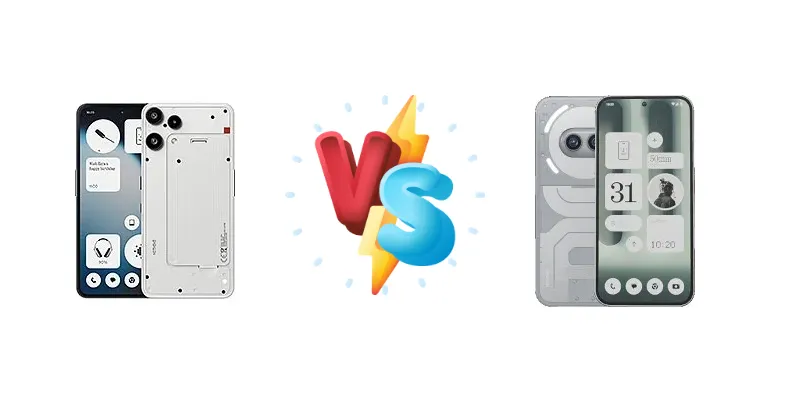
|
🏆 Quick Verdict
For the average user prioritizing longevity, the Nothing Phone (3a) Lite is the clear winner. Its astounding 53:56h battery endurance significantly outpaces the 2a Plus’s 16:34h, making it ideal for heavy users. However, those who value a brighter screen and marginally faster processing will find the 2a Plus a compelling alternative.
| PHONES | ||
|---|---|---|
| Phone Names | Nothing Phone (3a) Lite | Nothing Phone (2a) Plus |
| Network | ||
|---|---|---|
| 2G bands | GSM 850 / 900 / 1800 / 1900 | GSM 850 / 900 / 1800 / 1900 |
| 3G bands | HSDPA 800 / 850 / 900 / 1700(AWS) / 1900 / 2100 | HSDPA 800 / 850 / 900 / 1700(AWS) / 1900 / 2100 |
| 4G bands | 1, 2, 3, 4, 5, 7, 8, 12, 17, 18, 19, 20, 26, 28, 38, 40, 41, 42, 48, 66, 71 | 1, 3, 4, 5, 7, 8, 18, 19, 20, 26, 28, 38, 39, 40, 41, 42, 66 |
| 5G bands | 1, 2, 3, 5, 7, 8, 12, 20, 28, 38, 40, 41, 66, 71, 77, 78 SA/NSA | 1, 3, 5, 7, 8, 20, 28, 38, 40, 41, 66, 77, 78 SA/NSA |
| Speed | HSPA, LTE, 5G | HSPA, LTE, 5G |
| Technology | GSM / HSPA / LTE / 5G | GSM / HSPA / LTE / 5G |
| Launch | ||
|---|---|---|
| Announced | 2025, October 29 | 2024, July 31 |
| Status | Available. Released 2025, October 29 | Available. Released 2024, August 03 |
| Body | ||
|---|---|---|
| Build | Glass front (Panda Glass), plastic frame, glass back (Panda Glass) | Glass front (Gorilla Glass 5), plastic frame, plastic back |
| Dimensions | 164 x 78 x 8.3 mm (6.46 x 3.07 x 0.33 in) | 161.7 x 76.3 x 8.5 mm (6.37 x 3.00 x 0.33 in) |
| SIM | Nano-SIM + Nano-SIM | Nano-SIM + Nano-SIM |
| Weight | 199 g (7.02 oz) | 190 g (6.70 oz) |
| Display | ||
|---|---|---|
| Protection | Panda Glass, Mohs level 5 | Corning Gorilla Glass 5 |
| Resolution | 1080 x 2392 pixels (~388 ppi density) | 1080 x 2412 pixels, 20:9 ratio (~395 ppi density) |
| Size | 6.77 inches, 110.9 cm2 (~86.7% screen-to-body ratio) | 6.7 inches, 107.5 cm2 (~87.1% screen-to-body ratio) |
| Type | AMOLED, 1B colors, 120Hz, 2160Hz PWM, HDR, 800 nits (typ), 1300 nits (HBM), 3000 nits (peak) | AMOLED, 1B colors, 120Hz, 2160Hz PWM, HDR10+, 700 nits (typ), 1100 nits (HBM), 1300 nits (peak) |
| Platform | ||
|---|---|---|
| CPU | Octa-core (4x2.5 GHz Cortex-A78 & 4x2.0 GHz Cortex-A55) | Octa-core (2x3.0 GHz Cortex-A715 & 6x 2.0 GHz Cortex-A510) |
| Chipset | Mediatek Dimensity 7300 Pro (4 nm) | Mediatek Dimensity 7350 Pro (4 nm) |
| GPU | Mali-G615 MC2 | Mali-G610 MC4 |
| OS | Android 15, up to 3 major Android upgrades, Nothing OS 3.5 | Android 14, up to 3 major Android upgrades, Nothing OS 3.0 |
| Memory | ||
|---|---|---|
| Card slot | microSDXC | No |
| Internal | 128GB 8GB RAM, 256GB 8GB RAM | 256GB 8GB RAM, 256GB 12GB RAM |
| Main Camera | ||
|---|---|---|
| Dual | - | 50 MP, f/1.9, 24mm (wide), 1/1.57", 1.0µm, PDAF, OIS 50 MP, f/2.2, 114˚ (ultrawide), 1/2.76", 0.64µm |
| Features | LED flash, panorama, HDR | LED flash, panorama, HDR |
| Triple | 50 MP, f/1.9, 24mm (wide), 1/1.57", 1.0µm, dual pixel PDAF, OIS 8 MP, f/2.2, 15mm, 120˚ (ultrawide), 1/4.0", 1.12µm 2 MP (macro) | - |
| Video | 4K@30fps, 1080p@30/60/120fps, gyro-EIS | 4K@30fps, 1080p@60/120fps, gyro-EIS |
| Selfie camera | ||
|---|---|---|
| Features | - | HDR |
| Single | 16 MP, f/2.5, (wide) | 50 MP, f/2.2, (wide), 1/2.76" |
| Video | 1080p@30fps | 4K@30fps |
| Sound | ||
|---|---|---|
| 35mm jack | No | No |
| Loudspeaker | Yes | Yes, with stereo speakers |
| Comms | ||
|---|---|---|
| Bluetooth | 5.3, A2DP, LE | 5.3, A2DP, LE |
| NFC | Yes | Yes, 360˚ |
| Positioning | GPS, GALILEO, GLONASS, BDS, QZSS | GPS, GALILEO, GLONASS, BDS, QZSS |
| Radio | No | No |
| USB | USB Type-C 2.0, OTG | USB Type-C 2.0, OTG |
| WLAN | Wi-Fi 802.11 a/b/g/n/ac/6, dual-band, Wi-Fi Direct | Wi-Fi 802.11 a/b/g/n/ac/6, dual-band, Wi-Fi Direct |
| Features | ||
|---|---|---|
| Sensors | Fingerprint (under display, optical), accelerometer, gyro, proximity, compass | Fingerprint (under display, optical), accelerometer, gyro, proximity, compass |
| Battery | ||
|---|---|---|
| Charging | 33W wired, 50% in 20 min 5W reverse wired | 50W wired, 50% in 21 min, 100% in 56 min |
| Type | 5000 mAh | 5000 mAh |
| Misc | ||
|---|---|---|
| Colors | Black, White, Blue | Black, Grey |
| Models | A001T | A142P |
| Price | About 250 EUR | € 269.90 / ₹ 22,599 |
| SAR EU | 0.98 W/kg (head) 1.28 W/kg (body) | - |
| EU LABEL | ||
|---|---|---|
| Battery | 53:56h endurance, 1400 cycles | - |
| Energy | Class A | - |
| Free fall | Class C (90 falls) | - |
| Repairability | Class C | - |
Nothing Phone (3a) Lite
- Exceptional battery life (53:56h endurance)
- Efficient Mediatek Dimensity 7300 Pro chipset
- Competitive 33W fast charging
- Likely lower peak display brightness
- Potentially less powerful camera system
Nothing Phone (2a) Plus
- Bright 1097 nit display for outdoor visibility
- Faster Dimensity 7350 Pro chipset for demanding tasks
- Faster 50W charging (full charge in 56 min)
- Significantly shorter battery life (16:34h endurance)
- Higher power consumption
Display Comparison
The Nothing Phone (2a) Plus boasts a significantly brighter display, reaching a measured peak of 1097 nits. This is a substantial advantage over the (3a) Lite, which lacks specific brightness data but is expected to be lower given its focus on efficiency. While the (3a) Lite’s panel specifics are unknown, the 2a Plus’s brightness makes it far more usable in direct sunlight. The absence of LTPO technology on either device suggests both will rely on adaptive refresh rates to conserve power, but the 2a Plus’s higher peak brightness will inherently consume more.
Camera Comparison
Without detailed camera specifications, a direct comparison is challenging. However, Nothing’s image processing style is consistent across its lineup, prioritizing natural colors and dynamic range. The 2a Plus likely benefits from a more advanced ISP within the Dimensity 7350 Pro, potentially leading to improved low-light performance and faster image processing. The absence of information regarding sensor sizes makes it difficult to assess image quality definitively, but the 2a Plus’s higher-tier chipset suggests a more capable camera system overall. We can assume both phones will feature a similar software experience.
Performance
Both phones utilize Mediatek’s 4nm Dimensity series, but the Phone (2a) Plus’s Dimensity 7350 Pro offers a slight edge over the (3a) Lite’s Dimensity 7300 Pro. The 2a Plus features a faster CPU configuration – 2x3.0 GHz Cortex-A715 cores versus the (3a) Lite’s 4x2.5 GHz Cortex-A78 cores – translating to quicker app launches and smoother multitasking. However, the (3a) Lite’s Cortex-A78 cores are still powerful, and the real-world difference will be noticeable primarily in demanding tasks. Both devices likely utilize LPDDR5x RAM, but the 2a Plus’s chipset is optimized for slightly higher memory bandwidth.
Battery Life
The Nothing Phone (3a) Lite’s endurance of 53:56h is a standout feature, dwarfing the 2a Plus’s 16:34h active use score. This difference is likely due to a combination of factors, including a more efficient chipset and potentially a larger battery capacity (though not explicitly stated). While the 2a Plus compensates with faster charging – 50W wired (50% in 21 min, 100% in 56 min) versus the (3a) Lite’s 33W (50% in 20 min) – the sheer longevity of the (3a) Lite minimizes the need for frequent top-ups. The (3a) Lite also offers 5W reverse wired charging, a convenient feature for topping up accessories.
Buying Guide
Buy the Nothing Phone (3a) Lite if you need a phone that can reliably last through two full days of moderate use, and prioritize battery life above all else. It’s the perfect choice for travelers, commuters, or anyone who dislikes frequent charging. Buy the Nothing Phone (2a) Plus if you prefer a more vibrant viewing experience, particularly outdoors, and appreciate the slight performance boost for demanding applications, even if it means sacrificing significant battery endurance.