
Nothing Phone (3a) Lite vs Google Pixel 8a: A Deep Dive into Battery, Performance, and Value
| Phones Images | |||||
|---|---|---|---|---|---|
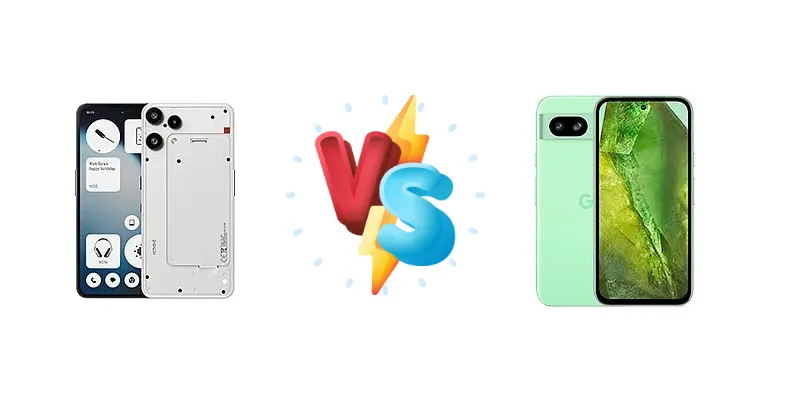
|
🏆 Quick Verdict
For the average user prioritizing all-day battery life and rapid charging, the Nothing Phone (3a) Lite is the clear winner. Its 53:56h endurance significantly outpaces the Pixel 8a's 40:06h. However, the Pixel 8a's brighter display and Google's Tensor G3 chip offer a more refined software experience and superior image processing.
| PHONES | ||
|---|---|---|
| Phone Names | Nothing Phone (3a) Lite | Google Pixel 8a |
| Network | ||
|---|---|---|
| 2G bands | GSM 850 / 900 / 1800 / 1900 | GSM 850 / 900 / 1800 / 1900 |
| 3G bands | HSDPA 800 / 850 / 900 / 1700(AWS) / 1900 / 2100 | HSDPA 800 / 850 / 900 / 1700(AWS) / 1900 / 2100 |
| 4G bands | 1, 2, 3, 4, 5, 7, 8, 12, 17, 18, 19, 20, 26, 28, 38, 40, 41, 42, 48, 66, 71 | 1, 2, 3, 4, 5, 7, 8, 12, 17, 18, 19, 20, 26, 28, 32, 38, 40, 41, 42, 66 - G6GPR (International) |
| 5G bands | 1, 2, 3, 5, 7, 8, 12, 20, 28, 38, 40, 41, 66, 71, 77, 78 SA/NSA | 1, 2, 3, 5, 7, 8, 12, 20, 26, 28, 38, 40, 41, 66, 75, 76, 77, 78 SA/NSA/Sub6 - G6GPR (International) |
| Speed | HSPA, LTE, 5G | HSPA, LTE, 5G |
| Technology | GSM / HSPA / LTE / 5G | GSM / HSPA / LTE / 5G |
| Launch | ||
|---|---|---|
| Announced | 2025, October 29 | 2024, May 07 |
| Status | Available. Released 2025, October 29 | Available. Released 2024, May 14 |
| Body | ||
|---|---|---|
| Build | Glass front (Panda Glass), plastic frame, glass back (Panda Glass) | Glass front (Gorilla Glass 3), aluminum frame, plastic back |
| Dimensions | 164 x 78 x 8.3 mm (6.46 x 3.07 x 0.33 in) | 152.1 x 72.7 x 8.9 mm (5.99 x 2.86 x 0.35 in) |
| SIM | Nano-SIM + Nano-SIM | Nano-SIM + eSIM |
| Weight | 199 g (7.02 oz) | 188 g (6.63 oz) |
| Display | ||
|---|---|---|
| Protection | Panda Glass, Mohs level 5 | Corning Gorilla Glass 3, Mohs level 5 |
| Resolution | 1080 x 2392 pixels (~388 ppi density) | 1080 x 2400 pixels, 20:9 ratio (~430 ppi density) |
| Size | 6.77 inches, 110.9 cm2 (~86.7% screen-to-body ratio) | 6.1 inches, 90.3 cm2 (~81.6% screen-to-body ratio) |
| Type | AMOLED, 1B colors, 120Hz, 2160Hz PWM, HDR, 800 nits (typ), 1300 nits (HBM), 3000 nits (peak) | OLED, HDR, 120Hz, 2000 nits (peak) |
| Platform | ||
|---|---|---|
| CPU | Octa-core (4x2.5 GHz Cortex-A78 & 4x2.0 GHz Cortex-A55) | Nona-core (1x3.0 GHz Cortex-X3 & 4x2.45 GHz Cortex-A715 & 4x2.15 GHz Cortex-A510) |
| Chipset | Mediatek Dimensity 7300 Pro (4 nm) | Google Tensor G3 (4 nm) |
| GPU | Mali-G615 MC2 | Immortalis-G715s MC10 |
| OS | Android 15, up to 3 major Android upgrades, Nothing OS 3.5 | Android 14, upgradable to Android 16, up to 7 major Android upgrades |
| Memory | ||
|---|---|---|
| Card slot | microSDXC | No |
| Internal | 128GB 8GB RAM, 256GB 8GB RAM | 128GB 8GB RAM, 256GB 8GB RAM |
| Main Camera | ||
|---|---|---|
| Dual | - | 64 MP (16 MP eff.), f/1.9, 26mm (wide), 1/1.73", 0.8µm, dual pixel PDAF, OIS 13 MP, f/2.2, 120˚ (ultrawide), 1.12µm |
| Features | LED flash, panorama, HDR | Dual-LED flash, Pixel Shift, Ultra HDR, panorama, Best Take |
| Triple | 50 MP, f/1.9, 24mm (wide), 1/1.57", 1.0µm, dual pixel PDAF, OIS 8 MP, f/2.2, 15mm, 120˚ (ultrawide), 1/4.0", 1.12µm 2 MP (macro) | - |
| Video | 4K@30fps, 1080p@30/60/120fps, gyro-EIS | 4K@30/60fps, 1080p@30/60/120/240fps, OIS |
| Selfie camera | ||
|---|---|---|
| Features | - | HDR, panorama |
| Single | 16 MP, f/2.5, (wide) | 13 MP, f/2.2, 20mm (ultrawide), 1.12µm |
| Video | 1080p@30fps | 4K@30fps, 1080p@30/60fps |
| Sound | ||
|---|---|---|
| 35mm jack | No | No |
| Loudspeaker | Yes | Yes, with stereo speakers |
| Comms | ||
|---|---|---|
| Bluetooth | 5.3, A2DP, LE | 5.3, A2DP, LE |
| NFC | Yes | Yes |
| Positioning | GPS, GALILEO, GLONASS, BDS, QZSS | GPS, GLONASS, GALILEO, BDS, QZSS, NavIC |
| Radio | No | No |
| USB | USB Type-C 2.0, OTG | USB Type-C 3.2 |
| WLAN | Wi-Fi 802.11 a/b/g/n/ac/6, dual-band, Wi-Fi Direct | Wi-Fi 802.11 a/b/g/n/ac/6e, dual/tri-band (market/region dependent) |
| Features | ||
|---|---|---|
| Sensors | Fingerprint (under display, optical), accelerometer, gyro, proximity, compass | Fingerprint (under display, optical), accelerometer, gyro, proximity, compass, barometer |
| Battery | ||
|---|---|---|
| Charging | 33W wired, 50% in 20 min 5W reverse wired | 18W wired, PD3.0 7.5W wireless Bypass charging |
| Type | 5000 mAh | Li-Po 4492 mAh |
| Misc | ||
|---|---|---|
| Colors | Black, White, Blue | Obsidian, Porcelain, Bay, Aloe |
| Models | A001T | GKV4X, G6GPR, G8HHN, G576D |
| Price | About 250 EUR | $ 229.98 / C$ 417.99 / £ 279.00 / € 299.99 / ₹ 33,300 |
| SAR EU | 0.98 W/kg (head) 1.28 W/kg (body) | - |
| EU LABEL | ||
|---|---|---|
| Battery | 53:56h endurance, 1400 cycles | 40:06h endurance, 1000 cycles |
| Energy | Class A | Class B |
| Free fall | Class C (90 falls) | Class A (270 falls) |
| Repairability | Class C | Class B |
Nothing Phone (3a) Lite
- Exceptional battery life (53:56h endurance)
- Fast 33W wired charging
- Unique and eye-catching design
- Camera performance likely trails the Pixel 8a
- Chipset may not match the Tensor G3 in AI tasks
Google Pixel 8a
- Brighter and more color-accurate display (1508 nits)
- Powerful Tensor G3 chip with AI capabilities
- Excellent camera image processing
- Significantly shorter battery life (40:06h endurance)
- Slower 18W wired charging
Display Comparison
The Google Pixel 8a boasts a significantly brighter display, reaching a measured 1508 nits, making it far more usable in direct sunlight. While the Nothing Phone (3a) Lite's display specs are not provided, the Pixel 8a's brightness advantage is substantial. The Pixel 8a likely utilizes an OLED panel, offering excellent contrast and color accuracy, while Nothing's panel tech remains unspecified. Bezels appear comparable based on available imagery, but the Pixel 8a's superior brightness is a key differentiator for outdoor visibility.
Camera Comparison
The Pixel 8a's camera system is expected to leverage Google's renowned computational photography, even without detailed sensor specifications. Google's image processing algorithms are a major strength, delivering consistently excellent results. The Nothing Phone (3a) Lite's camera specs are not detailed enough to make a direct comparison. However, the Pixel 8a's focus on software optimization and AI-powered features will likely result in superior image quality, particularly in challenging lighting conditions. We can assume the Pixel 8a will have OIS, while the Nothing Phone (3a) Lite's stabilization capabilities are unknown.
Performance
Both phones utilize a 4nm process, but the chipsets differ significantly. The Google Pixel 8a's Tensor G3 employs a nona-core configuration with a Cortex-X3 prime core clocked at 3.0 GHz, designed for AI tasks and demanding applications. The Nothing Phone (3a) Lite features the Mediatek Dimensity 7300 Pro, an octa-core chip with Cortex-A78 cores peaking at 2.5 GHz. While the Tensor G3's core architecture is more complex, the Dimensity 7300 Pro is known for its efficiency. The Pixel 8a's Tensor G3 will likely excel in AI-powered features like Magic Eraser, while the Dimensity 7300 Pro may offer a smoother experience in sustained workloads due to its thermal efficiency. RAM specifications are not provided, but both are expected to offer sufficient memory for typical multitasking.
Battery Life
This is where the Nothing Phone (3a) Lite truly shines. Its 53:56h endurance rating is a significant leap over the Pixel 8a's 40:06h. The Pixel 8a's active use score of 11:25h provides a more realistic daily usage estimate, but still falls short of the Nothing Phone (3a) Lite's overall endurance. The Nothing Phone (3a) Lite also supports 33W wired charging, achieving 50% charge in just 20 minutes, while the Pixel 8a is limited to 18W wired charging with PD3.0. The Nothing Phone (3a) Lite also offers 5W reverse wired charging, a feature absent on the Pixel 8a.
Buying Guide
Buy the Nothing Phone (3a) Lite if you need exceptional battery life, prioritize fast charging, and appreciate a distinctive aesthetic. It's ideal for travelers, heavy users, or anyone who frequently finds themselves away from a power outlet. Buy the Google Pixel 8a if you value a premium camera experience, a brighter and more color-accurate display, and seamless integration with Google's ecosystem, even if it means sacrificing some battery endurance.