
Nothing Phone (2a) vs. Xiaomi Redmi Note 13 Pro+: Which Mid-Range Phone Reigns Supreme?
| Phones Images | |||||
|---|---|---|---|---|---|
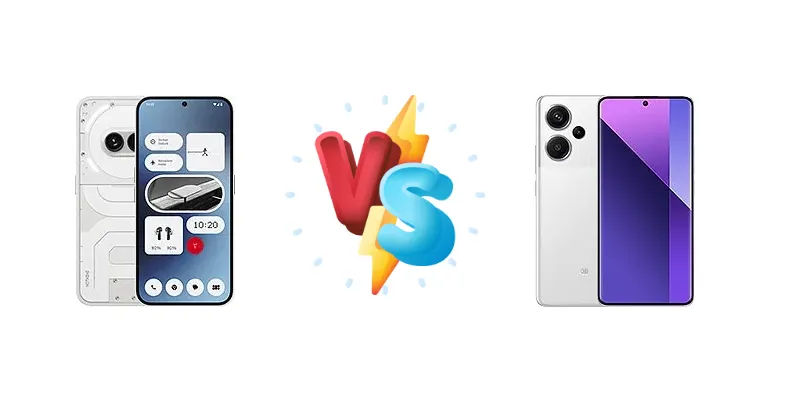
|
🏆 Quick Verdict
For the average user prioritizing longevity, the Nothing Phone (2a) emerges as the winner. Its significantly longer 15:53-hour active use battery life outweighs the Redmi Note 13 Pro+'s faster charging, especially considering the relatively similar performance profiles. However, users who absolutely need the fastest possible recharge times will favor the Redmi.
| PHONES | ||
|---|---|---|
| Phone Names | Nothing Phone (2a) | Xiaomi Redmi Note 13 Pro+ |
| Network | ||
|---|---|---|
| 2G bands | GSM 850 / 900 / 1800 / 1900 | GSM 850 / 900 / 1800 / 1900 |
| 3G bands | HSDPA 800 / 850 / 900 / 1700(AWS) / 1900 / 2100 | HSDPA 800 / 850 / 900 / 1700(AWS) / 1900 / 2100 - International |
| 4G bands | 1, 3, 4, 5, 7, 8, 18, 19, 20, 26, 28, 38, 39, 40, 41, 42, 66 | 1, 2, 3, 4, 5, 7, 8, 12, 13, 17, 18, 19, 20, 26, 28, 32, 38, 40, 41, 66 - International |
| 5G bands | 1, 3, 5, 7, 8, 20, 28, 38, 40, 41, 66, 77, 78 SA/NSA | 1, 3, 5, 7, 8, 20, 28, 38, 40, 41, 66, 77, 78 SA/NSA- International |
| Speed | HSPA, LTE, 5G | HSPA, LTE, 5G |
| Technology | GSM / HSPA / LTE / 5G | GSM / CDMA / HSPA / EVDO / LTE / 5G |
| Launch | ||
|---|---|---|
| Announced | 2024, March 05 | 2023, September 21 |
| Status | Available. Released 2024, March 12 | Available. Released 2023, September 21 |
| Body | ||
|---|---|---|
| Build | Glass front (Gorilla Glass 5), plastic frame, plastic back | Glass front (Gorilla Glass Victus), glass back or silicone polymer back (eco leather) |
| Dimensions | 161.7 x 76.3 x 8.6 mm (6.37 x 3.00 x 0.34 in) | 161.4 x 74.2 x 8.9 mm (6.35 x 2.92 x 0.35 in) |
| SIM | Nano-SIM + Nano-SIM | · Nano-SIM + eSIM· Nano-SIM + Nano-SIM |
| Weight | 190 g (6.70 oz) | 199 g or 204.5 g (7.02 oz) |
| Display | ||
|---|---|---|
| Protection | Corning Gorilla Glass 5 | Corning Gorilla Glass Victus |
| Resolution | 1080 x 2412 pixels, 20:9 ratio (~394 ppi density) | 1220 x 2712 pixels, 20:9 ratio (~446 ppi density) |
| Size | 6.7 inches, 108.0 cm2 (~87.6% screen-to-body ratio) | 6.67 inches, 107.4 cm2 (~89.7% screen-to-body ratio) |
| Type | AMOLED, 1B colors, 120Hz, 2160Hz PWM, HDR10+, 700 nits (typ), 1100 nits (HBM), 1300 nits (peak) | AMOLED, 68B colors, 120Hz, 1920Hz PWM, Dolby Vision, HDR10+, 1800 nits (peak) |
| Platform | ||
|---|---|---|
| CPU | Octa-core (2x2.8 GHz Cortex-A715 & 6x 2.0 Cortex-A510) | Octa-core (2x2.8 GHz Cortex-A715 & 6x2.0 GHz Cortex-A510) |
| Chipset | Mediatek Dimensity 7200 Pro (4 nm) | Mediatek Dimensity 7200 Ultra (4 nm) |
| GPU | Mali-G610 MC4 | Mali-G610 MC4 |
| OS | Android 14, upgradable to Android 15, up to 3 major Android upgrades, Nothing OS 3.0 | Android 13, up to 3 major Android upgrades, HyperOS |
| Memory | ||
|---|---|---|
| Card slot | No | No |
| Internal | 128GB 8GB RAM, 256GB 8GB RAM, 256GB 12GB RAM | 256GB 8GB RAM, 256GB 12GB RAM, 512GB 8GB RAM, 512GB 12GB RAM, 512GB 16GB RAM |
| Main Camera | ||
|---|---|---|
| Dual | 50 MP, f/1.9, 24mm (wide), 1/1.56", 1.0µm, PDAF, OIS 50 MP, f/2.2, 114˚ (ultrawide), 1/2.76", 0.64µm | - |
| Features | LED flash, panorama, HDR | Dual-LED dual-tone flash, HDR, panorama |
| Triple | - | 200 MP, f/1.7, 23mm (wide), 1/1.4", 0.56µm, multi-directional PDAF, OIS 8 MP, f/2.2, 16mm, 120˚ (ultrawide), 1/4.0", 1.12µm 2 MP (macro) |
| Video | 4K@30fps, 1080p@60/120fps, gyro-EIS | 4K@24/30fps, 1080p@30/60/120fps, gyro-EIS |
| Selfie camera | ||
|---|---|---|
| Features | HDR | HDR, panorama |
| Single | 32 MP, f/2.2, (wide), 1/2.74", 0.8µm | 16 MP, f/2.4, (wide) |
| Video | 1080p@60fps | 1080p@30/60fps |
| Sound | ||
|---|---|---|
| 35mm jack | No | No |
| Loudspeaker | Yes, with stereo speakers | Yes, with stereo speakers |
| Comms | ||
|---|---|---|
| Bluetooth | 5.3, A2DP, LE | 5.3, A2DP, LE |
| Infrared port | - | Yes |
| NFC | Yes, 360˚ | Yes (market/region dependent) |
| Positioning | GPS, GALILEO, GLONASS, BDS, QZSS | GPS, GLONASS, BDS, GALILEO, QZSS |
| Radio | No | No |
| USB | USB Type-C 2.0, OTG | USB Type-C 2.0, OTG |
| WLAN | Wi-Fi 802.11 a/b/g/n/ac/6, dual-band, Wi-Fi Direct | Wi-Fi 802.11 a/b/g/n/ac/6, dual-band, Wi-Fi Direct |
| Features | ||
|---|---|---|
| Sensors | Fingerprint (under display, optical), accelerometer, gyro, proximity, compass | Fingerprint (under display, optical), accelerometer, gyro, proximity, compass |
| Battery | ||
|---|---|---|
| Charging | 45W wired, 50% in 23 min, 100% in 1 hour | 120W wired, PD3.0, 100% in 19 min |
| Type | 5000 mAh | Li-Po 5000 mAh |
| Misc | ||
|---|---|---|
| Colors | Black, White, Milk, Blue | Midnight Black (Fushion Black), Moonlight White (Fushion White), Aurora Purple, Fushion Purple, Camo Green |
| Models | A142 | 23090RA98C, 23090RA98G, 23090RA98I |
| Price | € 192.59 / $ 389.00 / ₹ 21,999 | $ 299.98 / £ 299.00 / € 208.98 / ₹ 24,999 |
| SAR | - | 1.09 W/kg (head) 0.85 W/kg (body) |
| SAR EU | - | 0.98 W/kg (head) 1.00 W/kg (body) |
Nothing Phone (2a)
- Exceptional battery life (15:53h active use)
- Clean and streamlined software experience
- Unique and eye-catching design
- Lower peak display brightness
- Slower charging speed compared to the Redmi
Xiaomi Redmi Note 13 Pro+
- Incredibly fast 120W charging (0-100% in 19 min)
- Brighter display for outdoor visibility
- Potentially more versatile camera system (depending on sensor)
- Significantly shorter battery life (10:38h active use)
- MIUI software can be bloated with pre-installed apps
Display Comparison
The Xiaomi Redmi Note 13 Pro+ boasts a brighter display, reaching a measured 1283 nits compared to the Nothing Phone (2a)’s 981 nits. This translates to better visibility under direct sunlight. While both utilize AMOLED technology, the Redmi’s higher peak brightness is a clear advantage for outdoor users. However, the Nothing Phone (2a) is expected to have a more efficient panel, contributing to its superior battery life. Details regarding PWM dimming rates are currently unavailable, but this is a crucial factor for users sensitive to screen flicker.
Camera Comparison
Without detailed camera specifications, a direct comparison is challenging. However, the Redmi Note 13 Pro+ is known for its high-resolution main sensors (often exceeding 200MP in this series), which allows for detailed images and digital zoom capabilities. The Nothing Phone (2a) is expected to focus on computational photography and image processing. The presence of Optical Image Stabilization (OIS) on the main sensor is a critical factor for low-light performance and video stabilization, and its presence on either device is currently unknown. The inclusion of a dedicated telephoto lens would also be a significant advantage.
Performance
Both devices are powered by Mediatek Dimensity 7200 series chips, featuring the same octa-core CPU configuration (2x2.8 GHz Cortex-A715 & 6x2.0 Cortex-A510). The Redmi Note 13 Pro+ utilizes the Dimensity 7200 Ultra, while the Nothing Phone (2a) features the Dimensity 7200 Pro. While the 'Ultra' designation suggests a slight performance edge, real-world differences are likely to be minimal for most tasks. Both phones benefit from a 4nm process node, ensuring good thermal efficiency. RAM configurations and storage speeds (UFS 3.1 vs UFS 4.0) are unknown, but these factors could influence app loading times and multitasking performance.
Battery Life
The Nothing Phone (2a) delivers a substantial 15:53-hour active use battery life, significantly outperforming the Redmi Note 13 Pro+'s 10:38 hours. This difference is likely due to a combination of software optimization and potentially a more efficient display. While the Redmi Note 13 Pro+ compensates with blazing-fast 120W wired charging (0-100% in 19 minutes), the Nothing Phone (2a)’s 45W charging (50% in 23 min, 100% in 1 hour) is still respectable. The Redmi’s charging speed is ideal for users who frequently need a quick power boost, but the Nothing Phone (2a) offers peace of mind with its longer-lasting battery.
Buying Guide
Buy the Nothing Phone (2a) if you need exceptional battery life, a streamlined Android experience, and appreciate a distinctive design. It’s ideal for users who frequently travel or heavily rely on their phone throughout the day. Buy the Xiaomi Redmi Note 13 Pro+ if you prioritize incredibly fast 120W charging, a brighter display for outdoor visibility, and are comfortable with Xiaomi’s MIUI software customization.