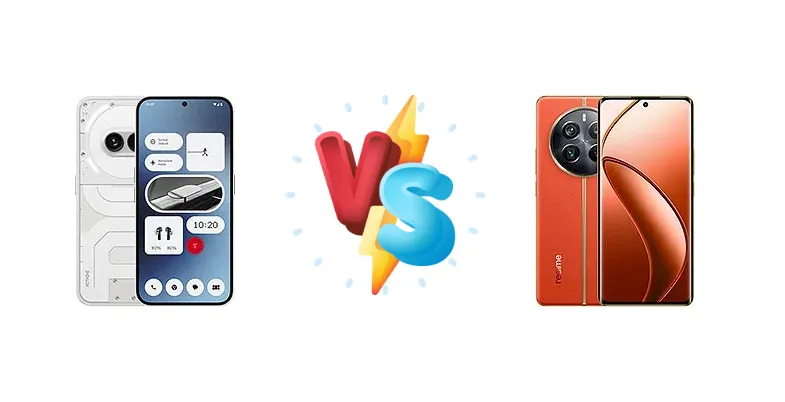
The mid-range smartphone market is fiercely competitive, and the Nothing Phone (2a) and Realme 12 Pro+ represent compelling options. The Nothing Phone (2a) aims to disrupt with its unique design and efficient chipset, while the Realme 12 Pro+ focuses on camera capabilities and rapid charging. This comparison dives deep into the specifications and real-world performance to determine which device offers the best value.
🏆 Quick Verdict
For the average user prioritizing all-day battery life and a distinctive aesthetic, the Nothing Phone (2a) is the better choice. Its 15:53h active use score significantly outperforms the Realme 12 Pro+'s 13:24h. However, the Realme 12 Pro+ excels in charging speed, reaching 50% in just 19 minutes, making it ideal for those who need a quick power boost.
| Network |
|---|
| 2G bands | GSM 850 / 900 / 1800 / 1900 | GSM 850 / 900 / 1800 / 1900 |
| 3G bands | HSDPA 800 / 850 / 900 / 1700(AWS) / 1900 / 2100 | HSDPA 850 / 900 / 2100 |
| 4G bands | 1, 3, 4, 5, 7, 8, 18, 19, 20, 26, 28, 38, 39, 40, 41, 42, 66 | 1, 3, 5, 8, 28, 40, 41 |
| 5G bands | 1, 3, 5, 7, 8, 20, 28, 38, 40, 41, 66, 77, 78 SA/NSA | 1, 3, 5, 8, 28, 40, 41, 77, 78 SA/NSA |
| Speed | HSPA, LTE, 5G | HSPA, LTE, 5G |
| Technology | GSM / HSPA / LTE / 5G | GSM / HSPA / LTE / 5G |
| Launch |
|---|
| Announced | 2024, March 05 | 2024, January 29 |
| Status | Available. Released 2024, March 12 | Available. Released 2024, January 29 |
| Body |
|---|
| Build | Glass front (Gorilla Glass 5), plastic frame, plastic back | - |
| Dimensions | 161.7 x 76.3 x 8.6 mm (6.37 x 3.00 x 0.34 in) | 161.5 x 74 x 8.8 mm (6.36 x 2.91 x 0.35 in) |
| SIM | Nano-SIM + Nano-SIM | Nano-SIM + Nano-SIM |
| Weight | 190 g (6.70 oz) | 196 g (6.91 oz) |
| Display |
|---|
| Protection | Corning Gorilla Glass 5 | - |
| Resolution | 1080 x 2412 pixels, 20:9 ratio (~394 ppi density) | 1080 x 2412 pixels, 20:9 ratio (~394 ppi density) |
| Size | 6.7 inches, 108.0 cm2 (~87.6% screen-to-body ratio) | 6.7 inches, 108.0 cm2 (~90.4% screen-to-body ratio) |
| Type | AMOLED, 1B colors, 120Hz, 2160Hz PWM, HDR10+, 700 nits (typ), 1100 nits (HBM), 1300 nits (peak) | AMOLED, 1B colors, 120Hz, 800 nits (HBM), 950 nits (peak) |
| Platform |
|---|
| CPU | Octa-core (2x2.8 GHz Cortex-A715 & 6x 2.0 Cortex-A510) | Octa-core (4x2.40 GHz Cortex-A78 & 4x1.95 GHz Cortex-A55) |
| Chipset | Mediatek Dimensity 7200 Pro (4 nm) | Qualcomm SM7435-AB Snapdragon 7s Gen 2 (4 nm) |
| GPU | Mali-G610 MC4 | Adreno 710 |
| OS | Android 14, upgradable to Android 15, up to 3 major Android upgrades, Nothing OS 3.0 | Android 14, Realme UI 5.0 |
| Memory |
|---|
| Card slot | No | No |
| Internal | 128GB 8GB RAM, 256GB 8GB RAM, 256GB 12GB RAM | 128GB 8GB RAM, 256GB 8GB RAM, 256GB 12GB RAM, 512GB 12GB RAM |
| Main Camera |
|---|
| Dual | 50 MP, f/1.9, 24mm (wide), 1/1.56", 1.0µm, PDAF, OIS
50 MP, f/2.2, 114˚ (ultrawide), 1/2.76", 0.64µm | - |
| Features | LED flash, panorama, HDR | LED flash, HDR, panorama |
| Triple | - | 50 MP, f/1.8, 24mm (wide), 1/1.56", 1.0µm, multi-directional PDAF, OIS
64 MP, f/2.8, 71mm, (periscope telephoto), 1/2.0", 0.7µm, PDAF, OIS, 3x optical zoom
8 MP, f/2.2, 16mm, 112˚ (ultrawide), 1/4.0", 1.12µm |
| Video | 4K@30fps, 1080p@60/120fps, gyro-EIS | 4K@30fps, 1080p@30/60/120fps, gyro-EIS |
| Selfie camera |
|---|
| Features | HDR | - |
| Single | 32 MP, f/2.2, (wide), 1/2.74", 0.8µm | 32 MP, f/2.4, 22mm (wide) |
| Video | 1080p@60fps | 1080p@30fps |
| Sound |
|---|
| 35mm jack | No | No |
| Loudspeaker | Yes, with stereo speakers | Yes, with stereo speakers |
| Comms |
|---|
| Bluetooth | 5.3, A2DP, LE | 5.2, A2DP, LE |
| NFC | Yes, 360˚ | Yes (market/region dependent) |
| Positioning | GPS, GALILEO, GLONASS, BDS, QZSS | GPS, GLONASS, GALILEO, BDS, QZSS |
| Radio | No | No |
| USB | USB Type-C 2.0, OTG | USB Type-C 2.0 |
| WLAN | Wi-Fi 802.11 a/b/g/n/ac/6, dual-band, Wi-Fi Direct | Wi-Fi 802.11 a/b/g/n/ac/6, dual-band |
| Features |
|---|
| Sensors | Fingerprint (under display, optical), accelerometer, gyro, proximity, compass | Fingerprint (under display, optical), accelerometer, gyro, proximity, compass |
| Battery |
|---|
| Charging | 45W wired, 50% in 23 min, 100% in 1 hour | 67W wired, 50% in 19 min |
| Type | 5000 mAh | 5000 mAh |
| Misc |
|---|
| Colors | Black, White, Milk, Blue | Submarine Blue, Navigator Beige, Explorer Red |
| Models | A142 | RMX3840, RMX3841 |
| Price | € 192.59 / $ 389.00 / ₹ 21,999 | $ 465.00 / £ 299.00 / € 344.26 / ₹ 28,400 |
Nothing Phone (2a)
- Superior battery life (15:53h active use)
- Brighter display (981 nits)
- Potentially faster CPU performance with Dimensity 7200 Pro
- Slower charging speed (45W)
- Camera system may not be as advanced as the Realme 12 Pro+
Realme 12 Pro+
- Faster charging (67W, 50% in 19 min)
- Potentially better camera system (based on Realme's history)
- Efficient Snapdragon 7s Gen 2 chipset
- Shorter battery life (13:24h active use)
- Dimmer display (802 nits)
Display Comparison
The Nothing Phone (2a) boasts a brighter display, reaching a measured peak of 981 nits, compared to the Realme 12 Pro+'s 802 nits. This translates to better visibility under direct sunlight. While both utilize 4nm chipsets, the display brightness difference is noticeable. Neither phone specifies refresh rate or panel type, but the higher peak brightness of the Nothing Phone (2a) provides a more vibrant viewing experience, especially for HDR content. The Realme 12 Pro+ may benefit from color calibration, but the raw brightness advantage goes to the Nothing Phone (2a).
Camera Comparison
Without detailed camera specs, a direct comparison is difficult. However, Realme historically emphasizes camera features, and the 'Pro+' designation suggests a focus on imaging. The Realme 12 Pro+ likely features a more sophisticated camera system, potentially with a larger main sensor and more advanced image processing algorithms. The Nothing Phone (2a) likely prioritizes a balanced camera experience, but may not match the Realme’s potential for low-light photography or zoom capabilities. The absence of detailed sensor information makes a definitive judgment impossible, but Realme’s marketing suggests a stronger camera focus.
Performance
Under the hood, the Nothing Phone (2a) features the Mediatek Dimensity 7200 Pro, utilizing a Cortex-A715 based octa-core CPU clocked up to 2.8 GHz. The Realme 12 Pro+ employs the Qualcomm Snapdragon 7s Gen 2, with a Cortex-A78 based octa-core CPU peaking at 2.40 GHz. While the Snapdragon 7s Gen 2 is known for its efficiency, the Dimensity 7200 Pro’s higher clock speeds suggest a performance edge in demanding tasks. The Dimensity 7200 Pro’s architecture, with its newer Cortex-A715 cores, should offer improved single-core performance, benefiting app launch speeds and general responsiveness. However, the Snapdragon’s Adreno GPU may provide a slight advantage in some gaming scenarios.
Battery Life
The Nothing Phone (2a) delivers a significant advantage in battery life, achieving 15:53h of active use, compared to the Realme 12 Pro+'s 13:24h. This nearly 2-hour difference is substantial. However, the Realme 12 Pro+ compensates with its faster 67W charging, reaching 50% in just 19 minutes, while the Nothing Phone (2a) takes 23 minutes. The Realme 12 Pro+’s faster charging is crucial for users who frequently need to quickly replenish their battery, despite the smaller overall capacity implied by the shorter runtime.
Buying Guide
Buy the Nothing Phone (2a) if you need exceptional battery endurance, a clean software experience, and a unique, eye-catching design. It’s perfect for users who prioritize longevity and aren’t heavily reliant on the absolute fastest charging speeds. Buy the Realme 12 Pro+ if you prioritize rapid charging, and are willing to trade some battery life for the convenience of getting back to 100% in under an hour. It’s a good fit for users who frequently find themselves needing to top up their battery throughout the day.
Frequently Asked Questions
❓ Does the Mediatek Dimensity 7200 Pro in the Nothing Phone (2a) throttle under sustained gaming loads?
While the Dimensity 7200 Pro is a capable chipset, throttling is always a possibility with any smartphone processor. The 4nm process node helps mitigate heat, but prolonged, graphically intensive gaming sessions may lead to some performance reduction. However, the Nothing Phone (2a)'s thermal design should be adequate for most gaming scenarios.
❓ How does the 67W charging on the Realme 12 Pro+ compare to other fast charging solutions?
67W charging is considered very fast, placing the Realme 12 Pro+ among the quickest charging phones in its price range. While some competitors offer 80W or 120W charging, the 67W solution is still significantly faster than standard 25W or 33W charging, allowing for a substantial battery top-up in a short amount of time.
❓ Is the difference in active use battery life between the two phones noticeable in everyday use?
Yes, the nearly two-hour difference in active use battery life (15:53h vs 13:24h) is likely to be very noticeable. Users of the Nothing Phone (2a) can expect to comfortably get through a full day of moderate to heavy use without needing to recharge, while Realme 12 Pro+ users may need to top up their battery before the end of the day, depending on their usage patterns.