
Nothing Phone (2a) vs Google Pixel 7a: A Detailed Comparison
| Phones Images | |||||
|---|---|---|---|---|---|
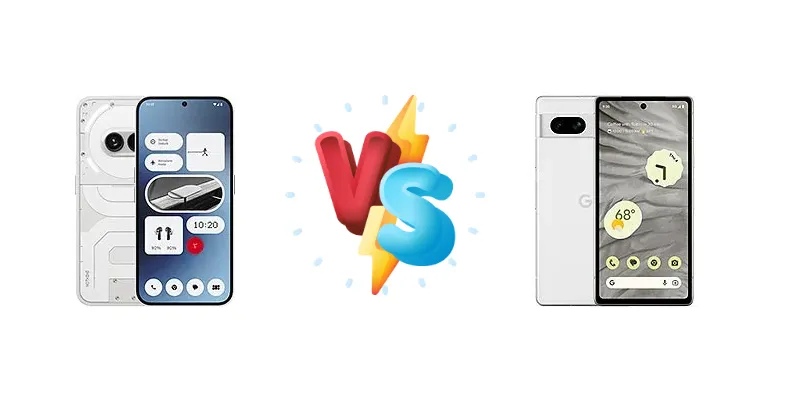
|
🏆 Quick Verdict
For the average user prioritizing camera quality and software experience, the Google Pixel 7a remains the superior choice. Its Tensor G2 chip delivers excellent image processing capabilities, while the Nothing Phone (2a) excels in battery endurance and offers a faster charging experience, making it ideal for power users.
| PHONES | ||
|---|---|---|
| Phone Names | Nothing Phone (2a) | Google Pixel 7a |
| Network | ||
|---|---|---|
| 2G bands | GSM 850 / 900 / 1800 / 1900 | GSM 850 / 900 / 1800 / 1900 |
| 3G bands | HSDPA 800 / 850 / 900 / 1700(AWS) / 1900 / 2100 | HSDPA 800 / 850 / 900 / 1700(AWS) / 1900 / 2100 |
| 4G bands | 1, 3, 4, 5, 7, 8, 18, 19, 20, 26, 28, 38, 39, 40, 41, 42, 66 | 1, 2, 3, 4, 5, 7, 8, 12, 13, 14, 17, 20, 25, 26, 28, 29, 30, 38, 40, 41, 48, 66, 71 - GWKK3, G0DZQ |
| 5G bands | 1, 3, 5, 7, 8, 20, 28, 38, 40, 41, 66, 77, 78 SA/NSA | 1, 2, 3, 5, 7, 8, 12, 14, 20, 25, 28, 30, 38, 41, 48, 66, 71, 77, 78 SA/NSA/Sub6 - GWKK3 |
| Speed | HSPA, LTE, 5G | HSPA, LTE, 5G |
| Technology | GSM / HSPA / LTE / 5G | GSM / HSPA / LTE / 5G |
| - | 1, 2, 3, 5, 7, 8, 12, 20, 25, 28, 38, 40, 41, 66, 75, 76, 77, 78, 79 SA/NSA/Sub6 - GHL1X, G82U8 | |
| Launch | ||
|---|---|---|
| Announced | 2024, March 05 | 2023, May 10 |
| Status | Available. Released 2024, March 12 | Available. Released 2023, May 10 |
| Body | ||
|---|---|---|
| Build | Glass front (Gorilla Glass 5), plastic frame, plastic back | Glass front (Gorilla Glass 3), aluminum frame, plastic back |
| Dimensions | 161.7 x 76.3 x 8.6 mm (6.37 x 3.00 x 0.34 in) | 152 x 72.9 x 9 mm (5.98 x 2.87 x 0.35 in) |
| SIM | Nano-SIM + Nano-SIM | Nano-SIM + eSIM |
| Weight | 190 g (6.70 oz) | 193.5 g (6.84 oz) |
| - | IP67 dust/water resistant (up to 1m for 30 min) | |
| Display | ||
|---|---|---|
| Protection | Corning Gorilla Glass 5 | Corning Gorilla Glass 3 |
| Resolution | 1080 x 2412 pixels, 20:9 ratio (~394 ppi density) | 1080 x 2400 pixels, 20:9 ratio (~429 ppi density) |
| Size | 6.7 inches, 108.0 cm2 (~87.6% screen-to-body ratio) | 6.1 inches, 90.7 cm2 (~81.8% screen-to-body ratio) |
| Type | AMOLED, 1B colors, 120Hz, 2160Hz PWM, HDR10+, 700 nits (typ), 1100 nits (HBM), 1300 nits (peak) | OLED, HDR, 90Hz |
| - | Always-on display | |
| Platform | ||
|---|---|---|
| CPU | Octa-core (2x2.8 GHz Cortex-A715 & 6x 2.0 Cortex-A510) | Octa-core (2x2.85 GHz Cortex-X1 & 2x2.35 GHz Cortex-A78 & 4x1.80 GHz Cortex-A55) |
| Chipset | Mediatek Dimensity 7200 Pro (4 nm) | Google Tensor G2 (5 nm) |
| GPU | Mali-G610 MC4 | Mali-G710 MP7 |
| OS | Android 14, upgradable to Android 15, up to 3 major Android upgrades, Nothing OS 3.0 | Android 13, upgradable to Android 15, up to 5 major Android upgrades |
| Memory | ||
|---|---|---|
| Card slot | No | No |
| Internal | 128GB 8GB RAM, 256GB 8GB RAM, 256GB 12GB RAM | 128GB 8GB RAM |
| - | UFS 3.1 | |
| Main Camera | ||
|---|---|---|
| Dual | 50 MP, f/1.9, 24mm (wide), 1/1.56", 1.0µm, PDAF, OIS 50 MP, f/2.2, 114˚ (ultrawide), 1/2.76", 0.64µm | 64 MP, f/1.9, 26mm (wide), 1/1.73", 0.8µm, dual pixel PDAF, OIS 13 MP, f/2.2, 120˚ (ultrawide), 1.12µm |
| Features | LED flash, panorama, HDR | Dual-LED flash, Pixel Shift, Auto-HDR, panorama |
| Video | 4K@30fps, 1080p@60/120fps, gyro-EIS | 4K@30/60fps, 1080p@30/60/120/240fps, OIS |
| Selfie camera | ||
|---|---|---|
| Features | HDR | HDR, panorama |
| Single | 32 MP, f/2.2, (wide), 1/2.74", 0.8µm | 13 MP, f/2.2, 20mm (ultrawide), 1.12µm |
| Video | 1080p@60fps | 4K@30fps, 1080p@30fps |
| Sound | ||
|---|---|---|
| 3.5mm jack | - | No |
| 35mm jack | No | No |
| Loudspeaker | Yes, with stereo speakers | Yes, with stereo speakers |
| Comms | ||
|---|---|---|
| Bluetooth | 5.3, A2DP, LE | 5.3, A2DP, LE |
| NFC | Yes, 360˚ | Yes |
| Positioning | GPS, GALILEO, GLONASS, BDS, QZSS | GPS, GLONASS, GALILEO, BDS, QZSS, NavIC |
| Radio | No | No |
| USB | USB Type-C 2.0, OTG | USB Type-C 3.2 |
| WLAN | Wi-Fi 802.11 a/b/g/n/ac/6, dual-band, Wi-Fi Direct | Wi-Fi 802.11 a/b/g/n/ac/6e, tri-band |
| Features | ||
|---|---|---|
| Sensors | Fingerprint (under display, optical), accelerometer, gyro, proximity, compass | Fingerprint (under display, optical), accelerometer, gyro, proximity, compass, barometer |
| Battery | ||
|---|---|---|
| Charging | 45W wired, 50% in 23 min, 100% in 1 hour | 18W wired, PD3.0 7.5W wireless |
| Type | 5000 mAh | Li-Po 4385 mAh |
| Misc | ||
|---|---|---|
| Colors | Black, White, Milk, Blue | Charcoal, Snow, Sea, Coral |
| Models | A142 | GWKK3, GHL1X, G0DZQ, G82U8 |
| Price | € 192.59 / $ 389.00 / ₹ 21,999 | € 179.90 / $ 150.00 / £ 170.00 / ₹ 25,980 |
Nothing Phone (2a)
- Faster 45W charging
- Longer battery life (15:53h)
- Unique and eye-catching design
- Less refined camera processing
- Chipset lacks dedicated AI acceleration
Google Pixel 7a
- Superior camera image quality
- Excellent software experience
- Powerful Tensor G2 chip for AI tasks
- Slower 18W charging
- Shorter battery life compared to Nothing Phone (2a)
Display Comparison
Both phones feature capable displays, but the Pixel 7a boasts a higher peak brightness of 1070 nits compared to the Nothing Phone (2a)’s 981 nits. This translates to better visibility under direct sunlight. While neither phone utilizes LTPO technology for variable refresh rates, the Pixel 7a’s superior brightness and color accuracy provide a more vibrant and immersive viewing experience. The Nothing Phone (2a) doesn’t specify PWM dimming frequency, while the Pixel 7a’s is likely higher, potentially making it a better choice for users sensitive to screen flicker.
Camera Comparison
The Pixel 7a’s strength lies in its computational photography prowess, powered by the Tensor G2. While specific sensor details aren’t provided in the context data, Google’s image processing algorithms consistently deliver exceptional results, particularly in low-light conditions. The Nothing Phone (2a) likely relies more on hardware capabilities, but lacks the software optimization of the Pixel. The Pixel 7a’s video capabilities are also likely superior due to the Tensor G2’s dedicated image signal processor (ISP). We can assume the Pixel 7a has OIS, while the Nothing Phone (2a)'s OIS status is unknown.
Performance
The chipset choice is a key differentiator. The Pixel 7a’s Google Tensor G2 (5nm) is designed for AI and machine learning tasks, excelling in image processing and voice recognition. The Nothing Phone (2a) utilizes the Mediatek Dimensity 7200 Pro (4nm). While the Dimensity 7200 Pro’s Cortex-A715 cores clock slightly higher (2.8 GHz vs 2.85 GHz on the Pixel), the Tensor G2’s Cortex-X1 prime core provides a performance advantage in demanding tasks. The 4nm process of the Dimensity 7200 Pro should offer good efficiency, but the Tensor G2’s integrated AI capabilities are a significant advantage. The Pixel 7a’s LPDDR5x RAM is also faster than the Nothing Phone (2a)'s likely LPDDR5.
Battery Life
The Nothing Phone (2a) demonstrates a clear advantage in battery endurance, achieving an active use score of 15:53h. The Pixel 7a’s older endurance rating of 76h is less specific, but suggests a shorter runtime. The Nothing Phone (2a) also boasts significantly faster charging at 45W, reaching 50% in 23 minutes and 100% in an hour, compared to the Pixel 7a’s 18W wired charging. The Pixel 7a does offer 7.5W wireless charging, a feature absent on the Nothing Phone (2a).
Buying Guide
Buy the Nothing Phone (2a) if you prioritize long battery life, rapid charging, and a distinctive design aesthetic. It’s the phone for users who frequently consume media on the go and value a phone that can keep up with their active lifestyle. Buy the Google Pixel 7a if you value computational photography, a clean and intuitive software experience, and consistently excellent image quality, even in challenging lighting conditions. It’s the phone for those who consider their smartphone their primary camera.