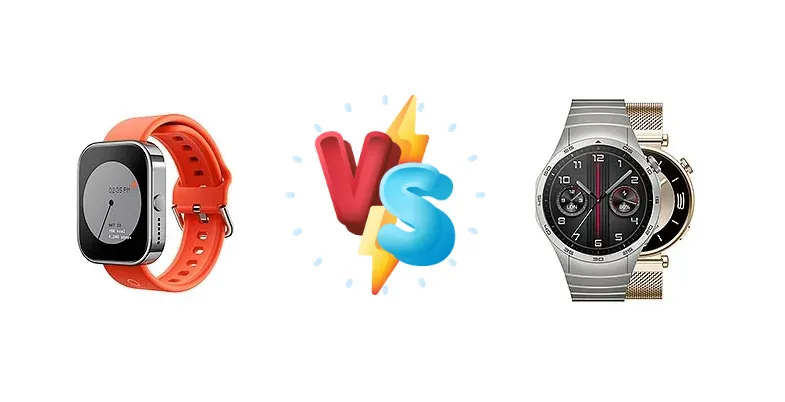
The smartwatch market is increasingly segmented, offering choices for every style and budget. The Nothing CMF Watch Pro aims to disrupt with its design-focused approach, while the Huawei Watch GT 4 continues Huawei’s tradition of feature-rich wearables. This comparison dives deep into their differences, helping you determine which device best aligns with your needs.
🏆 Quick Verdict
For the fashion-conscious user prioritizing a unique aesthetic, the Nothing CMF Watch Pro is a compelling choice. However, the Huawei Watch GT 4, with its wireless charging and established ecosystem, offers a more mature and potentially longer-lasting smartwatch experience for the average user.
| Network |
|---|
| 2G bands | N/A | N/A |
| 3G bands | N/A | N/A |
| 4G bands | N/A | N/A |
| EDGE | No | No |
| GPRS | No | No |
| Speed | - | No |
| Technology | No cellular connectivity | No cellular connectivity |
| Launch |
|---|
| Announced | 2023, September 26 | 2023, September 14 |
| Status | Available. Released 2023, September 26 | Available. Released 2023, October 02 |
| Body |
|---|
| Build | Glass front, aluminum frame | Glass front, plastic back, stainless steel frame |
| Dimensions | 46.9 x 39.9 x 11.4 mm (1.85 x 1.57 x 0.45 in) | 46 x 46 x 10.9 mm (1.81 x 1.81 x 0.43 in) |
| SIM | No | No |
| Weight | 31.1 g (1.09 oz) | 37 g (41mm) / 48 g (46mm) (1.31 oz) |
| Display |
|---|
| Resolution | 502 x 410 pixels (~331 ppi density) | 466 x 466 pixels (~326 ppi density) |
| Size | 1.96 inches | 1.43 inches |
| Type | AMOLED, 600 nits | AMOLED |
| Memory |
|---|
| Call records | Yes | - |
| Card slot | No | No |
| Internal | Unspecified | Unspecified |
| Phonebook | No | - |
| Sound |
|---|
| 35mm jack | No | No |
| Loudspeaker | Yes | Yes |
| Comms |
|---|
| Bluetooth | 5.3, A2DP, LE | 5.2, A2DP, LE |
| NFC | No | Yes |
| Positioning | GPS, GLONASS, GALILEO, BDS, QZSS | GPS (L1+L5), GLONASS, BDS, GALILEO, QZSS |
| Radio | No | No |
| USB | No | No |
| WLAN | No | No |
| Features |
|---|
| Games | No | - |
| Java | No | - |
| Messaging | SMS(threaded view), Email, IM | - |
| Sensors | Accelerometer, gyro, heart rate, SpO2 | Accelerometer, gyro, heart rate, barometer, compass, SpO2, thermometer (body temperature) |
| Battery |
|---|
| Charging | - | Wireless |
| Type | Li-Ion 340 mAh | Li-Ion 524 mAh |
| Misc |
|---|
| Colors | Dark Gray, Ash Gray, Metallic Gray | Black, Steel, Silver, Gold |
| Models | D395 | ARA-B19, PNX-B19 |
| Price | About 40 EUR | About 270 EUR |
Nothing CMF Watch Pro
- Unique and minimalist design aesthetic
- Potentially more affordable price point
- Focus on style as a key selling point
- Lack of detailed specifications
- Likely limited feature set compared to competitors
- Uncertainty regarding battery life and performance
Huawei Watch GT 4
- Wireless charging for added convenience
- Established health and fitness tracking ecosystem
- Likely longer battery life based on Huawei’s GT series history
- Design may be less distinctive than the CMF Watch Pro
- Proprietary operating system may have limited app support
- Potential privacy concerns associated with Huawei
Display Comparison
Given the lack of specific display specs for the Nothing CMF Watch Pro, we can infer a focus on visual clarity given Nothing’s brand aesthetic. The Huawei Watch GT 4 likely employs an AMOLED panel, common in its price range, offering vibrant colors and deep blacks. The GT 4’s display size is a key consideration, as larger screens improve readability for notifications and fitness data. The presence of wireless charging on the GT 4 suggests a more premium build quality, potentially including a more durable display glass.
Camera Comparison
Neither device is positioned as a camera-centric wearable, and neither is expected to have a camera. Therefore, this section is irrelevant for comparison.
Performance
Without chipset details for the CMF Watch Pro, it’s reasonable to assume a focus on efficiency to maximize battery life. The Huawei Watch GT 4, while not a performance powerhouse, benefits from Huawei’s optimization of its proprietary operating system. This likely translates to smoother animations and quicker app loading times compared to a less optimized platform. RAM capacity, absent from both specs, will influence multitasking capabilities; more RAM allows for more apps to run in the background.
Battery Life
The Huawei Watch GT 4’s wireless charging capability is a significant advantage, offering convenience over the likely wired charging solution of the Nothing CMF Watch Pro. While mAh capacity is unknown for both, Huawei typically prioritizes long battery life in its GT series, potentially offering several days of use on a single charge. The CMF Watch Pro, aiming for a lower price point, may sacrifice some battery capacity for cost savings. Charging speed, while not specified, will be a key differentiator; faster charging minimizes downtime.
Buying Guide
Buy the Nothing CMF Watch Pro if you value a distinctive, minimalist design and are willing to potentially compromise on established smartwatch features. It’s ideal for users who see their smartwatch as a fashion accessory. Buy the Huawei Watch GT 4 if you prioritize battery life, wireless charging convenience, and a more comprehensive health and fitness tracking suite, even if it means a less radical design.
Frequently Asked Questions
❓ Does the Huawei Watch GT 4’s wireless charging work with any Qi-compatible charger?
Yes, the Huawei Watch GT 4 supports Qi wireless charging, meaning it’s compatible with a wide range of wireless charging pads available on the market. However, Huawei recommends using its own charger for optimal charging speeds and efficiency.
❓ What operating systems are compatible with the Nothing CMF Watch Pro and Huawei Watch GT 4?
The Huawei Watch GT 4 is compatible with both Android and iOS, though functionality may be limited on iOS compared to Android. The Nothing CMF Watch Pro’s compatibility is currently unknown, but given Nothing’s focus on the broader ecosystem, Android and iOS support is highly probable.
❓ How does Huawei’s health tracking compare to other smartwatch brands?
Huawei’s health tracking, powered by TruSeen technology, is generally considered accurate and comprehensive, offering features like continuous heart rate monitoring, SpO2 tracking, and sleep analysis. It often rivals the accuracy of established brands like Fitbit and Apple, though the data presentation and ecosystem integration differ.