
Nothing CMF Phone 2 Pro vs Xiaomi 13 Lite: A Deep Dive into Battery, Performance, and Value
| Phones Images | |||||
|---|---|---|---|---|---|
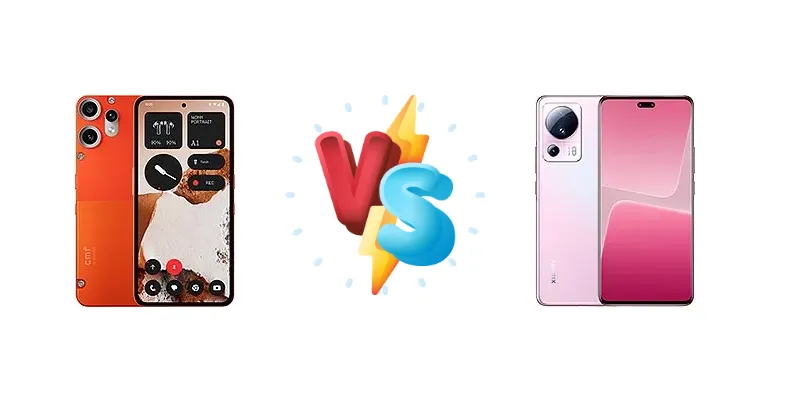
|
🏆 Quick Verdict
For users prioritizing all-day battery life and long-term reliability, the Nothing CMF Phone 2 Pro is the clear winner. Its impressive 53:56h endurance rating significantly surpasses the Xiaomi 13 Lite’s 93h (older rating), despite the latter’s faster charging. However, the Xiaomi 13 Lite’s 67W charging is a significant convenience factor.
| PHONES | ||
|---|---|---|
| Phone Names | Nothing CMF Phone 2 Pro | Xiaomi 13 Lite |
| Network | ||
|---|---|---|
| 2G bands | GSM 850 / 900 / 1800 / 1900 | GSM 850 / 900 / 1800 / 1900 |
| 3G bands | HSDPA 800 / 850 / 900 / 1700(AWS) / 1900 / 2100 | HSDPA 800 / 850 / 900 / 1700(AWS) / 1900 / 2100 |
| 4G bands | 1, 2, 3, 4, 5, 7, 8, 12, 17, 18, 19, 26, 20, 28, 38, 40, 41, 42, 48, 66, 71 - International | 1, 2, 3, 4, 5, 7, 8, 12, 13, 17, 18, 19, 20, 26, 28, 32, 38, 40, 41, 42, 66 |
| 5G bands | 1, 2, 3, 4, 5, 7, 8, 12, 17, 18, 19, 26, 20, 28, 38, 40, 41, 42, 48, 66, 71 SA/NSA - International | 1, 3, 5, 7, 8, 20, 28, 38, 40, 41, 66, 77, 78 SA/NSA |
| Speed | HSPA, LTE, 5G | HSPA, LTE, 5G |
| Technology | GSM / HSPA / LTE / 5G | GSM / HSPA / LTE / 5G |
| Launch | ||
|---|---|---|
| Announced | 2025, April 28 | 2023, February 26 |
| Status | Available. Released 2025, May 05 | Available. Released 2023, March 08 |
| Body | ||
|---|---|---|
| Build | - | Glass front (Gorilla Glass 5), glass back, plastic frame |
| Dimensions | 164 x 78 x 7.8 mm (6.46 x 3.07 x 0.31 in) | 159.2 x 72.7 x 7.2 mm (6.27 x 2.86 x 0.28 in) |
| SIM | Nano-SIM + Nano-SIM | · Nano-SIM + eSIM· Nano-SIM + Nano-SIM |
| Weight | 185 g (6.53 oz) | 171 g (6.03 oz) |
| - | IP53, dust and splash resistant | |
| Display | ||
|---|---|---|
| Protection | Panda Glass, Mohs level 5 | Corning Gorilla Glass 5 |
| Resolution | 1080 x 2392 pixels (~388 ppi density) | 1080 x 2400 pixels, 20:9 ratio (~402 ppi density) |
| Size | 6.77 inches, 110.9 cm2 (~86.7% screen-to-body ratio) | 6.55 inches, 103.6 cm2 (~89.5% screen-to-body ratio) |
| Type | AMOLED, 1B colors, 120Hz, 2160Hz PWM, HDR10+, 800 nits (typ), 1300 nits (HBM), 3000 nits (peak) | AMOLED, 68B colors, Dolby Vision, HDR10+, 120Hz, 500 nits (typ), 1000 nits (peak) |
| Platform | ||
|---|---|---|
| CPU | Octa-core (4x2.5 GHz Cortex-A78 & 4x2.0 GHz Cortex-A55) | Octa-core (1x2.4 GHz Cortex-A710 & 3x2.36 GHz Cortex-A710 & 4x1.8 GHz Cortex-A510) |
| Chipset | Mediatek Dimensity 7300 Pro (4 nm) | Qualcomm SM7450-AB Snapdragon 7 Gen 1 (4 nm) |
| GPU | Mali-G615 MC2 | Adreno 644 |
| OS | Android 15, up to 3 major Android upgrades, Nothing OS 3.2 | Android 12, MIUI 14 |
| Memory | ||
|---|---|---|
| Card slot | microSDXC | No |
| Internal | 128GB 8GB RAM, 256GB 8GB RAM | 64GB 8GB RAM, 128GB 8GB RAM, 256GB 8GB RAM |
| - | UFS 2.2 | |
| Main Camera | ||
|---|---|---|
| Features | LED flash, panorama, HDR | Dual-LED dual-tone flash, HDR, panorama |
| Triple | 50 MP, f/1.9, 24mm (wide), 1/1.57", 1.0µm, dual pixel PDAF 50 MP, f/1.9, 50mm (telephoto), 1/2.88", PDAF, 2x optical zoom 8 MP, f/2.2, 15mm, 120˚ (ultrawide), 1/4.0", 1.12µm | 50 MP, f/1.8, 23mm (wide), 1/1.56", 1.0µm, PDAF 8 MP, f/2.2, 119˚ (ultrawide), 1/4.0", 1.12µm 2 MP (macro) |
| Video | 4K@30fps, 1080p@30/60/120fps, gyro-EIS | 4K@30fps, 1080p@30/60/120fps, 720p@960fps |
| Selfie camera | ||
|---|---|---|
| Dual | - | 32 MP, f/2.4, 100˚ (ultrawide), 1/2.74", 0.8µm 8 MP, f/2.3, (depth) |
| Features | - | Dual-LED flash, HDR |
| Single | 16 MP, f/2.0, 22mm (wide), 1/3.0" | - |
| Video | 1080p@30fps | 1080p@30/60fps |
| Sound | ||
|---|---|---|
| 3.5mm jack | - | No |
| 35mm jack | No | No |
| Loudspeaker | Yes | Yes |
| - | 24-bit/192kHz audio | |
| Comms | ||
|---|---|---|
| Bluetooth | 5.3, A2DP, LE | 5.2, A2DP, LE |
| Infrared port | - | Yes |
| NFC | Yes (market/region dependent) | Yes (market/region dependent) |
| Positioning | GPS, GALILEO, GLONASS, BDS, QZSS | GPS (L1), GLONASS (G1), BDS (B1I+B1c), GALILEO (E1), QZSS (L1) |
| Radio | No | No |
| USB | USB Type-C | USB Type-C 2.0, OTG |
| WLAN | Wi-Fi 802.11 a/b/g/n/ac/6, dual-band | Wi-Fi 802.11 a/b/g/n/ac/6, dual-band |
| Features | ||
|---|---|---|
| Sensors | Fingerprint (under display, optical), accelerometer, gyro, proximity, compass | Fingerprint (under display, optical), accelerometer, gyro, proximity, compass |
| Battery | ||
|---|---|---|
| Charging | 33W wired 5W reverse wired | 67W wired, 100% in 40 min |
| Type | 5000 mAh | Li-Po 4500 mAh |
| Misc | ||
|---|---|---|
| Colors | White, Black, Orange, Light Green | Black, Lite Blue, Lite Pink |
| Models | A001 | - |
| Price | € 199.00 / ₹ 18,299 | About 180 EUR |
| Tests | ||
|---|---|---|
| Battery life | - | Endurance rating 93h |
| Camera | - | Photo / Video |
| Display | - | Contrast ratio: Infinite (nominal) |
| Loudspeaker | - | -28.5 LUFS (Average) |
| Performance | - | AnTuTu: 534143 (v9) GeekBench: 2936 (v5.1), 2434 (v6) GFXBench: 33fps (ES 3.1 onscreen) |
| EU LABEL | ||
|---|---|---|
| Battery | 53:56h endurance, 1400 cycles | - |
| Energy | Class A | - |
| Free fall | Class C (90 falls) | - |
| Repairability | Class C | - |
Nothing CMF Phone 2 Pro
- Exceptional battery life (53:56h endurance)
- Modern Dimensity 7300 Pro chipset
- Long-term battery health (1400 cycles)
- Slower 33W charging
- Limited camera details in provided specs
Xiaomi 13 Lite
- Blazing-fast 67W charging (100% in 40 min)
- Lightweight design (likely)
- Xiaomi ecosystem integration
- Lower battery endurance (93h - older rating)
- Snapdragon 7 Gen 1 is a generation older
Display Comparison
Both phones feature displays capable of reaching high brightness levels, with the Nothing CMF Phone 2 Pro leading at 1255 nits measured, compared to the Xiaomi 13 Lite’s 938 nits. This translates to better visibility under direct sunlight for the CMF Phone 2 Pro. While the Xiaomi 13 Lite boasts an 'Infinite' contrast ratio (nominal), this is a common marketing term and doesn’t necessarily indicate superior visual quality. The absence of LTPO technology on either device suggests both will rely on adaptive refresh rates to conserve power, but neither offers the granular control of an LTPO panel.
Camera Comparison
The context data for both devices is limited regarding camera specifics beyond 'Photo / Video' capability. Given Xiaomi’s history, the 13 Lite likely emphasizes computational photography and selfie quality. The Nothing CMF Phone 2 Pro, being a newer device, may benefit from more recent image processing algorithms. Without sensor size or aperture information, it’s difficult to definitively declare a winner. However, the absence of detail regarding advanced features like OIS suggests both phones target casual photographers rather than enthusiasts.
Performance
The Nothing CMF Phone 2 Pro utilizes the Mediatek Dimensity 7300 Pro (4nm), while the Xiaomi 13 Lite is powered by the Qualcomm Snapdragon 7 Gen 1 (4nm). Both are built on a 4nm process, offering good efficiency. However, the Dimensity 7300 Pro’s CPU configuration – 4x2.5 GHz Cortex-A78 & 4x2.0 GHz Cortex-A55 – suggests a slight edge in sustained performance compared to the Snapdragon 7 Gen 1’s 1x2.4 GHz Cortex-A710 & 3x2.36 GHz Cortex-A710 & 4x1.8 GHz Cortex-A510. The Snapdragon’s core configuration, while seemingly more numerous, features a mix of A710 cores which can be less efficient than the A78 found in the Dimensity chip. This difference will be most noticeable in demanding tasks like gaming and video editing.
Battery Life
The Nothing CMF Phone 2 Pro’s battery endurance of 53:56h is a standout feature, significantly exceeding the Xiaomi 13 Lite’s 93h (note: this is an older endurance rating and may not be directly comparable). While the Xiaomi 13 Lite compensates with 67W wired charging, achieving a 100% charge in just 40 minutes, the CMF Phone 2 Pro’s 33W charging is considerably slower. The CMF Phone 2 Pro also boasts a claimed 1400 battery cycles, suggesting superior long-term battery health compared to the Xiaomi 13 Lite, which lacks this specification.
Buying Guide
Buy the Nothing CMF Phone 2 Pro if you need exceptional battery life, value a more modern chipset with the Dimensity 7300 Pro, and prioritize long-term software support. Buy the Xiaomi 13 Lite if you prefer a faster charging experience, a lighter design, and are heavily invested in the Xiaomi ecosystem, potentially benefiting from its software optimizations.