
Nothing CMF Phone 2 Pro vs. Nothing Phone (1): Which Transparent Phone Reigns Supreme?
| Phones Images | |||||
|---|---|---|---|---|---|
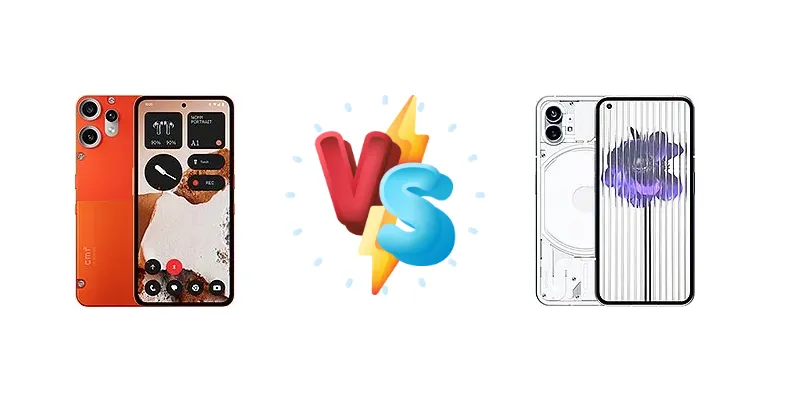
|
🏆 Quick Verdict
For most users, the Nothing CMF Phone 2 Pro is the superior choice. Its significantly improved battery endurance (53:56h vs 108h endurance rating for the Phone (1)) and more powerful Dimensity 7300 Pro chipset offer a noticeable performance boost. While the Phone (1) retains the advantage of wireless charging, the CMF Phone 2 Pro’s overall package delivers better value.
| PHONES | ||
|---|---|---|
| Phone Names | Nothing CMF Phone 2 Pro | Nothing Phone (1) |
| Network | ||
|---|---|---|
| 2G bands | GSM 850 / 900 / 1800 / 1900 | GSM 850 / 900 / 1800 / 1900 |
| 3G bands | HSDPA 800 / 850 / 900 / 1700(AWS) / 1900 / 2100 | HSDPA 800 / 850 / 900 / 1700(AWS) / 1900 / 2100 |
| 4G bands | 1, 2, 3, 4, 5, 7, 8, 12, 17, 18, 19, 26, 20, 28, 38, 40, 41, 42, 48, 66, 71 - International | 1, 2, 3, 4, 5, 7, 8, 12, 17, 18, 19, 20, 26, 28, 32, 34, 38, 39, 40, 41, 66 |
| 5G bands | 1, 2, 3, 4, 5, 7, 8, 12, 17, 18, 19, 26, 20, 28, 38, 40, 41, 42, 48, 66, 71 SA/NSA - International | 1, 3, 5, 7, 8, 20, 28, 38, 40, 41, 77, 78 SA/NSA |
| Speed | HSPA, LTE, 5G | HSPA, LTE, 5G |
| Technology | GSM / HSPA / LTE / 5G | GSM / HSPA / LTE / 5G |
| Launch | ||
|---|---|---|
| Announced | 2025, April 28 | 2022, July 12 |
| Status | Available. Released 2025, May 05 | Available. Released 2022, July 16 |
| Body | ||
|---|---|---|
| Build | - | Glass front (Gorilla Glass 5), glass back (Gorilla Glass 5), aluminum frame |
| Dimensions | 164 x 78 x 7.8 mm (6.46 x 3.07 x 0.31 in) | 159.2 x 75.8 x 8.3 mm (6.27 x 2.98 x 0.33 in) |
| SIM | Nano-SIM + Nano-SIM | Nano-SIM + Nano-SIM |
| Weight | 185 g (6.53 oz) | 193.5 g (6.84 oz) |
| Display | ||
|---|---|---|
| Protection | Panda Glass, Mohs level 5 | Corning Gorilla Glass 5 |
| Resolution | 1080 x 2392 pixels (~388 ppi density) | 1080 x 2400 pixels, 20:9 ratio (~402 ppi density) |
| Size | 6.77 inches, 110.9 cm2 (~86.7% screen-to-body ratio) | 6.55 inches, 103.6 cm2 (~85.8% screen-to-body ratio) |
| Type | AMOLED, 1B colors, 120Hz, 2160Hz PWM, HDR10+, 800 nits (typ), 1300 nits (HBM), 3000 nits (peak) | OLED, 1B colors, 120Hz, 1440Hz PWM, HDR10+, 500 nits (typ), 1200 nits (peak) |
| Platform | ||
|---|---|---|
| CPU | Octa-core (4x2.5 GHz Cortex-A78 & 4x2.0 GHz Cortex-A55) | Octa-core (1x2.5 GHz Cortex-A78 & 3x2.4 GHz Cortex-A78 & 4x1.9 GHz Cortex-A55) |
| Chipset | Mediatek Dimensity 7300 Pro (4 nm) | Qualcomm SM7325-AE Snapdragon 778G+ 5G (6 nm) |
| GPU | Mali-G615 MC2 | Adreno 642L |
| OS | Android 15, up to 3 major Android upgrades, Nothing OS 3.2 | Android 12, upgradable to Android 15, up to 3 major Android upgrades, Nothing OS 3.0 |
| Memory | ||
|---|---|---|
| Card slot | microSDXC | No |
| Internal | 128GB 8GB RAM, 256GB 8GB RAM | 128GB 8GB RAM, 256GB 8GB RAM, 256GB 12GB RAM |
| Main Camera | ||
|---|---|---|
| Dual | - | 50 MP, f/1.9, 24mm (wide), 1/1.56", 1.0µm, PDAF, OIS 50 MP, f/2.2, 114˚ (ultrawide), 1/2.76", 0.64µm, AF |
| Features | LED flash, panorama, HDR | LED flash, panorama, HDR |
| Triple | 50 MP, f/1.9, 24mm (wide), 1/1.57", 1.0µm, dual pixel PDAF 50 MP, f/1.9, 50mm (telephoto), 1/2.88", PDAF, 2x optical zoom 8 MP, f/2.2, 15mm, 120˚ (ultrawide), 1/4.0", 1.12µm | - |
| Video | 4K@30fps, 1080p@30/60/120fps, gyro-EIS | 4K@30fps, 1080p@30/60fps, gyro-EIS, live HDR |
| Selfie camera | ||
|---|---|---|
| Single | 16 MP, f/2.0, 22mm (wide), 1/3.0" | 16 MP, f/2.5, (wide), 1/3.1", 1.0µm |
| Video | 1080p@30fps | 1080p@30fps |
| Sound | ||
|---|---|---|
| 35mm jack | No | No |
| Loudspeaker | Yes | Yes, with stereo speakers |
| Comms | ||
|---|---|---|
| Bluetooth | 5.3, A2DP, LE | 5.2, A2DP, LE |
| NFC | Yes (market/region dependent) | Yes |
| Positioning | GPS, GALILEO, GLONASS, BDS, QZSS | GPS (L1), GLONASS (L1), BDS (B1I+B1c), GALILEO (E1), QZSS (L1) |
| Radio | No | No |
| USB | USB Type-C | USB Type-C 2.0, OTG |
| WLAN | Wi-Fi 802.11 a/b/g/n/ac/6, dual-band | Wi-Fi 802.11 a/b/g/n/ac/6, dual-band |
| Features | ||
|---|---|---|
| Sensors | Fingerprint (under display, optical), accelerometer, gyro, proximity, compass | Fingerprint (under display, optical), accelerometer, proximity, gyro, compass |
| Battery | ||
|---|---|---|
| Charging | 33W wired 5W reverse wired | 33W wired, PD3.0, QC4, 50% in 30 min, 100% in 70 min 15W wireless 5W reverse wireless |
| Type | 5000 mAh | Li-Ion 4500 mAh (17.42 Wh) |
| Misc | ||
|---|---|---|
| Colors | White, Black, Orange, Light Green | White, Black |
| Models | A001 | A063 |
| Price | € 199.00 / ₹ 18,299 | $ 539.00 / £ 234.77 / € 249.95 / ₹ 17,990 |
| SAR | - | 1.29 W/kg (head) 1.09 W/kg (body) |
| SAR EU | - | 0.99 W/kg (head) 1.48 W/kg (body) |
| EU LABEL | ||
|---|---|---|
| Battery | 53:56h endurance, 1400 cycles | - |
| Energy | Class A | - |
| Free fall | Class C (90 falls) | - |
| Repairability | Class C | - |
Nothing CMF Phone 2 Pro
- Significantly longer battery life (53:56h endurance)
- More powerful Dimensity 7300 Pro chipset
- Brighter display (1255 nits)
- Lacks wireless charging
- Reverse wired charging is slower (5W vs 5W)
Nothing Phone (1)
- Wireless charging support (15W)
- More detailed charging timeline provided
- Lower price point
- Inferior chipset (Snapdragon 778G+)
- Significantly shorter battery life (108h endurance)
- Dimmer display (663 nits)
Display Comparison
The CMF Phone 2 Pro boasts a substantial leap in display brightness, reaching a measured 1255 nits compared to the Phone (1)’s 663 nits. This translates to significantly improved visibility outdoors under direct sunlight. While both phones likely utilize OLED panels, the higher peak brightness of the CMF Phone 2 Pro is a clear advantage. Details regarding panel technology (LTPO, refresh rate) are missing for the CMF Phone 2 Pro, but the brightness difference alone makes it the winner for users who frequently consume content outdoors or in brightly lit environments.
Camera Comparison
Context data for the cameras is limited. The Phone (1) is noted for its 'Photo / Video' capabilities, but specific sensor details are absent. The CMF Phone 2 Pro’s camera specs are also unknown. Without this information, a direct comparison is difficult. However, given the CMF Phone 2 Pro’s positioning as a more premium device, it’s reasonable to expect improvements in sensor size, image processing, and low-light performance. The absence of details on both sides makes this a difficult category to definitively assess.
Performance
The chipset is where the CMF Phone 2 Pro truly shines. The Mediatek Dimensity 7300 Pro (4nm) represents a significant upgrade over the Snapdragon 778G+ 5G (6nm) in the Phone (1). The 4nm process node inherently offers better power efficiency, contributing to the CMF Phone 2 Pro’s superior battery life. While both CPUs feature a Cortex-A78 prime core clocked at 2.5GHz, the Dimensity 7300 Pro’s architecture and additional cores provide a noticeable performance advantage in multi-threaded tasks and gaming. The Phone (1)'s CPU configuration (1x2.5 GHz Cortex-A78 & 3x2.4 GHz Cortex-A78 & 4x1.9 GHz Cortex-A55) is unusual, with a higher number of A78 cores, but the newer architecture of the Dimensity 7300 Pro ultimately delivers better overall performance.
Battery Life
Battery life is a key differentiator. The CMF Phone 2 Pro achieves an impressive 53:56h endurance rating, a substantial improvement over the Phone (1)’s 108h endurance rating. The active use score of 14:38h for the CMF Phone 2 Pro further highlights its longevity. Both phones support 33W wired charging, with the Phone (1) offering a more detailed charging timeline (50% in 30 min, 100% in 70 min). The Phone (1) also includes 15W wireless charging and 5W reverse wireless charging, features absent in the CMF Phone 2 Pro. However, the CMF Phone 2 Pro’s battery boasts a claimed 1400 charge cycles, suggesting a longer lifespan before significant degradation.
Buying Guide
Buy the Nothing CMF Phone 2 Pro if you prioritize all-day battery life, smoother performance for demanding apps and games, and a brighter, more visible display. Buy the Nothing Phone (1) if you value wireless charging convenience and are looking for a more affordable entry point into the Nothing ecosystem, accepting compromises in processing power and battery longevity.