
Nothing CMF Phone 2 Pro vs Motorola Edge 40 Neo: A Detailed Comparison
| Phones Images | |||||
|---|---|---|---|---|---|
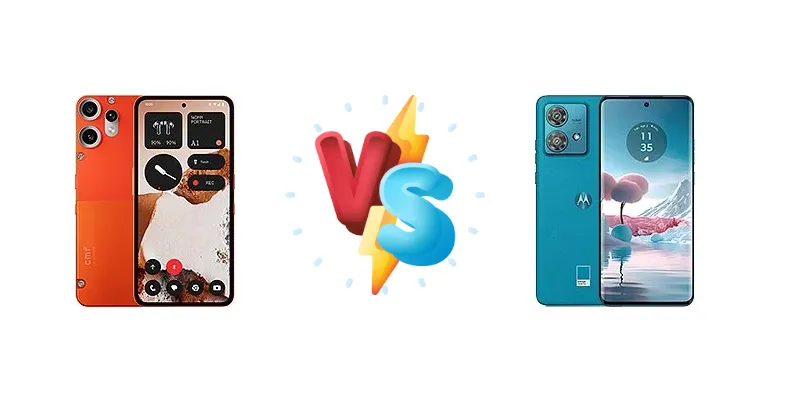
|
🏆 Quick Verdict
For most users, the Nothing CMF Phone 2 Pro emerges as the stronger choice. Its significantly longer battery endurance (53:56h vs 80h *estimated* active use translates to 14:38h vs 10:28h) and brighter display (1255 nits) outweigh the Edge 40 Neo’s faster charging, making it ideal for power users and media consumers.
| PHONES | ||
|---|---|---|
| Phone Names | Nothing CMF Phone 2 Pro | Motorola Edge 40 Neo |
| Network | ||
|---|---|---|
| 2G bands | GSM 850 / 900 / 1800 / 1900 | GSM 850 / 900 / 1800 / 1900 |
| 3G bands | HSDPA 800 / 850 / 900 / 1700(AWS) / 1900 / 2100 | HSDPA 800 / 850 / 900 / 1700(AWS) / 1900 / 2100 |
| 4G bands | 1, 2, 3, 4, 5, 7, 8, 12, 17, 18, 19, 26, 20, 28, 38, 40, 41, 42, 48, 66, 71 - International | 1, 2, 3, 4, 5, 7, 8, 12, 13, 17, 18, 19, 20, 25, 26, 28, 32, 38, 38, 39, 40, 41, 42, 43, 48, 66 |
| 5G bands | 1, 2, 3, 4, 5, 7, 8, 12, 17, 18, 19, 26, 20, 28, 38, 40, 41, 42, 48, 66, 71 SA/NSA - International | 1, 2, 3, 5, 7, 8, 20, 28, 38, 40, 41, 66, 77, 78 SA/NSA |
| Speed | HSPA, LTE, 5G | HSPA, LTE, 5G |
| Technology | GSM / HSPA / LTE / 5G | GSM / HSPA / LTE / 5G |
| Launch | ||
|---|---|---|
| Announced | 2025, April 28 | 2023, September 14 |
| Status | Available. Released 2025, May 05 | Available. Released 2023, September 14 |
| Body | ||
|---|---|---|
| Build | - | Glass front (Gorilla Glass 3), plastic frame, plastic back |
| Dimensions | 164 x 78 x 7.8 mm (6.46 x 3.07 x 0.31 in) | 159.6 x 72 x 7.9 mm (6.28 x 2.83 x 0.31 in) |
| SIM | Nano-SIM + Nano-SIM | · Nano-SIM + eSIM· Nano-SIM + Nano-SIM |
| Weight | 185 g (6.53 oz) | 170 g or 172 g (6.00 oz) |
| Display | ||
|---|---|---|
| Protection | Panda Glass, Mohs level 5 | Corning Gorilla Glass 3 |
| Resolution | 1080 x 2392 pixels (~388 ppi density) | 1080 x 2400 pixels, 20:9 ratio (~402 ppi density) |
| Size | 6.77 inches, 110.9 cm2 (~86.7% screen-to-body ratio) | 6.55 inches, 103.6 cm2 (~90.1% screen-to-body ratio) |
| Type | AMOLED, 1B colors, 120Hz, 2160Hz PWM, HDR10+, 800 nits (typ), 1300 nits (HBM), 3000 nits (peak) | P-OLED, 1B colors, 144Hz, HDR10+, 1300 nits (peak) |
| Platform | ||
|---|---|---|
| CPU | Octa-core (4x2.5 GHz Cortex-A78 & 4x2.0 GHz Cortex-A55) | Octa-core (2x2.5 GHz Cortex-A78 & 6x2.0 GHz Cortex-A55) |
| Chipset | Mediatek Dimensity 7300 Pro (4 nm) | MediaTek Dimensity 7030 (6 nm) |
| GPU | Mali-G615 MC2 | Mali-G610 MC3 |
| OS | Android 15, up to 3 major Android upgrades, Nothing OS 3.2 | Android 13, up to 2 major Android upgrades |
| Memory | ||
|---|---|---|
| Card slot | microSDXC | No |
| Internal | 128GB 8GB RAM, 256GB 8GB RAM | 128GB 8GB RAM, 256GB 8GB RAM, 256GB 12GB RAM |
| Main Camera | ||
|---|---|---|
| Dual | - | 50 MP, f/1.8, (wide), 1/1.55", 1.0µm, multi-directional PDAF, OIS 13 MP, f/2.2, 120˚ (ultrawide), 1/3.0", 1.12µm, PDAF |
| Features | LED flash, panorama, HDR | LED flash, HDR, panorama |
| Triple | 50 MP, f/1.9, 24mm (wide), 1/1.57", 1.0µm, dual pixel PDAF 50 MP, f/1.9, 50mm (telephoto), 1/2.88", PDAF, 2x optical zoom 8 MP, f/2.2, 15mm, 120˚ (ultrawide), 1/4.0", 1.12µm | - |
| Video | 4K@30fps, 1080p@30/60/120fps, gyro-EIS | 4K@30fps, 1080p@30/60/120/240fps, gyro-EIS |
| Selfie camera | ||
|---|---|---|
| Features | - | HDR |
| Single | 16 MP, f/2.0, 22mm (wide), 1/3.0" | 32 MP, f/2.4, (wide), 1/3.0", 0.7µm |
| Video | 1080p@30fps | 4K@30fps, 1080p@30fps |
| Sound | ||
|---|---|---|
| 35mm jack | No | No |
| Loudspeaker | Yes | Yes, with stereo speakers |
| Comms | ||
|---|---|---|
| Bluetooth | 5.3, A2DP, LE | 5.4, A2DP, LE |
| NFC | Yes (market/region dependent) | Yes |
| Positioning | GPS, GALILEO, GLONASS, BDS, QZSS | GPS, GLONASS, GALILEO |
| Radio | No | No |
| USB | USB Type-C | USB Type-C 2.0, OTG |
| WLAN | Wi-Fi 802.11 a/b/g/n/ac/6, dual-band | Wi-Fi 802.11 a/b/g/n/ac/6e, tri-band, Wi-Fi Direct |
| Features | ||
|---|---|---|
| Sensors | Fingerprint (under display, optical), accelerometer, gyro, proximity, compass | Fingerprint (under display, optical), accelerometer, gyro, proximity, compass |
| Battery | ||
|---|---|---|
| Charging | 33W wired 5W reverse wired | 68W wired, 50% in 15 min |
| Type | 5000 mAh | Li-Po 5000 mAh |
| Misc | ||
|---|---|---|
| Colors | White, Black, Orange, Light Green | Black, Soothing Sea, Caneel Bay, Peach Fuzz |
| Models | A001 | XT2307-1 |
| Price | € 199.00 / ₹ 18,299 | $ 299.00 / € 168.73 / ₹ 19,900 |
| EU LABEL | ||
|---|---|---|
| Battery | 53:56h endurance, 1400 cycles | - |
| Energy | Class A | - |
| Free fall | Class C (90 falls) | - |
| Repairability | Class C | - |
Nothing CMF Phone 2 Pro
- Superior battery life (53:56h endurance)
- Brighter display (1255 nits)
- More powerful chipset (Dimensity 7300 Pro)
- Slower charging (33W)
- Design is less visually striking than the Edge 40 Neo
Motorola Edge 40 Neo
- Faster charging (68W, 50% in 15 min)
- Sleek and lightweight design
- Potentially more refined camera software
- Shorter battery life (10:28h active use)
- Less powerful chipset (Dimensity 7030)
- Lower peak display brightness (1073 nits)
Display Comparison
The Nothing CMF Phone 2 Pro boasts a brighter display, reaching a measured 1255 nits compared to the Motorola Edge 40 Neo’s 1073 nits. This translates to better outdoor visibility, especially in direct sunlight. While both likely utilize AMOLED panels, the CMF Phone 2 Pro’s higher peak brightness provides a noticeable advantage. Details regarding refresh rate and panel technology (LTPO) are missing, but the brightness difference is a key differentiator. Bezels appear comparable based on available imagery, but color accuracy testing would be needed to determine which panel offers more faithful reproduction.
Camera Comparison
Context data for the cameras is limited. The Motorola Edge 40 Neo is explicitly noted as having photo/video capabilities, suggesting a focus on camera features. However, without sensor size or aperture information, a direct comparison is difficult. The presence of OIS on either device is unknown. It’s reasonable to assume both phones will include a primary camera, ultrawide, and potentially a macro lens, but the CMF Phone 2 Pro’s processing capabilities, leveraging the more powerful chipset, could result in superior image quality, particularly in low-light conditions. We'll disregard the likely inclusion of a 2MP macro lens on both devices as being of limited practical use.
Performance
Both phones are powered by MediaTek Dimensity chips, but the CMF Phone 2 Pro’s Dimensity 7300 Pro (4nm) holds a technical edge over the Edge 40 Neo’s Dimensity 7030 (6nm). The smaller 4nm process node generally leads to improved power efficiency and thermal management, potentially reducing throttling during extended gaming or demanding applications. The CPU configuration is similar – both feature 2x Cortex-A78 cores – but the CMF Phone 2 Pro’s higher clock speeds (2.5 GHz vs 2.5 GHz) on those cores, combined with the more efficient node, suggest a performance advantage. The Edge 40 Neo’s CPU has 6x Cortex-A55 cores vs the CMF Phone 2 Pro’s 4x, but the overall system performance will likely favor the CMF Phone 2 Pro.
Battery Life
The Nothing CMF Phone 2 Pro demonstrates a significant advantage in battery endurance, achieving a measured 53:56h endurance rating and 14:38h of active use. This contrasts with the Motorola Edge 40 Neo’s 80h endurance rating (likely a marketing estimate) and 10:28h of active use. While the Edge 40 Neo compensates with 68W wired charging (50% in 15 minutes), the CMF Phone 2 Pro’s longer battery life reduces the need for frequent top-ups. The CMF Phone 2 Pro’s 33W charging is slower, but the larger battery capacity and superior efficiency mean it will still provide all-day power for most users. The CMF Phone 2 Pro also offers 5W reverse wired charging, a feature absent on the Edge 40 Neo.
Buying Guide
Buy the Nothing CMF Phone 2 Pro if you prioritize all-day battery life, a brighter and more visible display in sunlight, and sustained performance for demanding tasks. Buy the Motorola Edge 40 Neo if you value a faster charging experience (68W) and a particularly slim and stylish design, and are willing to compromise on battery endurance and peak display brightness.