
Nothing CMF Phone 2 Pro vs Google Pixel 7a: A Deep Dive into Battery, Performance, and Camera
| Phones Images | |||||
|---|---|---|---|---|---|
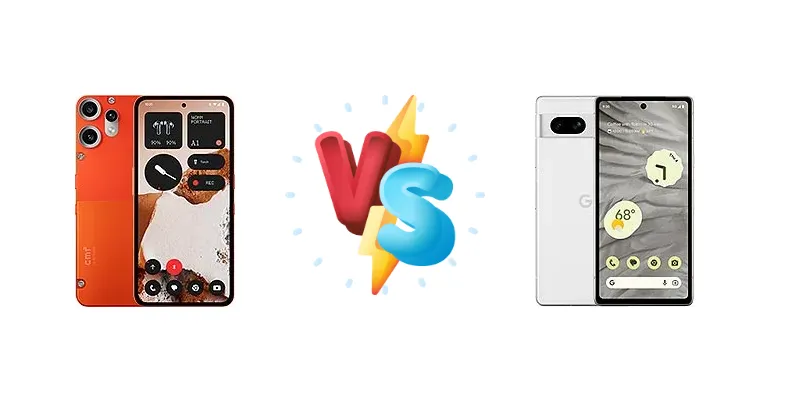
|
🏆 Quick Verdict
For the average user prioritizing all-day battery life and fast charging, the Nothing CMF Phone 2 Pro is the clear winner. Its 53:56h endurance significantly outpaces the Pixel 7a's 76h (likely an older rating), and the Dimensity 7300 Pro offers competitive performance. However, the Pixel 7a remains a compelling choice for photography enthusiasts and those deeply integrated into the Google ecosystem.
| PHONES | ||
|---|---|---|
| Phone Names | Nothing CMF Phone 2 Pro | Google Pixel 7a |
| Network | ||
|---|---|---|
| 2G bands | GSM 850 / 900 / 1800 / 1900 | GSM 850 / 900 / 1800 / 1900 |
| 3G bands | HSDPA 800 / 850 / 900 / 1700(AWS) / 1900 / 2100 | HSDPA 800 / 850 / 900 / 1700(AWS) / 1900 / 2100 |
| 4G bands | 1, 2, 3, 4, 5, 7, 8, 12, 17, 18, 19, 26, 20, 28, 38, 40, 41, 42, 48, 66, 71 - International | 1, 2, 3, 4, 5, 7, 8, 12, 13, 14, 17, 20, 25, 26, 28, 29, 30, 38, 40, 41, 48, 66, 71 - GWKK3, G0DZQ |
| 5G bands | 1, 2, 3, 4, 5, 7, 8, 12, 17, 18, 19, 26, 20, 28, 38, 40, 41, 42, 48, 66, 71 SA/NSA - International | 1, 2, 3, 5, 7, 8, 12, 14, 20, 25, 28, 30, 38, 41, 48, 66, 71, 77, 78 SA/NSA/Sub6 - GWKK3 |
| Speed | HSPA, LTE, 5G | HSPA, LTE, 5G |
| Technology | GSM / HSPA / LTE / 5G | GSM / HSPA / LTE / 5G |
| - | 1, 2, 3, 5, 7, 8, 12, 20, 25, 28, 38, 40, 41, 66, 75, 76, 77, 78, 79 SA/NSA/Sub6 - GHL1X, G82U8 | |
| Launch | ||
|---|---|---|
| Announced | 2025, April 28 | 2023, May 10 |
| Status | Available. Released 2025, May 05 | Available. Released 2023, May 10 |
| Body | ||
|---|---|---|
| Build | - | Glass front (Gorilla Glass 3), aluminum frame, plastic back |
| Dimensions | 164 x 78 x 7.8 mm (6.46 x 3.07 x 0.31 in) | 152 x 72.9 x 9 mm (5.98 x 2.87 x 0.35 in) |
| SIM | Nano-SIM + Nano-SIM | Nano-SIM + eSIM |
| Weight | 185 g (6.53 oz) | 193.5 g (6.84 oz) |
| - | IP67 dust/water resistant (up to 1m for 30 min) | |
| Display | ||
|---|---|---|
| Protection | Panda Glass, Mohs level 5 | Corning Gorilla Glass 3 |
| Resolution | 1080 x 2392 pixels (~388 ppi density) | 1080 x 2400 pixels, 20:9 ratio (~429 ppi density) |
| Size | 6.77 inches, 110.9 cm2 (~86.7% screen-to-body ratio) | 6.1 inches, 90.7 cm2 (~81.8% screen-to-body ratio) |
| Type | AMOLED, 1B colors, 120Hz, 2160Hz PWM, HDR10+, 800 nits (typ), 1300 nits (HBM), 3000 nits (peak) | OLED, HDR, 90Hz |
| - | Always-on display | |
| Platform | ||
|---|---|---|
| CPU | Octa-core (4x2.5 GHz Cortex-A78 & 4x2.0 GHz Cortex-A55) | Octa-core (2x2.85 GHz Cortex-X1 & 2x2.35 GHz Cortex-A78 & 4x1.80 GHz Cortex-A55) |
| Chipset | Mediatek Dimensity 7300 Pro (4 nm) | Google Tensor G2 (5 nm) |
| GPU | Mali-G615 MC2 | Mali-G710 MP7 |
| OS | Android 15, up to 3 major Android upgrades, Nothing OS 3.2 | Android 13, upgradable to Android 15, up to 5 major Android upgrades |
| Memory | ||
|---|---|---|
| Card slot | microSDXC | No |
| Internal | 128GB 8GB RAM, 256GB 8GB RAM | 128GB 8GB RAM |
| - | UFS 3.1 | |
| Main Camera | ||
|---|---|---|
| Dual | - | 64 MP, f/1.9, 26mm (wide), 1/1.73", 0.8µm, dual pixel PDAF, OIS 13 MP, f/2.2, 120˚ (ultrawide), 1.12µm |
| Features | LED flash, panorama, HDR | Dual-LED flash, Pixel Shift, Auto-HDR, panorama |
| Triple | 50 MP, f/1.9, 24mm (wide), 1/1.57", 1.0µm, dual pixel PDAF 50 MP, f/1.9, 50mm (telephoto), 1/2.88", PDAF, 2x optical zoom 8 MP, f/2.2, 15mm, 120˚ (ultrawide), 1/4.0", 1.12µm | - |
| Video | 4K@30fps, 1080p@30/60/120fps, gyro-EIS | 4K@30/60fps, 1080p@30/60/120/240fps, OIS |
| Selfie camera | ||
|---|---|---|
| Features | - | HDR, panorama |
| Single | 16 MP, f/2.0, 22mm (wide), 1/3.0" | 13 MP, f/2.2, 20mm (ultrawide), 1.12µm |
| Video | 1080p@30fps | 4K@30fps, 1080p@30fps |
| Sound | ||
|---|---|---|
| 3.5mm jack | - | No |
| 35mm jack | No | No |
| Loudspeaker | Yes | Yes, with stereo speakers |
| Comms | ||
|---|---|---|
| Bluetooth | 5.3, A2DP, LE | 5.3, A2DP, LE |
| NFC | Yes (market/region dependent) | Yes |
| Positioning | GPS, GALILEO, GLONASS, BDS, QZSS | GPS, GLONASS, GALILEO, BDS, QZSS, NavIC |
| Radio | No | No |
| USB | USB Type-C | USB Type-C 3.2 |
| WLAN | Wi-Fi 802.11 a/b/g/n/ac/6, dual-band | Wi-Fi 802.11 a/b/g/n/ac/6e, tri-band |
| Features | ||
|---|---|---|
| Sensors | Fingerprint (under display, optical), accelerometer, gyro, proximity, compass | Fingerprint (under display, optical), accelerometer, gyro, proximity, compass, barometer |
| Battery | ||
|---|---|---|
| Charging | 33W wired 5W reverse wired | 18W wired, PD3.0 7.5W wireless |
| Type | 5000 mAh | Li-Po 4385 mAh |
| Misc | ||
|---|---|---|
| Colors | White, Black, Orange, Light Green | Charcoal, Snow, Sea, Coral |
| Models | A001 | GWKK3, GHL1X, G0DZQ, G82U8 |
| Price | € 199.00 / ₹ 18,299 | € 179.90 / $ 150.00 / £ 170.00 / ₹ 25,980 |
| EU LABEL | ||
|---|---|---|
| Battery | 53:56h endurance, 1400 cycles | - |
| Energy | Class A | - |
| Free fall | Class C (90 falls) | - |
| Repairability | Class C | - |
Nothing CMF Phone 2 Pro
- Exceptional battery life (53:56h endurance)
- Faster 33W wired charging
- Modern and efficient Dimensity 7300 Pro chipset
- Camera performance likely trails the Pixel 7a
- Software experience may not be as refined as Google's
Google Pixel 7a
- Best-in-class camera and image processing
- Seamless Google software integration
- Strong AI capabilities with the Tensor G2
- Significantly shorter battery life
- Slower 18W wired charging
Display Comparison
The Nothing CMF Phone 2 Pro boasts a brighter display, reaching a measured 1255 nits compared to the Pixel 7a's 1070 nits. This translates to better visibility under direct sunlight. While both likely utilize OLED panels, the CMF Phone 2 Pro's higher peak brightness is a tangible advantage. Details regarding refresh rate and panel technology (LTPO vs standard OLED) are missing, but the brightness difference is a key differentiator. The Pixel 7a's color accuracy is likely superior, benefiting from Google's calibration, but the CMF Phone 2 Pro closes the gap with its higher peak output.
Camera Comparison
The Pixel 7a is renowned for its computational photography prowess, leveraging Google's image processing algorithms. While specific sensor details are missing for both, the Pixel 7a's strength lies in its software optimization. The CMF Phone 2 Pro's camera capabilities are less defined, and the inclusion of a 2MP macro lens is likely a marketing feature with limited practical benefit. The Pixel 7a's video recording capabilities are also expected to be superior, benefiting from Google's video stabilization and dynamic range processing. The Pixel 7a's OIS is a key advantage for low-light photography and stable video.
Performance
The chipset battle pits MediaTek's Dimensity 7300 Pro (4nm) against Google's Tensor G2 (5nm). While the Tensor G2 features Cortex-X1 cores for peak performance (2.85 GHz), the Dimensity 7300 Pro's architecture (4x2.5 GHz Cortex-A78 & 4x2.0 GHz Cortex-A55) offers a balanced approach. The 4nm process of the Dimensity 7300 Pro should provide better thermal efficiency, potentially leading to less throttling during sustained workloads. The Pixel 7a's Tensor G2 excels in AI-related tasks, but the CMF Phone 2 Pro delivers strong all-around performance for gaming and everyday use. RAM speeds are not specified, but both are expected to utilize LPDDR5x for fast memory access.
Battery Life
The Nothing CMF Phone 2 Pro truly shines in battery endurance, achieving a remarkable 53:56h rating and 14:38h of active use. This significantly surpasses the Pixel 7a's older 76h endurance rating. The CMF Phone 2 Pro also supports 33W wired charging, faster than the Pixel 7a's 18W wired charging with PD3.0. While the Pixel 7a offers 7.5W wireless charging, the CMF Phone 2 Pro includes 5W reverse wired charging, allowing it to top up other devices. The combination of superior endurance and faster charging makes the CMF Phone 2 Pro the clear winner for power users.
Buying Guide
Buy the Nothing CMF Phone 2 Pro if you need exceptional battery life, prioritize fast charging, and value a modern chipset for smooth daily use. Buy the Google Pixel 7a if you prefer a best-in-class camera experience, seamless Google software integration, and don't mind compromising on battery endurance for a more polished software experience.