
Nothing CMF Phone 1 vs Xiaomi Redmi Note 13 Pro 4G: A Detailed Comparison
| Phones Images | |||||
|---|---|---|---|---|---|
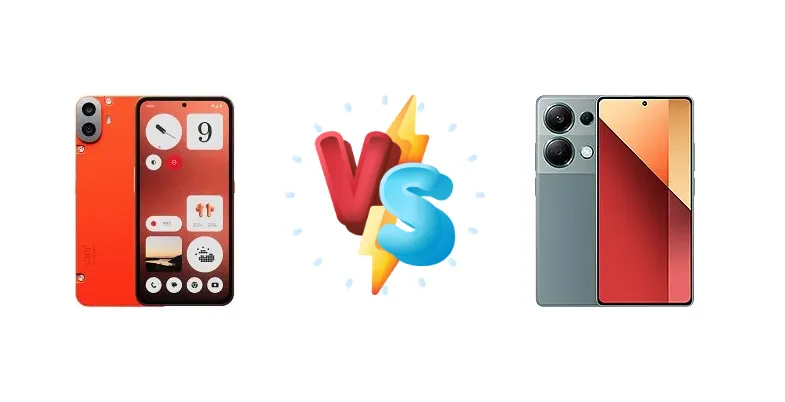
|
🏆 Quick Verdict
For the average user prioritizing sustained performance and a brighter display, the Nothing CMF Phone 1 emerges as the stronger contender. Its Dimensity 7300 chipset and superior battery life, evidenced by the 16:13 active use score, outweigh the Redmi Note 13 Pro 4G’s faster charging.
| PHONES | ||
|---|---|---|
| Phone Names | Nothing CMF Phone 1 | Xiaomi Redmi Note 13 Pro 4G |
| Network | ||
|---|---|---|
| 2G bands | GSM 850 / 900 / 1800 / 1900 | GSM 850 / 900 / 1800 / 1900 |
| 3G bands | HSDPA 800 / 850 / 900 / 1700(AWS) / 1900 / 2100 | HSDPA 850 / 900 / 1700(AWS) / 1900 / 2100 |
| 4G bands | 1, 3, 4, 5, 7, 8, 20, 28, 38, 40, 41, 66 | 1, 2, 3, 4, 5, 7, 8, 12, 13, 17, 18, 19, 20, 26, 28, 38, 40, 41, 66 |
| 5G bands | 1, 3, 5, 7, 8, 20, 28, 38, 40, 41, 66, 77, 78 SA/NSA | - |
| Speed | HSPA, LTE, 5G | HSPA, LTE |
| Technology | GSM / HSPA / LTE / 5G | GSM / HSPA / LTE |
| Launch | ||
|---|---|---|
| Announced | 2024, July 08 | 2024, January 15 |
| Status | Available. Released 2024, July 09 | Available. Released 2024, January 15 |
| Body | ||
|---|---|---|
| Build | Glass front, plastic back or silicone polymer back (eco leather) | Glass front (Gorilla Glass 5), plastic frame, plastic back |
| Dimensions | 164 x 77 x 8.2 mm (6.46 x 3.03 x 0.32 in) | 161.1 x 75 x 8 mm (6.34 x 2.95 x 0.31 in) |
| SIM | Nano-SIM + Nano-SIM | Nano-SIM + Nano-SIM |
| Weight | 197 g or 202 g (6.95 oz) | 188 g (6.63 oz) |
| Display | ||
|---|---|---|
| Protection | - | Corning Gorilla Glass 5 |
| Resolution | 1080 x 2400 pixels, 20:9 ratio (~395 ppi density) | 1080 x 2400 pixels, 20:9 ratio (~395 ppi density) |
| Size | 6.67 inches, 107.4 cm2 (~85.1% screen-to-body ratio) | 6.67 inches, 107.4 cm2 (~88.9% screen-to-body ratio) |
| Type | AMOLED, 120Hz, 960Hz PWM, 500 nits (typ), 2000 nits (peak) | AMOLED, 1B colors, 120Hz, 500 nits (typ), 1000 nits (HBM), 1300 nits (peak) |
| Platform | ||
|---|---|---|
| CPU | Octa-core (4x2.5 GHz Cortex-A78 & 4x2.0 GHz Cortex-A55) | Octa-core (2x2.2 GHz Cortex-A76 & 6x2.0 GHz Cortex-A55) |
| Chipset | Mediatek Dimensity 7300 (4 nm) | Mediatek Helio G99 Ultra |
| GPU | Mali-G615 MC2 | Mali-G57 MC2 |
| OS | Android 14, upgradable to Android 15, up to 2 major Android upgrades, Nothing OS 3.0 | Android 13, up to 3 major Android upgrades, HyperOS |
| Memory | ||
|---|---|---|
| Card slot | microSDXC | microSDXC (uses shared SIM slot) |
| Internal | 128GB 6GB RAM, 128GB 8GB RAM, 256GB 8GB RAM | 128GB 8GB RAM, 256GB 8GB RAM, 256GB 12GB RAM, 512GB 8GB RAM, 512GB 12GB RAM |
| Main Camera | ||
|---|---|---|
| Dual | 50 MP, f/1.8, (wide), PDAF Auxiliary lens | - |
| Features | LED flash, panorama, HDR | LED flash, HDR, panorama |
| Triple | - | 200 MP, f/1.7, 23mm (wide), 1/1.4", 0.56µm, multi-directional PDAF, OIS 8 MP, f/2.2, 15mm, 120˚ (ultrawide), 1/4.4", 1.0µm 2 MP (macro) |
| Video | 4K@30fps, 1080p@30/60fps, gyro-EIS | 1080p@30/60fps |
| Selfie camera | ||
|---|---|---|
| Single | 16 MP, f/2.0, (wide) | 16 MP, f/2.4, (wide), 1/3.0", 1.0µm |
| Video | 1080p@30fps | 1080p@30/60fps |
| Sound | ||
|---|---|---|
| 35mm jack | No | Yes |
| Loudspeaker | Yes | Yes, with dual speakers |
| Comms | ||
|---|---|---|
| Bluetooth | 5.3, A2DP, BLE | 5.2, A2DP, LE |
| Infrared port | - | Yes |
| NFC | No | Yes (market/region dependent) |
| Positioning | GPS, GALILEO, GLONASS, BDS, QZSS | GPS, GLONASS, GALILEO, BDS |
| Radio | No | FM radio |
| USB | USB Type-C | USB Type-C 2.0, OTG |
| WLAN | Wi-Fi 802.11 a/b/g/n/ac/6, dual-band | Wi-Fi 802.11 a/b/g/n/ac, dual-band |
| Features | ||
|---|---|---|
| Sensors | Fingerprint (under display, optical), accelerometer, gyro, proximity, compass | Fingerprint (under display, optical), accelerometer, gyro, compass |
| Battery | ||
|---|---|---|
| Charging | 33W wired 5W reverse wired | 67W wired, 50% in 16 min, 100% in 46 min |
| Type | 5000 mAh | 5000 mAh |
| Misc | ||
|---|---|---|
| Colors | Black, Orange, Light Green | Midnight Black, Lavender Purple, Forest Green |
| Models | A015 | 23117RA68G, 2312FPCA6G |
| Price | € 148.95 / ₹ 16,499 | € 92.00 / $ 269.99 / £ 299.99 |
| SAR | - | 1.09 W/kg (head) 1.09 W/kg (body) |
| SAR EU | - | 0.99 W/kg (head) 0.99 W/kg (body) |
Nothing CMF Phone 1
- Superior battery life (16:13h active use)
- Brighter display (1259 nits)
- More powerful and efficient chipset (Dimensity 7300, 4nm)
- Slower charging speed (33W)
- Camera specifications unknown
Xiaomi Redmi Note 13 Pro 4G
- Very fast charging (67W, 46 min to 100%)
- Potentially lower price point
- Xiaomi’s established camera software features
- Shorter battery life (11:36h active use)
- Less powerful chipset (Helio G99 Ultra)
- Dimmer display (1047 nits)
Display Comparison
The Nothing CMF Phone 1 boasts a significantly brighter display, reaching a measured peak of 1259 nits, compared to the Redmi Note 13 Pro 4G’s 1047 nits. This translates to better visibility outdoors under direct sunlight. While both likely utilize AMOLED panels (though not explicitly stated), the higher brightness of the CMF Phone 1 provides a more vibrant and usable experience. The lack of information on refresh rates or panel technology (LTPO) for either device makes a deeper analysis difficult, but the brightness difference is a clear win for the CMF Phone 1.
Camera Comparison
The context data for the Redmi Note 13 Pro 4G mentions 'Photo / Video' but provides no specifics. Given Xiaomi’s history, it likely features a high-resolution main sensor, but without knowing the sensor size, aperture, or OIS implementation, a direct comparison is impossible. The CMF Phone 1’s camera specs are also missing. However, focusing on the usable aspects, image processing will be a key differentiator. Xiaomi often leans towards more saturated and contrast-boosted images, while Nothing typically aims for a more natural look. Without sample images, it’s difficult to declare a winner, but sensor size and OIS (if present) will be crucial.
Performance
The core difference lies in the chipsets: the Nothing CMF Phone 1 utilizes the Mediatek Dimensity 7300 (4nm), while the Redmi Note 13 Pro 4G features the Helio G99 Ultra. The Dimensity 7300, built on a more efficient 4nm process, offers a substantial advantage in both raw performance and thermal management. Its octa-core configuration (4x2.5 GHz Cortex-A78 & 4x2.0 GHz Cortex-A55) is architecturally superior to the Helio G99 Ultra’s (2x2.2 GHz Cortex-A76 & 6x2.0 GHz Cortex-A55). This means the CMF Phone 1 will likely exhibit less throttling during prolonged gaming or intensive tasks. The Redmi Note 13 Pro 4G’s G99 Ultra is a capable chip, but it’s geared towards efficiency rather than outright speed.
Battery Life
The Nothing CMF Phone 1 delivers a significantly longer active use battery life of 16:13 hours, compared to the Redmi Note 13 Pro 4G’s 11:36 hours. This nearly 5-hour difference is substantial and highlights the efficiency gains of the Dimensity 7300’s 4nm process. While the Redmi Note 13 Pro 4G compensates with 67W wired charging (0-100% in 46 minutes), compared to the CMF Phone 1’s 33W charging, the longer runtime of the CMF Phone 1 reduces the need for frequent top-ups. The Redmi Note 13 Pro 4G’s faster charging is convenient, but the CMF Phone 1’s superior battery life offers a more practical benefit for most users.
Buying Guide
Buy the Nothing CMF Phone 1 if you need a phone that can handle demanding applications and extended use without significant performance throttling, and if display brightness is a key factor. Buy the Xiaomi Redmi Note 13 Pro 4G if you prioritize incredibly fast charging and are willing to trade some sustained performance and display quality for that convenience.