
Nothing CMF Phone 1 vs Motorola Edge 50 Fusion: A Deep Dive Comparison
| Phones Images | |||||
|---|---|---|---|---|---|
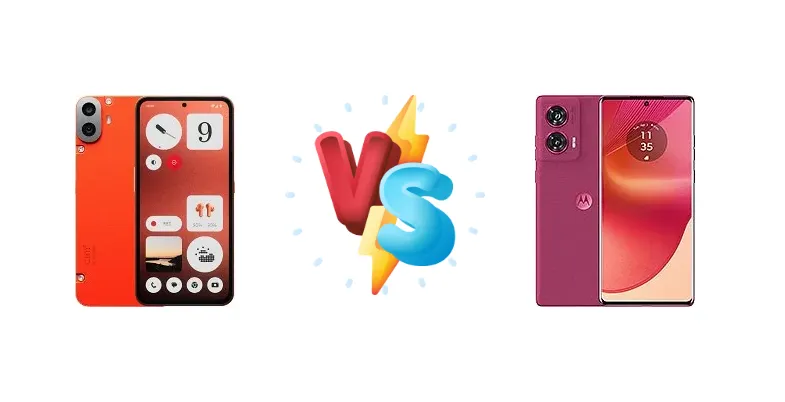
|
🏆 Quick Verdict
For users prioritizing all-day battery life and a consistently smooth experience, the Nothing CMF Phone 1 emerges as the winner. Its 16:13 active use score significantly outpaces the Edge 50 Fusion’s 12:40h, making it ideal for power users. However, the Motorola Edge 50 Fusion’s 68W charging is a compelling advantage for those who value speed.
| PHONES | ||
|---|---|---|
| Phone Names | Nothing CMF Phone 1 | Motorola Edge 50 Fusion |
| Network | ||
|---|---|---|
| 2G bands | GSM 850 / 900 / 1800 / 1900 | GSM 850 / 900 / 1800 / 1900 |
| 3G bands | HSDPA 800 / 850 / 900 / 1700(AWS) / 1900 / 2100 | HSDPA 850 / 900 / 1900 / 2100 |
| 4G bands | 1, 3, 4, 5, 7, 8, 20, 28, 38, 40, 41, 66 | 1, 2, 3, 5, 7, 8, 18, 19, 20, 26, 28, 32, 38, 40, 41, 42, 71 - International |
| 5G bands | 1, 3, 5, 7, 8, 20, 28, 38, 40, 41, 66, 77, 78 SA/NSA | 1, 3, 5, 7, 8, 20, 26, 28, 38, 40, 41, 77, 78 SA/NSA |
| Speed | HSPA, LTE, 5G | HSPA, LTE, 5G |
| Technology | GSM / HSPA / LTE / 5G | GSM / HSPA / LTE / 5G |
| Launch | ||
|---|---|---|
| Announced | 2024, July 08 | 2024, April 16 |
| Status | Available. Released 2024, July 09 | Available. Released 2024, May 15 |
| Body | ||
|---|---|---|
| Build | Glass front, plastic back or silicone polymer back (eco leather) | Glass front, silicone polymer back (eco leather), plastic frame |
| Dimensions | 164 x 77 x 8.2 mm (6.46 x 3.03 x 0.32 in) | 161.9 x 73.1 x 7.9 mm (6.37 x 2.88 x 0.31 in) |
| SIM | Nano-SIM + Nano-SIM | · Nano-SIM + eSIM· Nano-SIM + Nano-SIM |
| Weight | 197 g or 202 g (6.95 oz) | 174.9 g (6.17 oz) |
| Display | ||
|---|---|---|
| Protection | - | Corning Gorilla Glass 5 |
| Resolution | 1080 x 2400 pixels, 20:9 ratio (~395 ppi density) | 1080 x 2400 pixels, 20:9 ratio (~393 ppi density) |
| Size | 6.67 inches, 107.4 cm2 (~85.1% screen-to-body ratio) | 6.7 inches, 108.4 cm2 (~91.6% screen-to-body ratio) |
| Type | AMOLED, 120Hz, 960Hz PWM, 500 nits (typ), 2000 nits (peak) | P-OLED, 1B colors, 120Hz (LATAM), 144Hz (INT), 1600 nits (peak) |
| Platform | ||
|---|---|---|
| CPU | Octa-core (4x2.5 GHz Cortex-A78 & 4x2.0 GHz Cortex-A55) | Octa-core (4x2.40 GHz Cortex-A78 & 4x1.95 GHz Cortex-A55) - InternationalOcta-core (4x2.2 GHz Cortex-A78 & 4x1.8 GHz Cortex-A55) - LATAM |
| Chipset | Mediatek Dimensity 7300 (4 nm) | Qualcomm SM7435-AB Snapdragon 7s Gen 2 (4 nm) - InternationalQualcomm SM6450 Snapdragon 6 Gen 1 (4 nm) - LATAM |
| GPU | Mali-G615 MC2 | Adreno 710 |
| OS | Android 14, upgradable to Android 15, up to 2 major Android upgrades, Nothing OS 3.0 | Android 14, upgradable to Android 15, up to 3 major Android upgrades |
| Memory | ||
|---|---|---|
| Card slot | microSDXC | No |
| Internal | 128GB 6GB RAM, 128GB 8GB RAM, 256GB 8GB RAM | 128GB 8GB RAM, 256GB 8GB RAM, 256GB 12GB RAM, 512GB 8GB RAM, 512GB 12GB RAM |
| Main Camera | ||
|---|---|---|
| Dual | 50 MP, f/1.8, (wide), PDAF Auxiliary lens | 50 MP, f/1.9, (wide), 1/1.56", 1.0µm, multi-directional PDAF, OIS 13 MP, f/2.2, 120˚ (ultrawide), 1/3.0", 1.12µm, AF |
| Features | LED flash, panorama, HDR | LED flash, HDR, panorama |
| Video | 4K@30fps, 1080p@30/60fps, gyro-EIS | 4K@30fps, 1080p@30/60/120fps, gyro-EIS |
| Selfie camera | ||
|---|---|---|
| Features | - | HDR |
| Single | 16 MP, f/2.0, (wide) | 32 MP, f/2.5, (wide), 1/3.14", 0.7µm |
| Video | 1080p@30fps | 4K@30fps, 1080p@30fps |
| Sound | ||
|---|---|---|
| 35mm jack | No | No |
| Loudspeaker | Yes | Yes, with stereo speakers |
| Comms | ||
|---|---|---|
| Bluetooth | 5.3, A2DP, BLE | 5.2, A2DP, LE |
| NFC | No | Yes |
| Positioning | GPS, GALILEO, GLONASS, BDS, QZSS | GPS, GLONASS, GALILEO |
| Radio | No | No |
| USB | USB Type-C | USB Type-C 2.0, OTG |
| WLAN | Wi-Fi 802.11 a/b/g/n/ac/6, dual-band | Wi-Fi 802.11 a/b/g/n/ac, dual-band |
| Features | ||
|---|---|---|
| Sensors | Fingerprint (under display, optical), accelerometer, gyro, proximity, compass | Fingerprint (under display, optical), accelerometer, gyro, proximity, compass |
| Battery | ||
|---|---|---|
| Charging | 33W wired 5W reverse wired | 68W wired, 50% in 15 min |
| Type | 5000 mAh | 5000 mAh |
| Misc | ||
|---|---|---|
| Colors | Black, Orange, Light Green | Forest Blue, Marshmallow Blue, Hot Pink |
| Models | A015 | XT2429-1 |
| Price | € 148.95 / ₹ 16,499 | € 208.99 / $ 245.00 / ₹ 18,667 |
Nothing CMF Phone 1
- Exceptional battery life (16:13h active use)
- Potentially stronger CPU performance with Dimensity 7300
- 5W reverse wired charging for accessory top-ups
- Slightly lower peak display brightness
- Slower charging speed (33W)
Motorola Edge 50 Fusion
- Brighter display (1322 nits)
- Ultra-fast 68W charging (50% in 15 min)
- Snapdragon 7s Gen 2 offers strong GPU performance (International version)
- Shorter battery life (12:40h active use)
- Regional chipset variation impacts performance (LATAM version)
Display Comparison
Both devices feature 4nm chipsets, but their displays differ noticeably. The Motorola Edge 50 Fusion boasts a slightly brighter panel at 1322 nits compared to the CMF Phone 1’s 1259 nits, offering better visibility in direct sunlight. While the difference isn’t massive, it’s measurable. Neither specification details refresh rate or panel type (OLED/LCD), but given the market segment, OLED is highly probable for both. The impact of these brightness levels is most felt by users who consume a lot of outdoor content.
Camera Comparison
Without detailed camera specifications, a direct comparison is limited. However, focusing on the chipsets, the image signal processors (ISPs) within the Dimensity 7300 and Snapdragon 7s Gen 2 are capable of handling high-resolution sensors and advanced image processing. The absence of information regarding sensor size and optical image stabilization (OIS) makes it difficult to assess image quality definitively. Users should be wary of marketing hype surrounding 2MP macro lenses, as their utility is often minimal.
Performance
The performance landscape is more complex. The Nothing CMF Phone 1 utilizes the Mediatek Dimensity 7300, a 4nm chip with an octa-core configuration (4x2.5 GHz Cortex-A78 & 4x2.0 GHz Cortex-A55). The Motorola Edge 50 Fusion’s chipset varies by region: the international version gets the Qualcomm SM7435-AB Snapdragon 7s Gen 2 (also 4nm), while the LATAM version receives the less powerful Snapdragon 6 Gen 1. The Dimensity 7300’s higher Cortex-A78 clock speed suggests a slight edge in CPU-intensive tasks. However, the Snapdragon 7s Gen 2 often demonstrates superior GPU performance, potentially benefiting gamers. The regional chipset variation in the Edge 50 Fusion introduces a significant performance disparity for LATAM buyers.
Battery Life
The Nothing CMF Phone 1’s battery life is a clear standout, achieving a measured 16:13 hours of active use. This is a substantial improvement over the Motorola Edge 50 Fusion’s 12:40 hours. While the Edge 50 Fusion compensates with significantly faster 68W wired charging (claiming 50% in 15 minutes), the CMF Phone 1’s longer runtime reduces the need for frequent top-ups. The CMF Phone 1 also offers 5W reverse wired charging, a feature absent in the Motorola, allowing it to charge accessories on the go.
Buying Guide
Buy the Nothing CMF Phone 1 if you need exceptional battery endurance for demanding daily use, and appreciate a clean software experience. It’s the choice for users who prioritize longevity over the absolute fastest charging speeds. Buy the Motorola Edge 50 Fusion if you prefer a brighter display and value the convenience of incredibly fast 68W charging, even if it means sacrificing some battery life. It’s geared towards users who frequently top up their phones throughout the day.