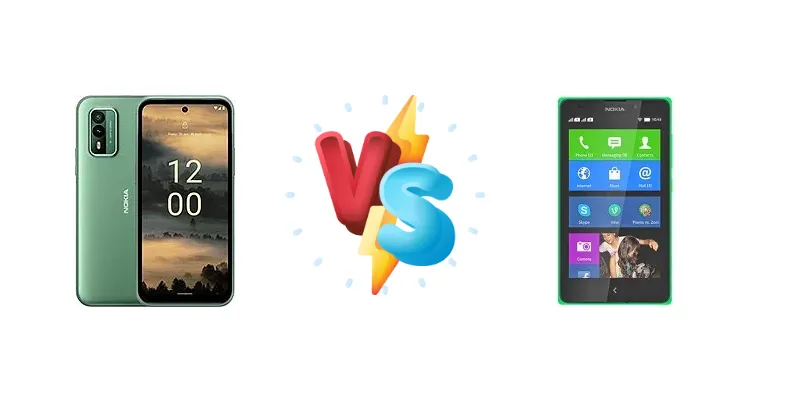
Nokia's legacy in mobile phones is undeniable, spanning decades of innovation. Today, we pit two distinct Nokia devices against each other: the modern, rugged Nokia XR21 and the older, legendary Nokia XL. This comparison explores their strengths and weaknesses to help you decide which phone best suits your needs.
🏆 Quick Verdict
The Nokia XR21 is the clear winner in terms of performance and features, boasting a modern chipset, 5G connectivity, and a more versatile camera. While the Nokia XL's incredible battery life is impressive, its outdated hardware makes it a niche choice for those prioritizing longevity over everything else.
| Network |
|---|
| 2G bands | GSM 850 / 900 / 1800 / 1900 | GSM 850 / 900 / 1800 / 1900 - SIM 1 & SIM 2 (dual-SIM model only) |
| 3G bands | HSDPA 850 / 900 / 1700(AWS) / 1900 / 2100 | HSDPA 900 / 2100 |
| 4G bands | 1, 2, 3, 4, 5, 7, 8, 12, 13, 17, 20, 25, 26, 28, 32, 38, 39, 40, 41, 42, 43, 48, 66, 71 | - |
| 5G bands | 1, 2, 3, 5, 7, 20, 25, 28, 40, 41, 66, 71, 77, 78, 79 SA/NSA | - |
| Speed | HSPA, LTE, 5G | HSPA 7.2/5.76 Mbps |
| Technology | GSM / HSPA / LTE / 5G | GSM / HSPA |
| | - | GSM 850 / 900 / 1800 / 1900 |
| Launch |
|---|
| Announced | 2023, May 03 | 2014, February. Released 2014, May |
| Status | Available. Released 2023, June 11 | Discontinued |
| Body |
|---|
| Build | Glass front (Gorilla Glass Victus), plastic back, plastic frame | - |
| Dimensions | 168 x 78.6 x 10.5 mm (6.61 x 3.09 x 0.41 in) | 141.4 x 77.7 x 10.9 mm, 109 cc (5.57 x 3.06 x 0.43 in) |
| SIM | Nano-SIM + Nano-SIM + eSIM (max 2 at a time) | Single SIM (Micro-SIM) or Dual SIM (Micro-SIM, dual stand-by) |
| Weight | 231 g (8.15 oz) | 190 g (6.70 oz) |
| | IP68/IP69K dust/water resistant (up to 1.5m for 60 min)
Drop-to-concrete resistance from up to 1.8m
MIL-STD-810H compliant | - |
| Display |
|---|
| Protection | Corning Gorilla Glass Victus | - |
| Resolution | 1080 x 2400 pixels, 20:9 ratio (~406 ppi density) | 480 x 800 pixels, 5:3 ratio (~187 ppi density) |
| Size | 6.49 inches, 101.7 cm2 (~77.0% screen-to-body ratio) | 5.0 inches, 71.2 cm2 (~64.8% screen-to-body ratio) |
| Type | IPS LCD, 120Hz, 450 nits (typ), 550 nits (HBM) | IPS LCD |
| Platform |
|---|
| CPU | Octa-core (2x2.2 GHz Kryo 660 Gold & 6x1.7 GHz Kryo 660 Silver) | Dual-core 1.0 GHz Cortex-A5 |
| Chipset | Qualcomm SM6375 Snapdragon 695 5G (6 nm) | Qualcomm MSM8225 Snapdragon S4 Play |
| GPU | Adreno 619 | Adreno 203 |
| OS | Android 12 | Android 4.1.2 (Jelly Bean), X platform 1 |
| Memory |
|---|
| Card slot | Unspecified | microSDHC (dedicated slot) |
| Internal | 128GB 6GB RAM | 4GB 768MB RAM |
| Main Camera |
|---|
| Dual | 64 MP, f/1.8, (wide), 1/2.0", PDAF
8 MP, f/2.2, (ultrawide), 1/4.0", 1.12µm | - |
| Features | Dual-LED dual-tone flash, second LED flash, HDR, panorama | LED flash, panorama |
| Single | - | 5 MP, f/2.8, 32mm (standard), 1/4.0", AF |
| Video | 1080p@30fps | 480p@30fps |
| Selfie camera |
|---|
| Single | 16 MP, f/2.4 (wide) | 2 MP |
| Video | 1080p@30fps | - |
| Sound |
|---|
| 3.5mm jack | Yes | Yes |
| 35mm jack | Yes | Yes |
| Loudspeaker | Yes, with stereo speakers | Yes |
| Comms |
|---|
| Bluetooth | 5.1, A2DP, LE, aptX Adaptive | 3.0, A2DP |
| NFC | Yes (market/region dependent) | No |
| Positioning | GPS (L1+L5), GLONASS (G1), BDS (B1I+B1c+B2a), GALILEO (E1+E5a), QZSS (L1+L5), NavIC (L5) | GPS |
| Radio | Unspecified | Stereo FM radio |
| USB | USB Type-C 2.0, OTG | microUSB 2.0 |
| WLAN | Wi-Fi 802.11 a/b/g/n/ac/6, dual-band | Wi-Fi 802.11 b/g/n, hotspot |
| Features |
|---|
| Sensors | Fingerprint (side-mounted), accelerometer, gyro, proximity, compass, barometer | Accelerometer, proximity |
| Battery |
|---|
| Charging | 33W wired, PD2.0, QC3 | - |
| Music play | - | Up to 37 h |
| Stand-by | - | Up to 720 h |
| Talk time | - | Up to 16 h (2G) / Up to 13 h (3G) |
| Type | Li-Po 4800 mAh | Li-Ion 2000 mAh, removable (BN-02) |
| Misc |
|---|
| Colors | Midnight Black, Pine Green | Bright green, orange, cyan, yellow, black, white |
| Price | About 570 EUR | About 100 EUR |
| SAR | - | 0.89 W/kg (head) 1.07 W/kg (body) |
| SAR EU | - | 0.67 W/kg (head) |
| Tests |
|---|
| Battery life | - |
Endurance rating 62h
|
| Camera | - |
Photo |
| Display | - |
Contrast ratio: 874:1 (nominal), 1.204 (sunlight) |
| Loudspeaker | - |
Voice 66dB / Noise 65dB / Ring 76dB
|
Nokia XR21
- Modern Chipset (Snapdragon 695 5G)
- 5G Connectivity
- Faster Charging (33W)
- More Responsive Performance
- Likely Better Camera Quality
- Battery life not as exceptional as XL
- Potentially more expensive
Nokia XL
- Exceptional Battery Life (62h Endurance)
- Excellent Sunlight Visibility
- Simple and Durable Design
- Outdated Hardware
- Slow Performance
- Limited App Compatibility
- Low-Resolution Display
Display Comparison
The Nokia XR21 features a modern display, likely with a higher resolution and improved color accuracy compared to the Nokia XL's older panel. While both boast impressive contrast ratios (874:1 nominal, 1204:1 sunlight), the XR21's display will likely offer a more vibrant and detailed viewing experience. The XL's display is known for its excellent outdoor visibility.
Camera Comparison
The Nokia XR21 likely has a more advanced camera system with higher resolution sensors and improved image processing capabilities. While both are described as 'Photo' cameras, the XR21's modern hardware will result in better image quality, especially in low-light conditions. The XL's camera is basic by today's standards.
Performance
Here, the XR21 dominates. Its Snapdragon 695 5G chipset and Octa-core CPU offer significantly more processing power than the Nokia XL's dual-core Snapdragon S4 Play. Expect smoother multitasking, faster app loading times, and a more responsive user interface on the XR21. The XL will struggle with modern apps and demanding tasks.
Battery Life
The Nokia XL's legendary endurance rating of 62 hours is its standout feature. While the XR21's 33W charging is faster, the XL's battery capacity and power efficiency likely contribute to its exceptional longevity. However, the XR21's battery is likely larger in absolute terms, offering a good balance between capacity and charging speed.
Buying Guide
The Nokia XR21 is ideal for users seeking a durable smartphone with decent performance, 5G capabilities, and a modern Android experience. The Nokia XL is a better fit for users who prioritize extreme battery life above all else and are comfortable with a basic, older smartphone experience.
Frequently Asked Questions
❓ Is the Nokia XL still worth buying?
The Nokia XL is only worth buying if extreme battery life is your absolute top priority and you're comfortable with a very basic smartphone experience. Otherwise, modern alternatives offer significantly better performance and features.
❓ What makes the Nokia XR21 rugged?
The Nokia XR21 is built to withstand drops, dust, and water, typically featuring reinforced materials and a durable design. Specific ruggedness certifications (like IP68) would confirm its level of protection.