
Nokia XR21 vs Nokia X30: A Head-to-Head Comparison
| Phones Images | |||||
|---|---|---|---|---|---|
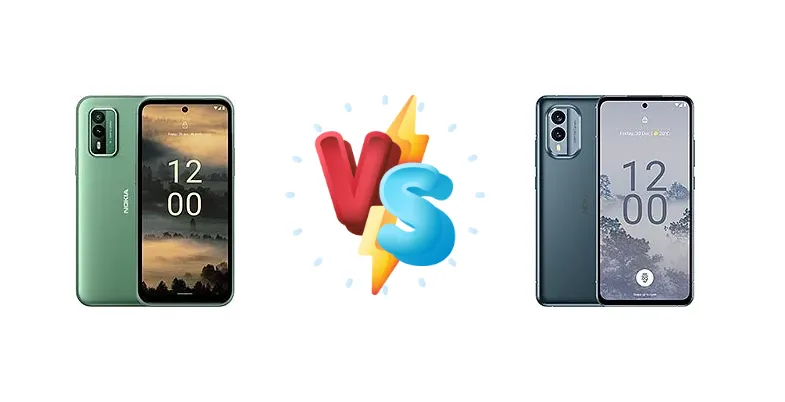
|
🏆 Quick Verdict
The Nokia X30 shines with its exceptional battery life and impressive display brightness. However, the XR21’s rugged design and enhanced durability make it a better choice for those needing a phone that can withstand tougher conditions. It's a close call, depending on your priorities.
| PHONES | ||
|---|---|---|
| Phone Names | Nokia XR21 | Nokia X30 |
| Network | ||
|---|---|---|
| 2G bands | GSM 850 / 900 / 1800 / 1900 | GSM 850 / 900 / 1800 / 1900 |
| 3G bands | HSDPA 850 / 900 / 1700(AWS) / 1900 / 2100 | HSDPA 850 / 900 / 1700(AWS) / 1900 / 2100 |
| 4G bands | 1, 2, 3, 4, 5, 7, 8, 12, 13, 17, 20, 25, 26, 28, 32, 38, 39, 40, 41, 42, 43, 48, 66, 71 | 1, 2, 3, 4, 5, 7, 8, 12, 17, 20, 28, 32, 38, 39, 40, 41 |
| 5G bands | 1, 2, 3, 5, 7, 20, 25, 28, 40, 41, 66, 71, 77, 78, 79 SA/NSA | 1, 3, 5, 7, 8, 28, 38, 40, 41, 77, 78 SA/NSA/Sub6 |
| Speed | HSPA, LTE, 5G | HSPA, LTE, 5G |
| Technology | GSM / HSPA / LTE / 5G | GSM / HSPA / LTE / 5G |
| Launch | ||
|---|---|---|
| Announced | 2023, May 03 | 2022, September 01 |
| Status | Available. Released 2023, June 11 | Available. Released 2022, September 21 |
| Body | ||
|---|---|---|
| Build | Glass front (Gorilla Glass Victus), plastic back, plastic frame | Glass front (Gorilla Glass Victus), aluminum frame, plastic back |
| Dimensions | 168 x 78.6 x 10.5 mm (6.61 x 3.09 x 0.41 in) | 158.9 x 73.9 x 8 mm (6.26 x 2.91 x 0.31 in) |
| SIM | Nano-SIM + Nano-SIM + eSIM (max 2 at a time) | · Nano-SIM + eSIM· Nano-SIM + Nano-SIM |
| Weight | 231 g (8.15 oz) | 185 g (6.53 oz) |
| IP68/IP69K dust/water resistant (up to 1.5m for 60 min) Drop-to-concrete resistance from up to 1.8m MIL-STD-810H compliant | IP67 dust/water resistant (up to 1m for 30 min) | |
| Display | ||
|---|---|---|
| Protection | Corning Gorilla Glass Victus | Corning Gorilla Glass Victus |
| Resolution | 1080 x 2400 pixels, 20:9 ratio (~406 ppi density) | 1080 x 2400 pixels, 20:9 ratio (~409 ppi density) |
| Size | 6.49 inches, 101.7 cm2 (~77.0% screen-to-body ratio) | 6.43 inches, 99.8 cm2 (~85.0% screen-to-body ratio) |
| Type | IPS LCD, 120Hz, 450 nits (typ), 550 nits (HBM) | AMOLED, 90Hz, 450 nits (typ), 700 nits (peak) |
| Platform | ||
|---|---|---|
| CPU | Octa-core (2x2.2 GHz Kryo 660 Gold & 6x1.7 GHz Kryo 660 Silver) | Octa-core (2x2.2 GHz Kryo 660 Gold & 6x1.7 GHz Kryo 660 Silver) |
| Chipset | Qualcomm SM6375 Snapdragon 695 5G (6 nm) | Qualcomm SM6375 Snapdragon 695 5G (6 nm) |
| GPU | Adreno 619 | Adreno 619 |
| OS | Android 12 | Android 12, upgradable to Android 13 |
| Memory | ||
|---|---|---|
| Card slot | Unspecified | No |
| Internal | 128GB 6GB RAM | 128GB 6GB RAM, 128GB 8GB RAM, 256GB 8GB RAM |
| - | UFS 2.2 - 128GB UFS 3.0 - 256GB | |
| Main Camera | ||
|---|---|---|
| Dual | 64 MP, f/1.8, (wide), 1/2.0", PDAF 8 MP, f/2.2, (ultrawide), 1/4.0", 1.12µm | 50 MP, f/1.9, (wide), 1/1.56", 1.0µm, PDAF, OIS 13 MP, f/2.4, 123˚ (ultrawide), 1/3.06" |
| Features | Dual-LED dual-tone flash, second LED flash, HDR, panorama | LED flash, HDR, panorama |
| Single | - | 16 MP, f/2.4, (wide), 1/3.06", 1.0µm |
| Video | 1080p@30fps | 1080p@30/60fps |
| Selfie camera | ||
|---|---|---|
| Single | 16 MP, f/2.4 (wide) | 16 MP, f/2.4, (wide), 1/3.06", 1.0µm |
| Video | 1080p@30fps | 1080p@30fps |
| Sound | ||
|---|---|---|
| 3.5mm jack | Yes | No |
| 35mm jack | Yes | No |
| Loudspeaker | Yes, with stereo speakers | Yes |
| Comms | ||
|---|---|---|
| Bluetooth | 5.1, A2DP, LE, aptX Adaptive | 5.1, A2DP, LE, aptX HD |
| NFC | Yes (market/region dependent) | Yes |
| Positioning | GPS (L1+L5), GLONASS (G1), BDS (B1I+B1c+B2a), GALILEO (E1+E5a), QZSS (L1+L5), NavIC (L5) | GPS, GLONASS, GALILEO, BDS |
| Radio | Unspecified | FM radio, RDS |
| USB | USB Type-C 2.0, OTG | USB Type-C 2.0, OTG |
| WLAN | Wi-Fi 802.11 a/b/g/n/ac/6, dual-band | Wi-Fi 802.11 a/b/g/n/ac/6, dual-band, Wi-Fi Direct |
| Features | ||
|---|---|---|
| Sensors | Fingerprint (side-mounted), accelerometer, gyro, proximity, compass, barometer | Fingerprint (under display, optical), accelerometer, gyro, proximity, compass |
| Battery | ||
|---|---|---|
| Charging | 33W wired, PD2.0, QC3 | 33W wired, PD3.0 |
| Type | Li-Po 4800 mAh | Li-Po 4200 mAh |
| Misc | ||
|---|---|---|
| Colors | Midnight Black, Pine Green | Cloudy Blue, Ice White |
| Models | - | TA-1450, TA-1443 |
| Price | About 570 EUR | $ 399.00 |
| SAR EU | - | 0.79 W/kg (head) 1.37 W/kg (body) |
| Tests | ||
|---|---|---|
| Battery life | - | Endurance rating 94h |
| Camera | - | Photo / Video |
| Display | - | Contrast ratio: Infinite (nominal) |
| Loudspeaker | - | -27.5 LUFS (Good) |
| Performance | - | AnTuTu: 403732 (v9) GeekBench: 1920 (v5.1) GFXBench: 17fps (ES 3.1 onscreen) |
Nokia XR21
- Rugged and durable design
- Enhanced drop resistance
- 33W fast charging (PD2.0, QC3)
- Reliable performance
- Less bright display compared to X30
- Battery life not as impressive as X30
- Camera details are limited
Nokia X30
- Exceptional battery life (94h endurance)
- Brighter display (746 nits)
- Modern design
- 33W fast charging (PD3.0)
- Less rugged than XR21
- Camera details are limited
- Nominal 'infinite' contrast ratio is marketing
Display Comparison
The Nokia X30 takes the lead in display quality. While both phones feature similar panels, the X30's measured 746 nits max brightness significantly outperforms the XR21, making it easier to see in direct sunlight. The X30's 'infinite' contrast ratio (nominal) suggests deeper blacks and better overall image quality, though this is a marketing term. The XR21's display is perfectly adequate, but not as visually impressive.
Camera Comparison
Camera performance is likely similar given the shared chipset. Both phones offer Photo/Video capabilities, but detailed camera specs (megapixels, aperture, features) are missing. Expect decent image quality in good lighting conditions, but potentially struggles in low light. A full camera comparison would require more detailed specifications and testing.
Performance
Both phones share the same Snapdragon 695 5G chipset and CPU configuration, meaning performance will be largely identical. Expect smooth everyday usage, capable multitasking, and decent gaming performance at moderate settings. Neither phone is a powerhouse, but both handle common tasks with ease.
Battery Life
The Nokia X30 boasts an outstanding endurance rating of 94 hours, a significant advantage over the XR21. This translates to exceptional battery life, easily lasting multiple days on a single charge. The XR21's battery life is respectable, but not in the same league as the X30.
Buying Guide
Who should buy the Nokia XR21? Users prioritizing durability, ruggedness, and a phone that can handle drops and bumps. Who should buy the Nokia X30? Users seeking long battery life, a brighter display for outdoor use, and a more streamlined, modern design.