
Nokia XR21 vs Nokia X20: A Detailed Comparison
| Phones Images | |||||
|---|---|---|---|---|---|
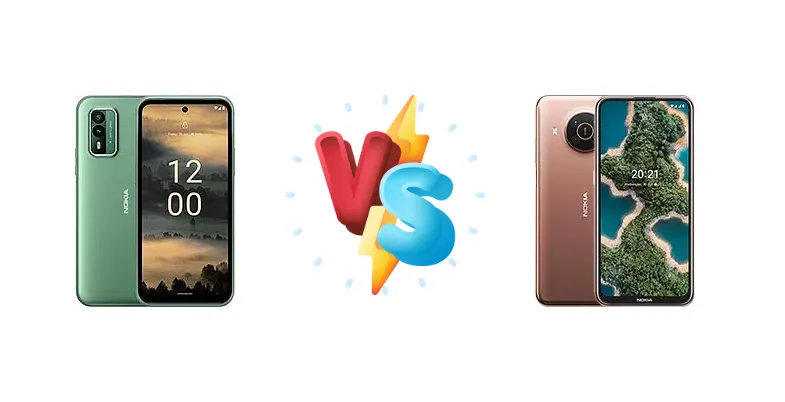
|
🏆 Quick Verdict
The Nokia XR21 clearly wins thanks to its significantly faster Snapdragon 695 chipset, faster charging, and rugged design. While the X20 offers a clean Android experience, the XR21's performance and durability make it the superior option for most users.
| PHONES | ||
|---|---|---|
| Phone Names | Nokia XR21 | Nokia X20 |
| Network | ||
|---|---|---|
| 2G bands | GSM 850 / 900 / 1800 / 1900 | GSM 850 / 900 / 1800 / 1900 |
| 3G bands | HSDPA 850 / 900 / 1700(AWS) / 1900 / 2100 | HSDPA 850 / 900 / 1700(AWS) / 1900 / 2100 |
| 4G bands | 1, 2, 3, 4, 5, 7, 8, 12, 13, 17, 20, 25, 26, 28, 32, 38, 39, 40, 41, 42, 43, 48, 66, 71 | 1, 2, 3, 4, 5, 7, 8, 12, 20, 28, 66, 38, 39, 40, 41 |
| 5G bands | 1, 2, 3, 5, 7, 20, 25, 28, 40, 41, 66, 71, 77, 78, 79 SA/NSA | 1, 2, 3, 5, 7, 28, 38, 41, 66, 78 SA/NSA/Sub6 |
| Speed | HSPA, LTE, 5G | HSPA, LTE, 5G |
| Technology | GSM / HSPA / LTE / 5G | GSM / HSPA / LTE / 5G |
| Launch | ||
|---|---|---|
| Announced | 2023, May 03 | 2021, April 08 |
| Status | Available. Released 2023, June 11 | Available. Released 2021, May 12 |
| Body | ||
|---|---|---|
| Build | Glass front (Gorilla Glass Victus), plastic back, plastic frame | - |
| Dimensions | 168 x 78.6 x 10.5 mm (6.61 x 3.09 x 0.41 in) | 168.9 x 79.7 x 9.1 mm (6.65 x 3.14 x 0.36 in) |
| SIM | Nano-SIM + Nano-SIM + eSIM (max 2 at a time) | · Nano-SIM· Nano-SIM + Nano-SIM |
| Weight | 231 g (8.15 oz) | 220 g (7.76 oz) |
| IP68/IP69K dust/water resistant (up to 1.5m for 60 min) Drop-to-concrete resistance from up to 1.8m MIL-STD-810H compliant | - | |
| Display | ||
|---|---|---|
| Protection | Corning Gorilla Glass Victus | Corning Gorilla Glass 5 |
| Resolution | 1080 x 2400 pixels, 20:9 ratio (~406 ppi density) | 1080 x 2400 pixels, 20:9 ratio (~395 ppi density) |
| Size | 6.49 inches, 101.7 cm2 (~77.0% screen-to-body ratio) | 6.67 inches, 107.4 cm2 (~79.8% screen-to-body ratio) |
| Type | IPS LCD, 120Hz, 450 nits (typ), 550 nits (HBM) | IPS LCD, 450 nits (typ) |
| Platform | ||
|---|---|---|
| CPU | Octa-core (2x2.2 GHz Kryo 660 Gold & 6x1.7 GHz Kryo 660 Silver) | Octa-core (2x2.0 GHz Kryo 460 & 6x1.8 GHz Kryo 460) |
| Chipset | Qualcomm SM6375 Snapdragon 695 5G (6 nm) | Qualcomm SM4350 Snapdragon 480 5G (8 nm) |
| GPU | Adreno 619 | Adreno 619 |
| OS | Android 12 | Android 11, upgradable to Android 14 |
| Memory | ||
|---|---|---|
| Card slot | Unspecified | microSDXC (uses shared SIM slot) |
| Internal | 128GB 6GB RAM | 128GB 6GB RAM, 128GB 8GB RAM |
| Main Camera | ||
|---|---|---|
| Dual | 64 MP, f/1.8, (wide), 1/2.0", PDAF 8 MP, f/2.2, (ultrawide), 1/4.0", 1.12µm | - |
| Features | Dual-LED dual-tone flash, second LED flash, HDR, panorama | Zeiss optics, LED flash, HDR, panorama |
| Quad | - | 64 MP, (wide), PDAF 5 MP, (ultrawide) 2 MP (macro) Auxiliary lens |
| Single | - | 32 MP, (wide) |
| Video | 1080p@30fps | 1080p@30/60fps |
| Selfie camera | ||
|---|---|---|
| Single | 16 MP, f/2.4 (wide) | 32 MP, (wide) |
| Video | 1080p@30fps | 1080p@30fps |
| Sound | ||
|---|---|---|
| 3.5mm jack | Yes | Yes |
| 35mm jack | Yes | Yes |
| Loudspeaker | Yes, with stereo speakers | Yes |
| Comms | ||
|---|---|---|
| Bluetooth | 5.1, A2DP, LE, aptX Adaptive | 5.0, A2DP, LE, aptX HD |
| NFC | Yes (market/region dependent) | Yes |
| Positioning | GPS (L1+L5), GLONASS (G1), BDS (B1I+B1c+B2a), GALILEO (E1+E5a), QZSS (L1+L5), NavIC (L5) | GPS, GLONASS, GALILEO |
| Radio | Unspecified | FM radio |
| USB | USB Type-C 2.0, OTG | USB Type-C 2.0, OTG |
| WLAN | Wi-Fi 802.11 a/b/g/n/ac/6, dual-band | Wi-Fi 802.11 a/b/g/n/ac, dual-band, Wi-Fi Direct |
| Features | ||
|---|---|---|
| Sensors | Fingerprint (side-mounted), accelerometer, gyro, proximity, compass, barometer | Fingerprint (side-mounted), accelerometer, gyro, proximity |
| Battery | ||
|---|---|---|
| Charging | 33W wired, PD2.0, QC3 | 18W wired |
| Type | Li-Po 4800 mAh | Li-Po 4470 mAh |
| Misc | ||
|---|---|---|
| Colors | Midnight Black, Pine Green | Midnight Sun, Nordic Blue |
| Models | - | TA-1341, TA-1344 |
| Price | About 570 EUR | About 130 EUR |
| SAR | - | 1.04 W/kg (head) 0.62 W/kg (body) |
| SAR EU | - | 0.51 W/kg (head) 1.29 W/kg (body) |
Nokia XR21
- Significantly faster performance
- Faster 33W charging
- Rugged design (MIL-STD 810H)
- 5G Connectivity
- Clean Android experience
- Potentially higher price
- Design may be less appealing to some
Nokia X20
- Clean Android experience
- More affordable price
- Decent camera performance
- 5G Connectivity
- Slower performance
- Slower 18W charging
- Less durable design
Display Comparison
Both phones feature a 6.67-inch display, but the XR21 likely has slightly better color accuracy and brightness due to its newer chipset. The X20's display is perfectly adequate, but the XR21 offers a more premium viewing experience.
Camera Comparison
The X20 boasts a 64MP main camera, while the XR21 has a 64MP main camera as well. However, the XR21's newer chipset and image processing capabilities likely result in better image quality, especially in low-light conditions. Both phones offer decent camera performance overall.
Performance
The XR21's Snapdragon 695 is a substantial upgrade over the X20's Snapdragon 480. Expect noticeably faster app loading times, smoother multitasking, and better gaming performance on the XR21. The X20 can handle everyday tasks, but it will struggle with more demanding applications.
Battery Life
Both phones have a 4470mAh battery. However, the XR21's 33W fast charging significantly outperforms the X20's 18W charging, allowing for much quicker top-ups.
Buying Guide
The Nokia XR21 is ideal for users who prioritize performance, durability, and faster charging. It's a great choice for those who work in demanding environments or simply want a phone that can withstand everyday wear and tear. The Nokia X20 is better suited for users who value a clean Android experience and a slightly more affordable price point, but are less concerned about raw power and ruggedness.