
Nokia XR21 vs Nokia G60: A Head-to-Head Comparison
| Phones Images | |||||
|---|---|---|---|---|---|
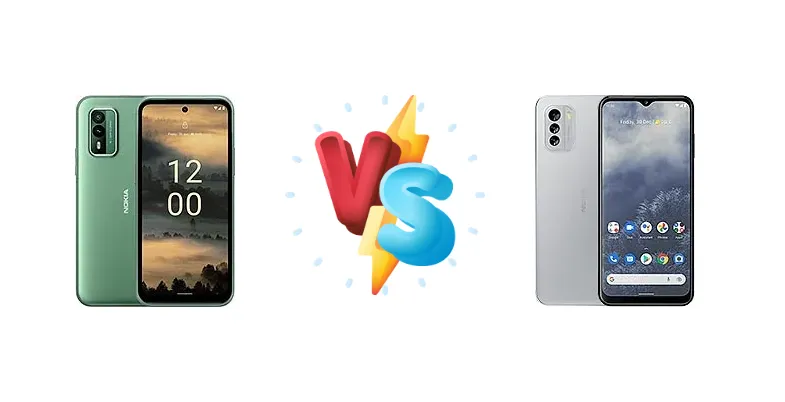
|
🏆 Quick Verdict
The Nokia XR21 edges out the G60 thanks to its significantly faster charging and more rugged design. While the G60 boasts a slightly brighter display, the XR21's durability and charging speed make it the more compelling choice for most users seeking a dependable budget 5G phone.
| PHONES | ||
|---|---|---|
| Phone Names | Nokia XR21 | Nokia G60 |
| Network | ||
|---|---|---|
| 2G bands | GSM 850 / 900 / 1800 / 1900 | GSM 850 / 900 / 1800 / 1900 |
| 3G bands | HSDPA 850 / 900 / 1700(AWS) / 1900 / 2100 | HSDPA 850 / 900 / 1900 / 2100 - International |
| 4G bands | 1, 2, 3, 4, 5, 7, 8, 12, 13, 17, 20, 25, 26, 28, 32, 38, 39, 40, 41, 42, 43, 48, 66, 71 | 1, 3, 5, 7, 8, 20, 28, 38, 39, 40, 41 - International |
| 5G bands | 1, 2, 3, 5, 7, 20, 25, 28, 40, 41, 66, 71, 77, 78, 79 SA/NSA | 1, 3, 5, 7, 28, 38, 40, 41, 77, 78 SA/NSA/Sub6 - International |
| Speed | HSPA, LTE, 5G | HSPA, LTE, 5G |
| Technology | GSM / HSPA / LTE / 5G | GSM / HSPA / LTE / 5G |
| - | 1, 3, 5, 7, 28, 38, 40, 41, 66, 78 SA/NSA/Sub6 - LATAM | |
| Launch | ||
|---|---|---|
| Announced | 2023, May 03 | 2022, September 01 |
| Status | Available. Released 2023, June 11 | Available. Released 2022, September 01 |
| Body | ||
|---|---|---|
| Build | Glass front (Gorilla Glass Victus), plastic back, plastic frame | Glass front (Gorilla Glass 5), plastic frame, plastic back |
| Dimensions | 168 x 78.6 x 10.5 mm (6.61 x 3.09 x 0.41 in) | 166 x 75.9 x 8.6 mm (6.54 x 2.99 x 0.34 in) |
| SIM | Nano-SIM + Nano-SIM + eSIM (max 2 at a time) | · Nano-SIM + eSIM· Nano-SIM + Nano-SIM |
| Weight | 231 g (8.15 oz) | 190 g (6.70 oz) |
| IP68/IP69K dust/water resistant (up to 1.5m for 60 min) Drop-to-concrete resistance from up to 1.8m MIL-STD-810H compliant | Splash resistant | |
| Display | ||
|---|---|---|
| Protection | Corning Gorilla Glass Victus | Corning Gorilla Glass 5 |
| Resolution | 1080 x 2400 pixels, 20:9 ratio (~406 ppi density) | 1080 x 2408 pixels, 20:9 ratio (~401 ppi density) |
| Size | 6.49 inches, 101.7 cm2 (~77.0% screen-to-body ratio) | 6.58 inches, 104.3 cm2 (~82.8% screen-to-body ratio) |
| Type | IPS LCD, 120Hz, 450 nits (typ), 550 nits (HBM) | IPS LCD, 120Hz, 400 nits (typ) |
| Platform | ||
|---|---|---|
| CPU | Octa-core (2x2.2 GHz Kryo 660 Gold & 6x1.7 GHz Kryo 660 Silver) | Octa-core (2x2.2 GHz Kryo 660 Gold & 6x1.7 GHz Kryo 660 Silver) |
| Chipset | Qualcomm SM6375 Snapdragon 695 5G (6 nm) | Qualcomm SM6375 Snapdragon 695 5G (6 nm) |
| GPU | Adreno 619 | Adreno 619 |
| OS | Android 12 | Android 12 |
| Memory | ||
|---|---|---|
| Card slot | Unspecified | microSDXC (uses shared SIM slot) |
| Internal | 128GB 6GB RAM | 64GB 4GB RAM, 128GB 4GB RAM, 128GB 6GB RAM |
| Main Camera | ||
|---|---|---|
| Dual | 64 MP, f/1.8, (wide), 1/2.0", PDAF 8 MP, f/2.2, (ultrawide), 1/4.0", 1.12µm | - |
| Features | Dual-LED dual-tone flash, second LED flash, HDR, panorama | LED flash, HDR, panorama |
| Single | - | 8 MP, f/2.0, (wide), 1/4.0", 1.12µm |
| Triple | - | 50 MP, f/1.8, (wide), 1/2.5", 0.7µm, PDAF 5 MP, f/2.2, (ultrawide), 1/5.0" Auxiliary lens |
| Video | 1080p@30fps | 1080p@30fps |
| Selfie camera | ||
|---|---|---|
| Single | 16 MP, f/2.4 (wide) | 8 MP, f/2.0, (wide), 1/4.0", 1.12µm |
| Video | 1080p@30fps | 1080p@30fps |
| Sound | ||
|---|---|---|
| 3.5mm jack | Yes | Yes |
| 35mm jack | Yes | Yes |
| Loudspeaker | Yes, with stereo speakers | Yes |
| Comms | ||
|---|---|---|
| Bluetooth | 5.1, A2DP, LE, aptX Adaptive | 5.1, A2DP, LE, aptX HD, aptX Adaptive |
| NFC | Yes (market/region dependent) | Yes (market/region dependent) |
| Positioning | GPS (L1+L5), GLONASS (G1), BDS (B1I+B1c+B2a), GALILEO (E1+E5a), QZSS (L1+L5), NavIC (L5) | GPS, GALILEO, BDS |
| Radio | Unspecified | FM radio |
| USB | USB Type-C 2.0, OTG | USB Type-C 2.0, OTG |
| WLAN | Wi-Fi 802.11 a/b/g/n/ac/6, dual-band | Wi-Fi 802.11 a/b/g/n/ac/6, dual-band |
| Features | ||
|---|---|---|
| Sensors | Fingerprint (side-mounted), accelerometer, gyro, proximity, compass, barometer | Fingerprint (side-mounted), accelerometer, gyro, proximity, compass |
| Battery | ||
|---|---|---|
| Charging | 33W wired, PD2.0, QC3 | 20W wired, PD3.0 |
| Type | Li-Po 4800 mAh | Li-Po 4500 mAh |
| Misc | ||
|---|---|---|
| Colors | Midnight Black, Pine Green | Pure Black, Ice Gray |
| Models | - | TA-1490, TA-1481, TA-1479, TA-1475 |
| Price | About 570 EUR | About 240 EUR |
| SAR | - | 1.30 W/kg (head) 0.83 W/kg (body) |
| SAR EU | - | 1.10 W/kg (head) 1.27 W/kg (body) |
Nokia XR21
- Rugged and durable design
- Faster 33W charging
- Potentially better sustained performance
- 64MP Main Camera
- Likely 60Hz display
- Potentially less vibrant display than G60
Nokia G60
- 120Hz Refresh Rate Display
- Brighter Display (444 nits)
- Clean Android experience
- Slower 20W charging
- Less durable design
- Lower resolution main camera
Display Comparison
The Nokia G60 features a 6.57-inch FHD+ display with a 120Hz refresh rate and a measured peak brightness of 444 nits, offering a vibrant and smooth viewing experience. The XR21 has a slightly smaller 6.43-inch FHD+ display, likely with a standard 60Hz refresh rate (spec not explicitly stated). While the XR21's display is perfectly adequate, the G60's higher refresh rate and brightness give it a slight edge.
Camera Comparison
The Nokia G60 features a triple-camera system with a 48MP main sensor, a 5MP ultrawide lens, and a 2MP depth sensor. The XR21 has a dual-camera setup with a 64MP main sensor and a 5MP depth sensor. While megapixels aren't everything, the XR21's higher resolution main sensor *could* translate to slightly more detailed photos in good lighting conditions. Low-light performance is likely comparable.
Performance
Both phones share the same Qualcomm Snapdragon 695 5G chipset and CPU configuration, meaning performance will be largely similar in everyday tasks and moderate gaming. However, the XR21's potentially better thermal management (due to its rugged design) might allow it to sustain performance slightly longer under heavy load. Software optimization could also play a role, but both are expected to run Android with Nokia's clean software experience.
Battery Life
The Nokia XR21 packs a 4470mAh battery and supports 33W fast charging, a significant advantage over the G60's 4400mAh battery and 20W charging. This means the XR21 will charge much faster and potentially offer slightly better battery life, especially with demanding usage.
Buying Guide
The Nokia XR21 is ideal for users who prioritize durability, fast charging, and a phone that can withstand some abuse. The Nokia G60 is a good option for those who value a slightly better display and are less concerned about ruggedness or charging speed.