
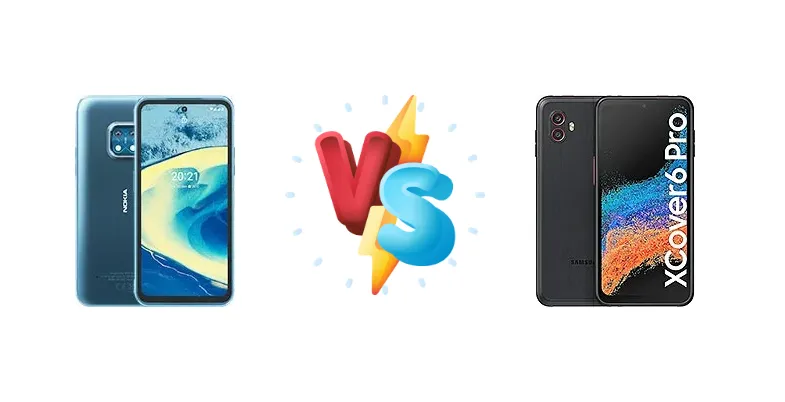
Nokia XR20 vs Samsung Galaxy XCover6 Pro: The Ultimate Rugged Phone Comparison
| Phones Images | |||||
|---|---|---|---|---|---|
|
🏆 Quick Verdict
The Samsung Galaxy XCover6 Pro takes the crown thanks to its significantly faster processor, brighter display, and more versatile camera system. While the XR20 boasts exceptional durability, the XCover6 Pro offers a better balance of ruggedness and modern smartphone features.
| PHONES | ||
|---|---|---|
| Phone Names | Nokia XR20 | Samsung Galaxy XCover6 Pro |
| Network | ||
|---|---|---|
| 2G bands | GSM 850 / 900 / 1800 / 1900 | GSM 850 / 900 / 1800 / 1900 |
| 3G bands | HSDPA 850 / 900 / 1700(AWS) / 1900 / 2100 | HSDPA 850 / 900 / 1700(AWS) / 1900 / 2100 |
| 4G bands | 1, 2, 3, 4, 5, 7, 8, 12, 13, 14, 20, 25, 26, 28, 30, 38, 40, 41, 48, 66, 71 | 1, 2, 3, 4, 5, 7, 8, 12, 17, 20, 26, 28, 32, 38, 39, 40, 41, 66 - International |
| 5G bands | 2, 5, 25, 38, 41, 48, 66, 77, 78 SA/NSA | 1, 3, 5, 7, 8, 20, 28, 38, 40, 41, 78 SA/NSA |
| Speed | HSPA, LTE, 5G | HSPA, LTE, 5G |
| Technology | GSM / CDMA / HSPA / EVDO / LTE / 5G | GSM / HSPA / LTE / 5G |
| CDMA2000 1xEV-DO | - | |
| Launch | ||
|---|---|---|
| Announced | 2021, July 27 | 2022, June 29 |
| Status | Available. Released 2021, August 04 | Available. Released 2022, July 13 |
| Body | ||
|---|---|---|
| Dimensions | 171.6 x 81.5 x 10.6 mm (6.76 x 3.21 x 0.42 in) | 168.8 x 79.9 x 9.9 mm (6.65 x 3.15 x 0.39 in) |
| SIM | · Nano-SIM· Nano-SIM + Nano-SIM | · Nano-SIM· Nano-SIM + Nano-SIM |
| Weight | 248 g (8.75 oz) | 235 g (8.29 oz) |
| IP68 dust/water resistant (up to 1.5m for 60 min) Drop-to-concrete resistance from up to 1.8m MIL-STD-810H compliant | IP68 dust/water resistant (up to 1.5m for 35 min) Drop-to-concrete resistance from up to 1.5m MIL-STD-810H compliant* *does not guarantee ruggedness or use in extreme conditions | |
| Display | ||
|---|---|---|
| Protection | Corning Gorilla Glass Victus | Corning Gorilla Glass Victus+ |
| Resolution | 1080 x 2400 pixels, 20:9 ratio (~395 ppi density) | 1080 x 2408 pixels, 20:9 ratio (~400 ppi density) |
| Size | 6.67 inches, 107.4 cm2 (~76.8% screen-to-body ratio) | 6.6 inches, 104.9 cm2 (~77.8% screen-to-body ratio) |
| Type | IPS LCD, 550 nits | PLS LCD, 120Hz |
| Platform | ||
|---|---|---|
| CPU | Octa-core (2x2.0 GHz Kryo 460 & 6x1.8 GHz Kryo 460) | Octa-core (1x2.4 GHz Cortex-A78 & 3x2.2 GHz Cortex-A78 & 4x1.9 GHz Cortex-A55) |
| Chipset | Qualcomm SM4350 Snapdragon 480 5G (8 nm) | Qualcomm SM7325 Snapdragon 778G 5G (6 nm) |
| GPU | Adreno 619 | Adreno 642L |
| OS | Android 11, upgradable to Android 13 | Android 12, upgradable to Android 15, One UI 7 |
| Memory | ||
|---|---|---|
| Card slot | microSDXC (uses shared SIM slot) | microSDXC (dedicated slot) |
| Internal | 64GB 4GB RAM, 128GB 6GB RAM | 128GB 6GB RAM |
| Main Camera | ||
|---|---|---|
| Dual | 48 MP, f/1.8, (wide), 1/2.25", 0.8µm, PDAF 13 MP, f/2.4, 123˚ (ultrawide), 1/3.0", 1.12µm | 50 MP, f/1.8, (wide), 1/2.76", 0.64µm, PDAF 8 MP, f/2.2, 123˚ (ultrawide), 1/4.0", 1.12µm |
| Features | Zeiss optics, Dual-LED dual-tone flash, second LED flash, HDR, panorama | Dual-LED flash, HDR, panorama |
| Single | 8 MP, f/2.0 (wide), 1/4.0", 1.12µm | 50 MP, f/1.8, (wide), 1/2.76", 0.64µm, PDAF 8 MP, f/2.2, 123˚ (ultrawide), 1/4.0", 1.12µm |
| Video | 1080p@30fps | 4K@30fps, 1080p@30fps |
| Selfie camera | ||
|---|---|---|
| Features | - | HDR |
| Single | 8 MP, f/2.0 (wide), 1/4.0", 1.12µm | 13 MP, f/2.2, (wide), 1/3.1", 1.12µm |
| Video | 1080p@30fps | 1080p@30fps |
| Sound | ||
|---|---|---|
| 3.5mm jack | Yes | Yes |
| 35mm jack | Yes | Yes |
| Loudspeaker | Yes, with stereo speakers | Yes |
| Comms | ||
|---|---|---|
| Bluetooth | 5.1, A2DP, LE, aptX Adaptive | 5.2, A2DP, LE |
| NFC | Yes | Yes |
| Positioning | GPS (L1+L5), GLONASS, BDS, GALILEO, QZSS, NavIC | GPS, GLONASS, BDS, GALILEO, QZSS |
| Radio | Unspecified | No |
| USB | USB Type-C 3.0 | USB Type-C 3.2, charging connector pins |
| WLAN | Wi-Fi 802.11 a/b/g/n/ac/6, dual-band, Wi-Fi Direct | Wi-Fi 802.11 a/b/g/n/ac/mc/6e, tri-band, Wi-Fi Direct |
| Features | ||
|---|---|---|
| Sensors | Fingerprint (side-mounted), accelerometer, gyro, proximity, compass, barometer | Fingerprint (side-mounted), accelerometer, gyro, proximity, compass, barometer |
| - | Samsung DeX support | |
| Battery | ||
|---|---|---|
| Charging | 18W wired 15W wireless | 25W wired (USA) 15W wired (International) |
| Type | Li-Po 4630 mAh | Li-Po 4050 mAh, removable |
| Misc | ||
|---|---|---|
| Colors | Ultra Blue, Granite Gray | Black |
| Models | TA-1368, TA-1362 | SM-G736U, SM-G736U1, SM-G736B, SM-G736B/DS |
| Price | About 270 EUR | $ 155.92 / C$ 329.97 / £ 249.00 / € 199.99 |
| SAR | - | 1.03 W/kg (head) 1.08 W/kg (body) |
| SAR EU | 1.13 W/kg (head) 1.43 W/kg (body) | 1.48 W/kg (head) 1.23 W/kg (body) |
Nokia XR20
- Exceptional durability (MIL-STD-810H certified)
- 5G connectivity
- Wireless charging
- Clean Android experience
- Slower processor
- Less impressive camera
- Lower screen brightness
- Slower wired charging
Samsung Galaxy XCover6 Pro
- Faster processor (Snapdragon 778G 5G)
- Brighter display (120Hz refresh rate)
- More versatile camera system
- Customizable physical buttons
- 25W wired charging (in some regions)
- Samsung's One UI can be bloated
- Durability, while good, isn't quite as extreme as the XR20
- Price is generally higher
Display Comparison
The XCover6 Pro features a brighter 6.6-inch FHD+ display, offering better visibility in sunlight. The XR20 has a slightly smaller 6.6-inch display, but both utilize Gorilla Glass Victus for scratch resistance. The XCover6 Pro's display also supports a 120Hz refresh rate, providing smoother scrolling and animations.
Camera Comparison
The XCover6 Pro's camera system is more versatile, featuring a 50MP main sensor and a 12MP ultrawide lens. The XR20 has a 64MP main camera and a 5MP depth sensor. While both phones can capture decent photos, the XCover6 Pro generally produces better image quality, especially in low light. The XCover6 Pro also offers more advanced camera features.
Performance
The Snapdragon 778G 5G in the XCover6 Pro is a clear winner here. It offers significantly faster processing speeds and better graphics performance compared to the XR20's Snapdragon 480 5G. Expect smoother multitasking, faster app loading times, and a more responsive user experience on the XCover6 Pro.
Battery Life
Both phones offer a 4,400mAh battery. However, the XCover6 Pro's more efficient processor and optimized software contribute to slightly better battery life in real-world usage. Both support 15W wireless charging, but the XCover6 Pro supports 25W wired charging (in some regions).
Buying Guide
The Nokia XR20 is ideal for those prioritizing extreme durability above all else, particularly those working in harsh environments. The Samsung Galaxy XCover6 Pro is a better choice for users who want a rugged phone with a more premium feel, better performance, and a more capable camera, without sacrificing too much toughness.