
Nokia XR20 vs Samsung Galaxy XCover Pro: The Ultimate Rugged Phone Comparison
| Phones Images | |||||
|---|---|---|---|---|---|
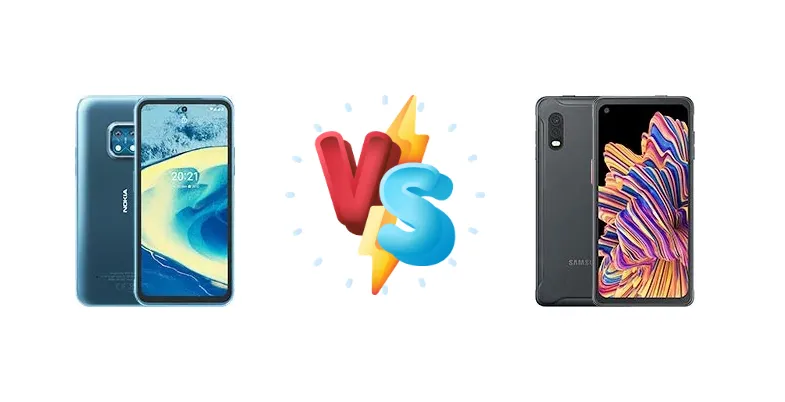
|
🏆 Quick Verdict
The Nokia XR20 edges out the XCover Pro thanks to its 5G connectivity, wireless charging, and slightly more modern chipset. While the XCover Pro boasts a more refined software experience and potentially better camera optimization, the XR20's durability and future-proofing make it the winner for most users.
| PHONES | ||
|---|---|---|
| Phone Names | Nokia XR20 | Samsung Galaxy XCover Pro |
| Network | ||
|---|---|---|
| 2G bands | GSM 850 / 900 / 1800 / 1900 | GSM 850 / 900 / 1800 / 1900 |
| 3G bands | HSDPA 850 / 900 / 1700(AWS) / 1900 / 2100 | HSDPA 850 / 900 / 1900 / 2100 - International |
| 4G bands | 1, 2, 3, 4, 5, 7, 8, 12, 13, 14, 20, 25, 26, 28, 30, 38, 40, 41, 48, 66, 71 | 1, 2, 3, 5, 7, 8, 20, 28, 38, 40, 41 - International |
| 5G bands | 2, 5, 25, 38, 41, 48, 66, 77, 78 SA/NSA | - |
| Speed | HSPA, LTE, 5G | HSPA 42.2/5.76 Mbps, LTE (3CA) Cat11 600/50 Mbps |
| Technology | GSM / CDMA / HSPA / EVDO / LTE / 5G | GSM / HSPA / LTE |
| CDMA2000 1xEV-DO | 1, 2, 3, 4, 5, 7, 12, 13, 14, 20, 29, 38, 40, 41, 66 - Canada | |
| Launch | ||
|---|---|---|
| Announced | 2021, July 27 | 2020, January |
| Status | Available. Released 2021, August 04 | Available. Released 2020, January |
| Body | ||
|---|---|---|
| Dimensions | 171.6 x 81.5 x 10.6 mm (6.76 x 3.21 x 0.42 in) | 159.9 x 76.7 x 10 mm (6.30 x 3.02 x 0.39 in) |
| SIM | · Nano-SIM· Nano-SIM + Nano-SIM | · Nano-SIM· Nano-SIM + Nano-SIM |
| Weight | 248 g (8.75 oz) | 218 g (7.69 oz) |
| IP68 dust/water resistant (up to 1.5m for 60 min) Drop-to-concrete resistance from up to 1.8m MIL-STD-810H compliant | IP68 dust/water resistant (up to 1.5m for 35 min) Drop-to-concrete resistance from up to 1.5m MIL-STD-810G compliant* *does not guarantee ruggedness or use in extreme conditions | |
| Display | ||
|---|---|---|
| Protection | Corning Gorilla Glass Victus | Corning Gorilla Glass 5 |
| Resolution | 1080 x 2400 pixels, 20:9 ratio (~395 ppi density) | 1080 x 2340 pixels, 19.5:9 ratio (~409 ppi density) |
| Size | 6.67 inches, 107.4 cm2 (~76.8% screen-to-body ratio) | 6.3 inches, 97.4 cm2 (~79.4% screen-to-body ratio) |
| Type | IPS LCD, 550 nits | IPS LCD |
| Platform | ||
|---|---|---|
| CPU | Octa-core (2x2.0 GHz Kryo 460 & 6x1.8 GHz Kryo 460) | Octa-core (4x2.3 GHz Cortex-A73 & 4x1.7 GHz Cortex-A53) |
| Chipset | Qualcomm SM4350 Snapdragon 480 5G (8 nm) | Exynos 9611 (10 nm) |
| GPU | Adreno 619 | Mali-G72 MP3 |
| OS | Android 11, upgradable to Android 13 | Android 10, upgradable to Android 13, One UI 5 |
| Memory | ||
|---|---|---|
| Card slot | microSDXC (uses shared SIM slot) | microSDXC (dedicated slot) |
| Internal | 64GB 4GB RAM, 128GB 6GB RAM | 64GB 4GB RAM |
| Main Camera | ||
|---|---|---|
| Dual | 48 MP, f/1.8, (wide), 1/2.25", 0.8µm, PDAF 13 MP, f/2.4, 123˚ (ultrawide), 1/3.0", 1.12µm | 25 MP, f/1.7, 26mm (wide), PDAF 8 MP, f/2.2, 123˚ (ultrawide), 1/4.0", 1.12µm |
| Features | Zeiss optics, Dual-LED dual-tone flash, second LED flash, HDR, panorama | Dual-LED flash, HDR, panorama |
| Single | 8 MP, f/2.0 (wide), 1/4.0", 1.12µm | - |
| Video | 1080p@30fps | 1080p@30fps |
| Selfie camera | ||
|---|---|---|
| Features | - | HDR |
| Single | 8 MP, f/2.0 (wide), 1/4.0", 1.12µm | 13 MP, f/2.0, (wide), 1/3.1", 1.12µm |
| Video | 1080p@30fps | 1080p@30fps |
| Sound | ||
|---|---|---|
| 3.5mm jack | Yes | Yes |
| 35mm jack | Yes | Yes |
| Loudspeaker | Yes, with stereo speakers | Yes |
| Comms | ||
|---|---|---|
| Bluetooth | 5.1, A2DP, LE, aptX Adaptive | 5.0, A2DP, LE |
| NFC | Yes | Yes |
| Positioning | GPS (L1+L5), GLONASS, BDS, GALILEO, QZSS, NavIC | GPS, GLONASS, GALILEO, BDS |
| Radio | Unspecified | FM radio (market/region dependent) |
| USB | USB Type-C 3.0 | USB Type-C 2.0 |
| WLAN | Wi-Fi 802.11 a/b/g/n/ac/6, dual-band, Wi-Fi Direct | Wi-Fi 802.11 a/b/g/n/ac/k/v/r, dual-band, Wi-Fi Direct |
| Features | ||
|---|---|---|
| Sensors | Fingerprint (side-mounted), accelerometer, gyro, proximity, compass, barometer | Fingerprint (side-mounted), accelerometer, gyro, proximity, compass |
| - | ANT+ | |
| Battery | ||
|---|---|---|
| Charging | 18W wired 15W wireless | 15W wired |
| Type | Li-Po 4630 mAh | Li-Po 4050 mAh, removable |
| Misc | ||
|---|---|---|
| Colors | Ultra Blue, Granite Gray | Black |
| Models | TA-1368, TA-1362 | SM-G715FN/DS, SM-G715FN, SM-G715F, SM-G715W, SM-G715U, SM-G715U1 |
| Price | About 270 EUR | About 120 EUR |
| SAR EU | 1.13 W/kg (head) 1.43 W/kg (body) | 0.47 W/kg (head) 1.23 W/kg (body) |
Nokia XR20
- 5G Connectivity
- Wireless Charging
- More Modern Chipset
- Excellent Durability (Military-Grade)
- Expandable Storage (MicroSD)
- Camera not as refined as XCover Pro
- Software updates may be slower
Samsung Galaxy XCover Pro
- Refined Samsung Software Experience
- Potentially Better Camera Optimization
- Enterprise Features & Support
- Rugged Design
- No 5G
- No Wireless Charging
- Older Chipset
- Less Future-Proof
Display Comparison
Both phones feature 6.6-inch displays, but the XR20 has a slightly higher resolution (1080 x 2400 vs 1080 x 2400). Viewing angles and color accuracy are generally comparable, though Samsung's display technology often provides a slightly more vibrant experience. Both are designed for outdoor visibility.
Camera Comparison
The XCover Pro generally receives slightly better reviews for its camera performance, particularly in well-lit conditions. Both phones feature a dual-camera setup, but Samsung's image processing algorithms often produce more pleasing results. The XR20's camera is perfectly adequate, but not a standout feature.
Performance
The Nokia XR20's Snapdragon 480 5G offers a slight edge in raw processing power and benefits from a more modern 8nm manufacturing process. The XCover Pro's Exynos 9611 is still capable, but the XR20's 5G modem provides future-proofing. Expect smoother multitasking and slightly faster app loading on the XR20.
Battery Life
Both phones offer substantial battery life, easily lasting a full day of moderate use. The XR20 has a slightly larger battery capacity (4470 mAh vs 4500 mAh), but real-world battery performance is likely to be similar. The XR20's wireless charging is a significant advantage.
Buying Guide
The Nokia XR20 is ideal for outdoor enthusiasts, construction workers, or anyone needing a seriously durable phone with 5G. The Samsung Galaxy XCover Pro is a good choice for businesses requiring a rugged device with Samsung's ecosystem integration and potentially better enterprise support.