
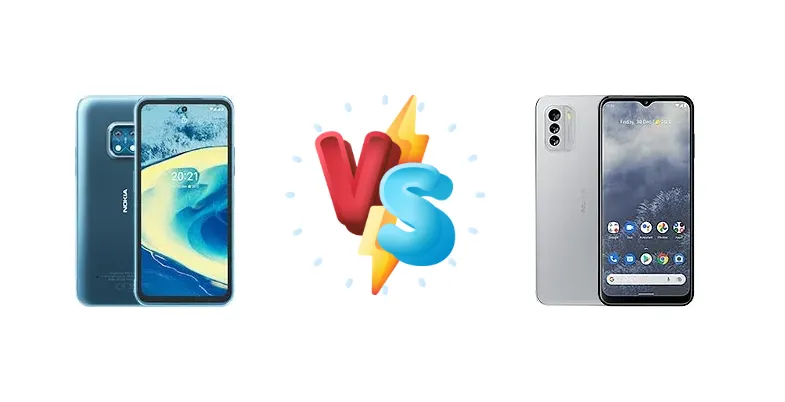
Nokia XR20 vs Nokia G60: A Head-to-Head Comparison
| Phones Images | |||||
|---|---|---|---|---|---|
|
🏆 Quick Verdict
The Nokia G60 wins on display quality and slightly better performance thanks to its Snapdragon 695. However, the XR20's rugged build and 5G connectivity make it ideal for those needing a durable device that can withstand tough conditions. It's a trade-off between resilience and refinement.
| PHONES | ||
|---|---|---|
| Phone Names | Nokia XR20 | Nokia G60 |
| Network | ||
|---|---|---|
| 2G bands | GSM 850 / 900 / 1800 / 1900 | GSM 850 / 900 / 1800 / 1900 |
| 3G bands | HSDPA 850 / 900 / 1700(AWS) / 1900 / 2100 | HSDPA 850 / 900 / 1900 / 2100 - International |
| 4G bands | 1, 2, 3, 4, 5, 7, 8, 12, 13, 14, 20, 25, 26, 28, 30, 38, 40, 41, 48, 66, 71 | 1, 3, 5, 7, 8, 20, 28, 38, 39, 40, 41 - International |
| 5G bands | 2, 5, 25, 38, 41, 48, 66, 77, 78 SA/NSA | 1, 3, 5, 7, 28, 38, 40, 41, 77, 78 SA/NSA/Sub6 - International |
| Speed | HSPA, LTE, 5G | HSPA, LTE, 5G |
| Technology | GSM / CDMA / HSPA / EVDO / LTE / 5G | GSM / HSPA / LTE / 5G |
| CDMA2000 1xEV-DO | 1, 3, 5, 7, 28, 38, 40, 41, 66, 78 SA/NSA/Sub6 - LATAM | |
| Launch | ||
|---|---|---|
| Announced | 2021, July 27 | 2022, September 01 |
| Status | Available. Released 2021, August 04 | Available. Released 2022, September 01 |
| Body | ||
|---|---|---|
| Build | - | Glass front (Gorilla Glass 5), plastic frame, plastic back |
| Dimensions | 171.6 x 81.5 x 10.6 mm (6.76 x 3.21 x 0.42 in) | 166 x 75.9 x 8.6 mm (6.54 x 2.99 x 0.34 in) |
| SIM | · Nano-SIM· Nano-SIM + Nano-SIM | · Nano-SIM + eSIM· Nano-SIM + Nano-SIM |
| Weight | 248 g (8.75 oz) | 190 g (6.70 oz) |
| IP68 dust/water resistant (up to 1.5m for 60 min) Drop-to-concrete resistance from up to 1.8m MIL-STD-810H compliant | Splash resistant | |
| Display | ||
|---|---|---|
| Protection | Corning Gorilla Glass Victus | Corning Gorilla Glass 5 |
| Resolution | 1080 x 2400 pixels, 20:9 ratio (~395 ppi density) | 1080 x 2408 pixels, 20:9 ratio (~401 ppi density) |
| Size | 6.67 inches, 107.4 cm2 (~76.8% screen-to-body ratio) | 6.58 inches, 104.3 cm2 (~82.8% screen-to-body ratio) |
| Type | IPS LCD, 550 nits | IPS LCD, 120Hz, 400 nits (typ) |
| Platform | ||
|---|---|---|
| CPU | Octa-core (2x2.0 GHz Kryo 460 & 6x1.8 GHz Kryo 460) | Octa-core (2x2.2 GHz Kryo 660 Gold & 6x1.7 GHz Kryo 660 Silver) |
| Chipset | Qualcomm SM4350 Snapdragon 480 5G (8 nm) | Qualcomm SM6375 Snapdragon 695 5G (6 nm) |
| GPU | Adreno 619 | Adreno 619 |
| OS | Android 11, upgradable to Android 13 | Android 12 |
| Memory | ||
|---|---|---|
| Card slot | microSDXC (uses shared SIM slot) | microSDXC (uses shared SIM slot) |
| Internal | 64GB 4GB RAM, 128GB 6GB RAM | 64GB 4GB RAM, 128GB 4GB RAM, 128GB 6GB RAM |
| Main Camera | ||
|---|---|---|
| Dual | 48 MP, f/1.8, (wide), 1/2.25", 0.8µm, PDAF 13 MP, f/2.4, 123˚ (ultrawide), 1/3.0", 1.12µm | - |
| Features | Zeiss optics, Dual-LED dual-tone flash, second LED flash, HDR, panorama | LED flash, HDR, panorama |
| Single | 8 MP, f/2.0 (wide), 1/4.0", 1.12µm | 8 MP, f/2.0, (wide), 1/4.0", 1.12µm |
| Triple | - | 50 MP, f/1.8, (wide), 1/2.5", 0.7µm, PDAF 5 MP, f/2.2, (ultrawide), 1/5.0" Auxiliary lens |
| Video | 1080p@30fps | 1080p@30fps |
| Selfie camera | ||
|---|---|---|
| Single | 8 MP, f/2.0 (wide), 1/4.0", 1.12µm | 8 MP, f/2.0, (wide), 1/4.0", 1.12µm |
| Video | 1080p@30fps | 1080p@30fps |
| Sound | ||
|---|---|---|
| 3.5mm jack | Yes | Yes |
| 35mm jack | Yes | Yes |
| Loudspeaker | Yes, with stereo speakers | Yes |
| Comms | ||
|---|---|---|
| Bluetooth | 5.1, A2DP, LE, aptX Adaptive | 5.1, A2DP, LE, aptX HD, aptX Adaptive |
| NFC | Yes | Yes (market/region dependent) |
| Positioning | GPS (L1+L5), GLONASS, BDS, GALILEO, QZSS, NavIC | GPS, GALILEO, BDS |
| Radio | Unspecified | FM radio |
| USB | USB Type-C 3.0 | USB Type-C 2.0, OTG |
| WLAN | Wi-Fi 802.11 a/b/g/n/ac/6, dual-band, Wi-Fi Direct | Wi-Fi 802.11 a/b/g/n/ac/6, dual-band |
| Features | ||
|---|---|---|
| Sensors | Fingerprint (side-mounted), accelerometer, gyro, proximity, compass, barometer | Fingerprint (side-mounted), accelerometer, gyro, proximity, compass |
| Battery | ||
|---|---|---|
| Charging | 18W wired 15W wireless | 20W wired, PD3.0 |
| Type | Li-Po 4630 mAh | Li-Po 4500 mAh |
| Misc | ||
|---|---|---|
| Colors | Ultra Blue, Granite Gray | Pure Black, Ice Gray |
| Models | TA-1368, TA-1362 | TA-1490, TA-1481, TA-1479, TA-1475 |
| Price | About 270 EUR | About 240 EUR |
| SAR | - | 1.30 W/kg (head) 0.83 W/kg (body) |
| SAR EU | 1.13 W/kg (head) 1.43 W/kg (body) | 1.10 W/kg (head) 1.27 W/kg (body) |
Nokia XR20
- Extremely durable and rugged build
- 5G connectivity
- Water and dust resistant (IP68)
- Repairable design
- Less vibrant display
- Slightly slower performance
- Slower charging speed
Nokia G60
- Vibrant and high-contrast display
- Slightly better performance
- PD3.0 fast charging
- Modern design
- Less durable than XR20
- Potentially less repairable
- May not be ideal for very rugged environments
Display Comparison
The Nokia G60 boasts a significantly better display. Its 444 nits brightness and 1523:1 contrast ratio provide a more vibrant and enjoyable viewing experience compared to the XR20's likely more standard display. The G60's screen is simply more visually appealing for media consumption and general use.
Camera Comparison
Both phones feature decent camera setups, but the G60 likely has a slight advantage due to its more modern chipset and potentially better image processing. The XR20's camera is adequate, but the G60's should produce slightly more detailed and vibrant photos, particularly in good lighting conditions. Both likely offer similar video recording capabilities.
Performance
The Nokia G60's Snapdragon 695 5G chipset, built on a 6nm process, offers a noticeable performance edge over the XR20's Snapdragon 480 5G (8nm). While both are capable of handling everyday tasks, the G60 will feel snappier and more responsive, especially when multitasking or running more demanding apps. The G60's Kryo 660 Gold cores also contribute to better overall performance.
Battery Life
Battery life is expected to be comparable between the two devices, with both offering all-day usage for moderate users. The G60's support for PD3.0 fast charging provides a faster charging experience than the XR20's 18W wired charging.
Buying Guide
The Nokia XR20 is perfect for outdoor enthusiasts, construction workers, or anyone needing a phone that can survive drops and harsh environments. The Nokia G60 is a better choice for users prioritizing a vibrant display, smoother performance for everyday tasks, and a more modern aesthetic.