
Nokia XR20 vs Nokia 7.2: A Head-to-Head Comparison
| Phones Images | |||||
|---|---|---|---|---|---|
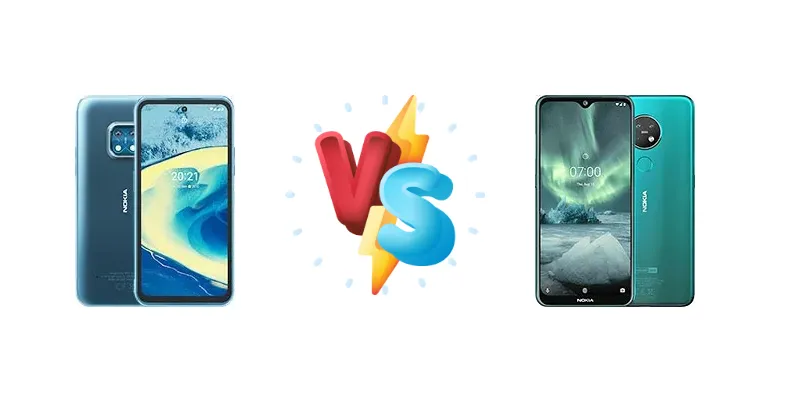
|
🏆 Quick Verdict
The Nokia XR20 wins for durability and 5G connectivity, making it ideal for active users. However, the Nokia 7.2 offers a brighter display and potentially better value for those prioritizing screen quality and a slightly more powerful chipset, especially if 5G isn't essential.
| PHONES | ||
|---|---|---|
| Phone Names | Nokia XR20 | Nokia 7.2 |
| Network | ||
|---|---|---|
| 2G bands | GSM 850 / 900 / 1800 / 1900 | GSM 850 / 900 / 1800 / 1900 |
| 3G bands | HSDPA 850 / 900 / 1700(AWS) / 1900 / 2100 | HSDPA 850 / 900 / 2100 - ROW |
| 4G bands | 1, 2, 3, 4, 5, 7, 8, 12, 13, 14, 20, 25, 26, 28, 30, 38, 40, 41, 48, 66, 71 | 1, 3, 5, 7, 8, 20, 28, 38, 40, 41 - ROW |
| 5G bands | 2, 5, 25, 38, 41, 48, 66, 77, 78 SA/NSA | - |
| Speed | HSPA, LTE, 5G | HSPA 42.2/5.76 Mbps, LTE (2CA) Cat6 300/50 Mbps or LTE Cat4 150/50 Mbps |
| Technology | GSM / CDMA / HSPA / EVDO / LTE / 5G | GSM / HSPA / LTE |
| CDMA2000 1xEV-DO | 1, 3, 5, 8, 40, 41 - IN | |
| Launch | ||
|---|---|---|
| Announced | 2021, July 27 | 2019, September 05. Released 2019, September 23 |
| Status | Available. Released 2021, August 04 | Discontinued |
| Body | ||
|---|---|---|
| Build | - | Glass front (Gorilla Glass 3), glass back (Gorilla Glass 3), plastic frame |
| Dimensions | 171.6 x 81.5 x 10.6 mm (6.76 x 3.21 x 0.42 in) | 159.9 x 75.2 x 8.3 mm (6.30 x 2.96 x 0.33 in) |
| SIM | · Nano-SIM· Nano-SIM + Nano-SIM | · Nano-SIM· Nano-SIM + Nano-SIM |
| Weight | 248 g (8.75 oz) | 180 g (6.35 oz) |
| IP68 dust/water resistant (up to 1.5m for 60 min) Drop-to-concrete resistance from up to 1.8m MIL-STD-810H compliant | - | |
| Display | ||
|---|---|---|
| Protection | Corning Gorilla Glass Victus | Corning Gorilla Glass 3 |
| Resolution | 1080 x 2400 pixels, 20:9 ratio (~395 ppi density) | 1080 x 2280 pixels, 19:9 ratio (~400 ppi density) |
| Size | 6.67 inches, 107.4 cm2 (~76.8% screen-to-body ratio) | 6.3 inches, 99.1 cm2 (~82.4% screen-to-body ratio) |
| Type | IPS LCD, 550 nits | IPS LCD, HDR10 |
| Platform | ||
|---|---|---|
| CPU | Octa-core (2x2.0 GHz Kryo 460 & 6x1.8 GHz Kryo 460) | Octa-core (4x2.2 GHz Kryo 260 Gold & 4x1.8 GHz Kryo 260 Silver) |
| Chipset | Qualcomm SM4350 Snapdragon 480 5G (8 nm) | Qualcomm SDM660 Snapdragon 660 (14 nm) |
| GPU | Adreno 619 | Adreno 512 |
| OS | Android 11, upgradable to Android 13 | Android 9.0 (Pie), upgradable to Android 11, Android One |
| Memory | ||
|---|---|---|
| Card slot | microSDXC (uses shared SIM slot) | microSDXC (dedicated slot) |
| Internal | 64GB 4GB RAM, 128GB 6GB RAM | 64GB 4GB RAM, 64GB 6GB RAM, 128GB 4GB RAM, 128GB 6GB RAM |
| - | eMMC 5.1 | |
| Main Camera | ||
|---|---|---|
| Dual | 48 MP, f/1.8, (wide), 1/2.25", 0.8µm, PDAF 13 MP, f/2.4, 123˚ (ultrawide), 1/3.0", 1.12µm | - |
| Features | Zeiss optics, Dual-LED dual-tone flash, second LED flash, HDR, panorama | Zeiss optics, LED flash, panorama, HDR |
| Single | 8 MP, f/2.0 (wide), 1/4.0", 1.12µm | - |
| Triple | - | 48 MP, f/1.8, (wide), 1/2.0", 0.8µm, PDAF 8 MP, f/2.2, 13mm (ultrawide), 1/4.0", 1.12µm Auxiliary lens |
| Video | 1080p@30fps | 4K@30fps, 1080p@30fps (gyro-EIS) |
| Selfie camera | ||
|---|---|---|
| Features | - | Zeiss optics, HDR |
| Single | 8 MP, f/2.0 (wide), 1/4.0", 1.12µm | 20 MP, f/2.0, (wide), 1/3", 0.9µm |
| Video | 1080p@30fps | 1080p@30fps |
| Sound | ||
|---|---|---|
| 3.5mm jack | Yes | Yes |
| 35mm jack | Yes | Yes |
| Loudspeaker | Yes, with stereo speakers | Yes |
| Comms | ||
|---|---|---|
| Bluetooth | 5.1, A2DP, LE, aptX Adaptive | 5.0, A2DP, EDR, LE, aptX |
| NFC | Yes | Yes (excl. India) |
| Positioning | GPS (L1+L5), GLONASS, BDS, GALILEO, QZSS, NavIC | GPS, GLONASS, GALILEO, BDS |
| Radio | Unspecified | FM radio |
| USB | USB Type-C 3.0 | USB Type-C 2.0, OTG |
| WLAN | Wi-Fi 802.11 a/b/g/n/ac/6, dual-band, Wi-Fi Direct | Wi-Fi 802.11 b/g/n/ac, dual-band, Wi-Fi Direct |
| Features | ||
|---|---|---|
| Sensors | Fingerprint (side-mounted), accelerometer, gyro, proximity, compass, barometer | Fingerprint (rear-mounted), accelerometer, gyro, proximity, compass |
| Battery | ||
|---|---|---|
| Charging | 18W wired 15W wireless | 10W wired |
| Type | Li-Po 4630 mAh | Li-Po 3500 mAh, non-removable |
| Misc | ||
|---|---|---|
| Colors | Ultra Blue, Granite Gray | Cyan Green, Charcoal, Ice |
| Models | TA-1368, TA-1362 | TA-1193, TA-1178, TA-1196, TA-1181 |
| Price | About 270 EUR | About 240 EUR |
| SAR | - | 1.15 W/kg (head) 0.90 W/kg (body) |
| SAR EU | 1.13 W/kg (head) 1.43 W/kg (body) | 0.99 W/kg (head) 1.44 W/kg (body) |
| Tests | ||
|---|---|---|
| Audio quality | - | Noise -93.0dB / Crosstalk -93.4dB |
| Battery life | - | Endurance rating 69h |
| Camera | - | Photo / Video |
| Display | - | Contrast ratio: 1342:1 (nominal) |
| Loudspeaker | - | -29.6 LUFS (Average) |
| Performance | - | AnTuTu: 139495 (v7), 164484 (v8) GeekBench: 5440 (v4.4), 1398 (v5.1) GFXBench: 8.1fps (ES 3.1 onscreen) |
Nokia XR20
- Rugged and durable (MIL-STD 810H certified)
- 5G Connectivity
- More efficient chipset (8nm)
- Wireless Charging
- Potentially less vibrant display
- Lower peak brightness
- Snapdragon 480 is a mid-range chipset
Nokia 7.2
- Brighter display (585 nits)
- Good value for money
- Slightly more powerful chipset (Snapdragon 660)
- High contrast ratio (1342:1)
- No 5G connectivity
- Less durable
- 10W wired charging is slow
- Older chipset
Display Comparison
The Nokia 7.2 boasts a significantly brighter display (585 nits vs. XR20's likely lower brightness, estimated around 450-500 nits) and a high contrast ratio (1342:1). While the XR20 prioritizes durability with a potentially less vibrant screen, the 7.2 offers a more visually appealing experience for media consumption. The XR20 likely has Gorilla Glass Victus for added protection.
Camera Comparison
Both phones feature 'Photo / Video' capabilities, but detailed camera specs are missing. Generally, the 7.2's Snapdragon 660 might offer slightly better image processing, but the XR20's camera is likely optimized for durability and outdoor use. Expect similar image quality in good lighting conditions.
Performance
The Nokia XR20's Snapdragon 480 5G offers a slight edge in processing power and importantly, 5G connectivity. The 7.2's Snapdragon 660 is still capable for everyday tasks, but the XR20 will handle more demanding apps and multitasking a bit better. The 8nm process of the XR20 also contributes to better power efficiency.
Battery Life
Both phones claim an impressive endurance rating of 69 hours. However, real-world usage will vary. The XR20's more efficient 8nm chipset could give it a slight advantage in battery life under heavy load, despite potentially having a smaller battery capacity than the 7.2.
Buying Guide
Who should buy the Nokia XR20? Users needing a rugged, drop-proof phone for outdoor activities or demanding work environments. Who should buy the Nokia 7.2? Budget-conscious buyers seeking a good display and decent performance for everyday tasks.