
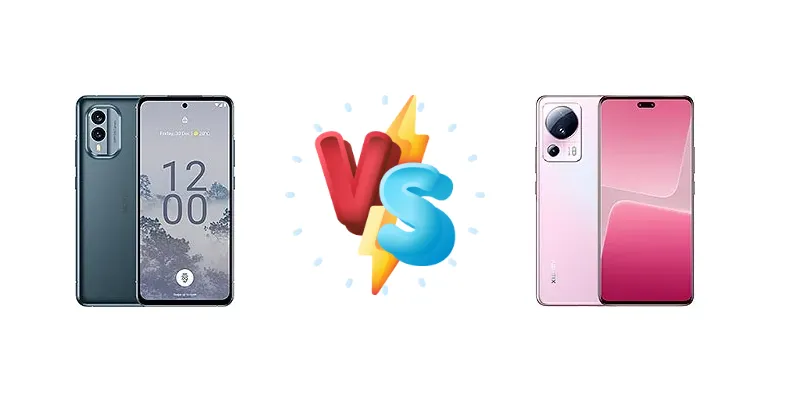
Xiaomi 13 Lite vs Nokia X30: A Detailed Comparison of Mid-Range Contenders
| Phones Images | |||||
|---|---|---|---|---|---|
|
🏆 Quick Verdict
For most users, the Xiaomi 13 Lite emerges as the stronger choice. Its Snapdragon 7 Gen 1 chipset provides a noticeable performance boost over the Nokia X30’s Snapdragon 695, and the 67W charging significantly reduces downtime. While the Nokia boasts comparable battery endurance, the Xiaomi’s overall package is more compelling.
| PHONES | ||
|---|---|---|
| Phone Names | Nokia X30 | Xiaomi 13 Lite |
| Network | ||
|---|---|---|
| 2G bands | GSM 850 / 900 / 1800 / 1900 | GSM 850 / 900 / 1800 / 1900 |
| 3G bands | HSDPA 850 / 900 / 1700(AWS) / 1900 / 2100 | HSDPA 800 / 850 / 900 / 1700(AWS) / 1900 / 2100 |
| 4G bands | 1, 2, 3, 4, 5, 7, 8, 12, 17, 20, 28, 32, 38, 39, 40, 41 | 1, 2, 3, 4, 5, 7, 8, 12, 13, 17, 18, 19, 20, 26, 28, 32, 38, 40, 41, 42, 66 |
| 5G bands | 1, 3, 5, 7, 8, 28, 38, 40, 41, 77, 78 SA/NSA/Sub6 | 1, 3, 5, 7, 8, 20, 28, 38, 40, 41, 66, 77, 78 SA/NSA |
| Speed | HSPA, LTE, 5G | HSPA, LTE, 5G |
| Technology | GSM / HSPA / LTE / 5G | GSM / HSPA / LTE / 5G |
| Launch | ||
|---|---|---|
| Announced | 2022, September 01 | 2023, February 26 |
| Status | Available. Released 2022, September 21 | Available. Released 2023, March 08 |
| Body | ||
|---|---|---|
| Build | Glass front (Gorilla Glass Victus), aluminum frame, plastic back | Glass front (Gorilla Glass 5), glass back, plastic frame |
| Dimensions | 158.9 x 73.9 x 8 mm (6.26 x 2.91 x 0.31 in) | 159.2 x 72.7 x 7.2 mm (6.27 x 2.86 x 0.28 in) |
| SIM | · Nano-SIM + eSIM· Nano-SIM + Nano-SIM | · Nano-SIM + eSIM· Nano-SIM + Nano-SIM |
| Weight | 185 g (6.53 oz) | 171 g (6.03 oz) |
| IP67 dust/water resistant (up to 1m for 30 min) | IP53, dust and splash resistant | |
| Display | ||
|---|---|---|
| Protection | Corning Gorilla Glass Victus | Corning Gorilla Glass 5 |
| Resolution | 1080 x 2400 pixels, 20:9 ratio (~409 ppi density) | 1080 x 2400 pixels, 20:9 ratio (~402 ppi density) |
| Size | 6.43 inches, 99.8 cm2 (~85.0% screen-to-body ratio) | 6.55 inches, 103.6 cm2 (~89.5% screen-to-body ratio) |
| Type | AMOLED, 90Hz, 450 nits (typ), 700 nits (peak) | AMOLED, 68B colors, Dolby Vision, HDR10+, 120Hz, 500 nits (typ), 1000 nits (peak) |
| Platform | ||
|---|---|---|
| CPU | Octa-core (2x2.2 GHz Kryo 660 Gold & 6x1.7 GHz Kryo 660 Silver) | Octa-core (1x2.4 GHz Cortex-A710 & 3x2.36 GHz Cortex-A710 & 4x1.8 GHz Cortex-A510) |
| Chipset | Qualcomm SM6375 Snapdragon 695 5G (6 nm) | Qualcomm SM7450-AB Snapdragon 7 Gen 1 (4 nm) |
| GPU | Adreno 619 | Adreno 644 |
| OS | Android 12, upgradable to Android 13 | Android 12, MIUI 14 |
| Memory | ||
|---|---|---|
| Card slot | No | No |
| Internal | 128GB 6GB RAM, 128GB 8GB RAM, 256GB 8GB RAM | 64GB 8GB RAM, 128GB 8GB RAM, 256GB 8GB RAM |
| UFS 2.2 - 128GB UFS 3.0 - 256GB | UFS 2.2 | |
| Main Camera | ||
|---|---|---|
| Dual | 50 MP, f/1.9, (wide), 1/1.56", 1.0µm, PDAF, OIS 13 MP, f/2.4, 123˚ (ultrawide), 1/3.06" | - |
| Features | LED flash, HDR, panorama | Dual-LED dual-tone flash, HDR, panorama |
| Single | 16 MP, f/2.4, (wide), 1/3.06", 1.0µm | - |
| Triple | - | 50 MP, f/1.8, 23mm (wide), 1/1.56", 1.0µm, PDAF 8 MP, f/2.2, 119˚ (ultrawide), 1/4.0", 1.12µm 2 MP (macro) |
| Video | 1080p@30/60fps | 4K@30fps, 1080p@30/60/120fps, 720p@960fps |
| Selfie camera | ||
|---|---|---|
| Dual | - | 32 MP, f/2.4, 100˚ (ultrawide), 1/2.74", 0.8µm 8 MP, f/2.3, (depth) |
| Features | - | Dual-LED flash, HDR |
| Single | 16 MP, f/2.4, (wide), 1/3.06", 1.0µm | - |
| Video | 1080p@30fps | 1080p@30/60fps |
| Sound | ||
|---|---|---|
| 3.5mm jack | No | No |
| 35mm jack | No | No |
| Loudspeaker | Yes | Yes |
| - | 24-bit/192kHz audio | |
| Comms | ||
|---|---|---|
| Bluetooth | 5.1, A2DP, LE, aptX HD | 5.2, A2DP, LE |
| Infrared port | - | Yes |
| NFC | Yes | Yes (market/region dependent) |
| Positioning | GPS, GLONASS, GALILEO, BDS | GPS (L1), GLONASS (G1), BDS (B1I+B1c), GALILEO (E1), QZSS (L1) |
| Radio | FM radio, RDS | No |
| USB | USB Type-C 2.0, OTG | USB Type-C 2.0, OTG |
| WLAN | Wi-Fi 802.11 a/b/g/n/ac/6, dual-band, Wi-Fi Direct | Wi-Fi 802.11 a/b/g/n/ac/6, dual-band |
| Features | ||
|---|---|---|
| Sensors | Fingerprint (under display, optical), accelerometer, gyro, proximity, compass | Fingerprint (under display, optical), accelerometer, gyro, proximity, compass |
| Battery | ||
|---|---|---|
| Charging | 33W wired, PD3.0 | 67W wired, 100% in 40 min |
| Type | Li-Po 4200 mAh | Li-Po 4500 mAh |
| Misc | ||
|---|---|---|
| Colors | Cloudy Blue, Ice White | Black, Lite Blue, Lite Pink |
| Models | TA-1450, TA-1443 | - |
| Price | $ 399.00 | About 180 EUR |
| SAR EU | 0.79 W/kg (head) 1.37 W/kg (body) | - |
| Tests | ||
|---|---|---|
| Battery life | Endurance rating 94h | Endurance rating 93h |
| Camera | Photo / Video | Photo / Video |
| Display | Contrast ratio: Infinite (nominal) | Contrast ratio: Infinite (nominal) |
| Loudspeaker | -27.5 LUFS (Good) | -28.5 LUFS (Average) |
| Performance | AnTuTu: 403732 (v9) GeekBench: 1920 (v5.1) GFXBench: 17fps (ES 3.1 onscreen) | AnTuTu: 534143 (v9) GeekBench: 2936 (v5.1), 2434 (v6) GFXBench: 33fps (ES 3.1 onscreen) |
Nokia X30
- Sustainable design with recycled materials
- Long-term software support promise
- Comparable battery endurance
- Less powerful Snapdragon 695 chipset
- Slower 33W charging
- Lower peak display brightness
Xiaomi 13 Lite
- Faster Snapdragon 7 Gen 1 chipset
- Significantly faster 67W charging (40 min)
- Brighter display for outdoor visibility
- Less emphasis on sustainable materials
- Potentially shorter software support lifespan
- May not prioritize long-term durability as much as Nokia
Display Comparison
Both the Nokia X30 and Xiaomi 13 Lite feature displays with an 'Infinite' contrast ratio, suggesting deep blacks. However, the Xiaomi 13 Lite pulls ahead with a measured peak brightness of 938 nits, compared to the Nokia X30’s 746 nits. This translates to superior visibility in direct sunlight. While both likely utilize OLED panels, the Xiaomi’s higher brightness makes it the better choice for outdoor use and HDR content consumption. The lack of refresh rate information for both devices makes it difficult to assess motion clarity.
Camera Comparison
Both phones are listed as having 'Photo / Video' capabilities, but lack specific details. Without sensor size, aperture, or OIS information, a direct comparison is difficult. However, given Xiaomi’s history of incorporating competitive camera hardware in the mid-range, it’s reasonable to assume the 13 Lite will offer a more versatile and capable camera system. The Nokia X30 likely focuses on computational photography to enhance image quality, but may fall short in low-light scenarios compared to a Xiaomi with a larger sensor and wider aperture.
Performance
The core difference lies in the chipsets. The Xiaomi 13 Lite’s Snapdragon 7 Gen 1 (4nm) is a significant upgrade over the Nokia X30’s Snapdragon 695 (6nm). The 4nm process node of the 7 Gen 1 offers improved power efficiency and thermal performance, allowing for sustained performance under load. The CPU architecture also favors the Xiaomi, with a 1x2.4 GHz Cortex-A710 prime core and 3x2.36 GHz Cortex-A710 performance cores, versus the Nokia’s 2x2.2 GHz Kryo 660 Gold and 6x1.7 GHz Kryo 660 Silver configuration. This will result in faster app loading times, smoother multitasking, and a better gaming experience on the Xiaomi.
Battery Life
Both devices achieve similar endurance ratings – 94 hours for the Nokia X30 and 93 hours for the Xiaomi 13 Lite. This suggests comparable real-world battery life despite the difference in chipsets. However, the charging speeds are drastically different. The Xiaomi 13 Lite supports 67W wired charging, achieving a full charge in just 40 minutes, while the Nokia X30 is limited to 33W with PD3.0. This faster charging capability significantly reduces downtime and provides a more convenient user experience. The Nokia’s slightly higher endurance rating is offset by the Xiaomi’s charging advantage.
Buying Guide
Buy the Nokia X30 if you prioritize a phone built with recycled materials and long-term software support, and are comfortable with a more modest processor. Buy the Xiaomi 13 Lite if you value faster performance for demanding apps and games, a brighter display, and significantly quicker charging speeds, even if it means sacrificing some of Nokia’s sustainability focus.