
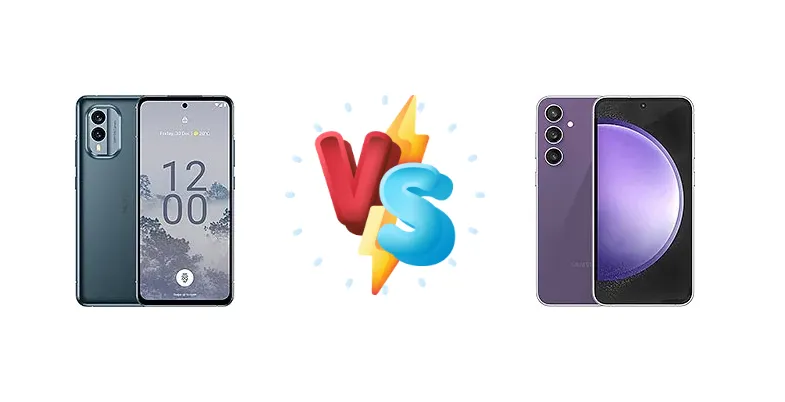
Nokia X30 vs Samsung Galaxy S23 FE: A Detailed Comparison
| Phones Images | |||||
|---|---|---|---|---|---|
|
🏆 Quick Verdict
For most users, the Samsung Galaxy S23 FE is the superior choice. Its significantly more powerful Exynos 2200 (or Snapdragon 8 Gen 1 in the US) chipset and brighter display offer a smoother, more immersive experience. While the Nokia X30 boasts impressive battery endurance, the S23 FE’s faster charging and overall performance outweigh this advantage.
| PHONES | ||
|---|---|---|
| Phone Names | Nokia X30 | Samsung Galaxy S23 FE |
| Network | ||
|---|---|---|
| 2G bands | GSM 850 / 900 / 1800 / 1900 | GSM 850 / 900 / 1800 / 1900 |
| 3G bands | HSDPA 850 / 900 / 1700(AWS) / 1900 / 2100 | HSDPA 850 / 900 / 1700(AWS) / 1900 / 2100 |
| 4G bands | 1, 2, 3, 4, 5, 7, 8, 12, 17, 20, 28, 32, 38, 39, 40, 41 | 1, 2, 3, 4, 5, 7, 8, 12, 13, 17, 20, 26, 28, 38, 40, 41, 66 - International |
| 5G bands | 1, 3, 5, 7, 8, 28, 38, 40, 41, 77, 78 SA/NSA/Sub6 | 1, 2, 3, 5, 7, 8, 20, 28, 38, 40, 41, 66, 77, 78 SA/NSA/Sub6 - International |
| Speed | HSPA, LTE, 5G | HSPA, LTE, 5G |
| Technology | GSM / HSPA / LTE / 5G | GSM / HSPA / LTE / 5G |
| Launch | ||
|---|---|---|
| Announced | 2022, September 01 | 2023, October 04 |
| Status | Available. Released 2022, September 21 | Available. Released 2023, October 05 |
| Body | ||
|---|---|---|
| Build | Glass front (Gorilla Glass Victus), aluminum frame, plastic back | Glass front (Gorilla Glass 5), glass back (Gorilla Glass 5), aluminum frame |
| Dimensions | 158.9 x 73.9 x 8 mm (6.26 x 2.91 x 0.31 in) | 158 x 76.5 x 8.2 mm (6.22 x 3.01 x 0.32 in) |
| SIM | · Nano-SIM + eSIM· Nano-SIM + Nano-SIM | · Nano-SIM· Nano-SIM + Nano-SIM· Nano-SIM + Nano-SIM + eSIM (max 2 at a time) |
| Weight | 185 g (6.53 oz) | 209 g (7.37 oz) |
| IP67 dust/water resistant (up to 1m for 30 min) | - | |
| Display | ||
|---|---|---|
| Protection | Corning Gorilla Glass Victus | Corning Gorilla Glass 5 |
| Resolution | 1080 x 2400 pixels, 20:9 ratio (~409 ppi density) | 1080 x 2340 pixels, 19.5:9 ratio (~403 ppi density) |
| Size | 6.43 inches, 99.8 cm2 (~85.0% screen-to-body ratio) | 6.4 inches, 100.5 cm2 (~83.2% screen-to-body ratio) |
| Type | AMOLED, 90Hz, 450 nits (typ), 700 nits (peak) | Dynamic AMOLED 2X, 120Hz, HDR10+, 1450 nits (peak) |
| Platform | ||
|---|---|---|
| CPU | Octa-core (2x2.2 GHz Kryo 660 Gold & 6x1.7 GHz Kryo 660 Silver) | Octa-core (1x2.8 GHz Cortex-X2 & 3x2.50 GHz Cortex-A710 & 4x1.8 GHz Cortex-A510) - InternationalOcta-core (1x3.00 GHz Cortex-X2 & 3x2.50 GHz Cortex-A710 & 4x1.80 GHz Cortex-A510) - USA |
| Chipset | Qualcomm SM6375 Snapdragon 695 5G (6 nm) | Exynos 2200 (4 nm) - InternationalQualcomm SM8450 Snapdragon 8 Gen 1 (4 nm) - USA |
| GPU | Adreno 619 | Xclipse 920 - InternationalAdreno 730 - USA |
| OS | Android 12, upgradable to Android 13 | Android 13, up to 4 major Android upgrades, One UI 8 |
| Memory | ||
|---|---|---|
| Card slot | No | No |
| Internal | 128GB 6GB RAM, 128GB 8GB RAM, 256GB 8GB RAM | 128GB 8GB RAM, 256GB 8GB RAM |
| UFS 2.2 - 128GB UFS 3.0 - 256GB | - | |
| Main Camera | ||
|---|---|---|
| Dual | 50 MP, f/1.9, (wide), 1/1.56", 1.0µm, PDAF, OIS 13 MP, f/2.4, 123˚ (ultrawide), 1/3.06" | - |
| Features | LED flash, HDR, panorama | LED flash, HDR, panorama |
| Single | 16 MP, f/2.4, (wide), 1/3.06", 1.0µm | - |
| Triple | - | 50 MP, f/1.8, 23mm (wide), 1/1.57", 1.0µm, dual pixel PDAF, OIS 8 MP, f/2.4, 76mm (telephoto), 1/4.5", 1.0µm, PDAF, OIS, 3x optical zoom 12 MP, f/2.2, 13mm, 123˚ (ultrawide), 1/3.0", 1.12µm |
| Video | 1080p@30/60fps | 8K@24fps, 4K@30/60fps, 1080p@30/60/120/240fps |
| Selfie camera | ||
|---|---|---|
| Single | 16 MP, f/2.4, (wide), 1/3.06", 1.0µm | 10 MP, f/2.4, 25mm (wide), 1/3.0", 1.22µm |
| Video | 1080p@30fps | 4K@30/60fps, 1080p@30/60fps; gyro-EIS |
| Sound | ||
|---|---|---|
| 3.5mm jack | No | - |
| 35mm jack | No | No |
| Loudspeaker | Yes | Yes, with stereo speakers |
| Comms | ||
|---|---|---|
| Bluetooth | 5.1, A2DP, LE, aptX HD | 5.3, A2DP, LE |
| NFC | Yes | Yes |
| Positioning | GPS, GLONASS, GALILEO, BDS | GPS, GLONASS, GALILEO, BDS |
| Radio | FM radio, RDS | Unspecified |
| USB | USB Type-C 2.0, OTG | USB Type-C, OTG |
| WLAN | Wi-Fi 802.11 a/b/g/n/ac/6, dual-band, Wi-Fi Direct | Wi-Fi 802.11 a/b/g/n/ac/6e, dual-band, Wi-Fi Direct |
| Features | ||
|---|---|---|
| Sensors | Fingerprint (under display, optical), accelerometer, gyro, proximity, compass | Fingerprint (under display, optical), accelerometer, gyro, compass |
| Battery | ||
|---|---|---|
| Charging | 33W wired, PD3.0 | 25W wired, PD3.0, 50% in 30 min 15W wireless Reverse wireless |
| Type | Li-Po 4200 mAh | Li-Ion 4500 mAh |
| Misc | ||
|---|---|---|
| Colors | Cloudy Blue, Ice White | Mint, Cream, Graphite, Purple, Indigo, Tangerine |
| Models | TA-1450, TA-1443 | SM-S711B, SM-S711B/DS, SM-S711U1, SM-S711U, SM-S711W, SM-S7110, SM-S711N |
| Price | $ 399.00 | $ 219.95 / C$ 327.90 / £ 248.99 / € 272.00 / ₹ 34,999 |
| SAR | - | 0.80 W/kg (head) 0.72 W/kg (body) |
| SAR EU | 0.79 W/kg (head) 1.37 W/kg (body) | 0.76 W/kg (head) 1.04 W/kg (body) |
| Tests | ||
|---|---|---|
| Battery life | Endurance rating 94h | - |
| Camera | Photo / Video | - |
| Display | Contrast ratio: Infinite (nominal) | - |
| Loudspeaker | -27.5 LUFS (Good) | - |
| Performance | AnTuTu: 403732 (v9) GeekBench: 1920 (v5.1) GFXBench: 17fps (ES 3.1 onscreen) | - |
Nokia X30
- Exceptional battery life (94h endurance)
- Eco-conscious design and materials
- Competitive price point
- Significantly weaker processor
- Dimmer display
- Limited camera capabilities
Samsung Galaxy S23 FE
- Powerful Exynos 2200/Snapdragon 8 Gen 1 processor
- Bright and vibrant display
- Faster charging and wireless charging
- Shorter battery life compared to X30
- Potential for thermal throttling (Exynos variant)
- Higher price
Display Comparison
The Samsung Galaxy S23 FE boasts a significantly brighter display, reaching 985 nits compared to the Nokia X30’s 746 nits. This translates to superior visibility in direct sunlight. While both displays have an 'infinite' (nominal) contrast ratio, the S23 FE’s higher peak brightness provides a more dynamic and visually appealing image. The S23 FE’s panel technology is likely to be more advanced, potentially including LTPO for adaptive refresh rates, though this isn’t explicitly stated in the provided data. The Nokia X30’s display, while adequate, will appear dimmer and less vibrant in comparison.
Camera Comparison
Both phones offer photo and video capabilities, but the S23 FE is expected to deliver superior image quality due to its likely larger sensor and more advanced image processing. While specific sensor details are missing, Samsung’s flagship heritage suggests a more sophisticated camera system. The S23 FE likely benefits from features like optical image stabilization (OIS), which the X30 may lack. The Nokia X30’s camera will likely perform adequately in good lighting conditions, but will struggle in low-light scenarios compared to the S23 FE. The inclusion of a 2MP macro camera on either device is largely a marketing gimmick and unlikely to significantly impact image quality.
Performance
The performance gap between these two devices is substantial. The Samsung Galaxy S23 FE utilizes either the Exynos 2200 (international) or Snapdragon 8 Gen 1 (USA), both built on a 4nm process, while the Nokia X30 is powered by the 6nm Snapdragon 695 5G. The Exynos 2200/Snapdragon 8 Gen 1 feature more powerful CPU cores – a Cortex-X2 prime core alongside Cortex-A710 performance cores – compared to the X30’s Kryo 660 Gold and Silver cores. This results in significantly faster app loading times, smoother multitasking, and a much better gaming experience on the S23 FE. The 4nm process also contributes to better thermal efficiency, potentially mitigating throttling during sustained workloads. The X30’s Snapdragon 695 is sufficient for everyday tasks, but will struggle with demanding applications.
Battery Life
The Nokia X30 excels in battery endurance, achieving a remarkable 94-hour rating. However, the Samsung Galaxy S23 FE’s active use score of 8:28 hours, while lower, is still respectable. The S23 FE compensates with faster charging – 25W wired with 50% charge in 30 minutes, plus 15W wireless and reverse wireless charging – features absent on the X30. The X30’s 33W wired charging, while supporting PD3.0, will likely take longer to fully charge the battery. The difference in battery life may be less noticeable in real-world usage, especially considering the S23 FE’s faster charging capabilities.
Buying Guide
Buy the Nokia X30 if you prioritize exceptional battery life and a commitment to eco-conscious design, and are willing to compromise on processing power. It’s ideal for users who primarily use their phone for communication, light social media, and basic tasks. Buy the Samsung Galaxy S23 FE if you demand a more responsive experience for gaming, multitasking, and photography, and value a brighter, more vibrant display. This phone is geared towards power users and content creators.