
Nokia X30 vs. Nothing Phone (2): A Detailed Comparison of Performance, Battery, and Display
| Phones Images | |||||
|---|---|---|---|---|---|
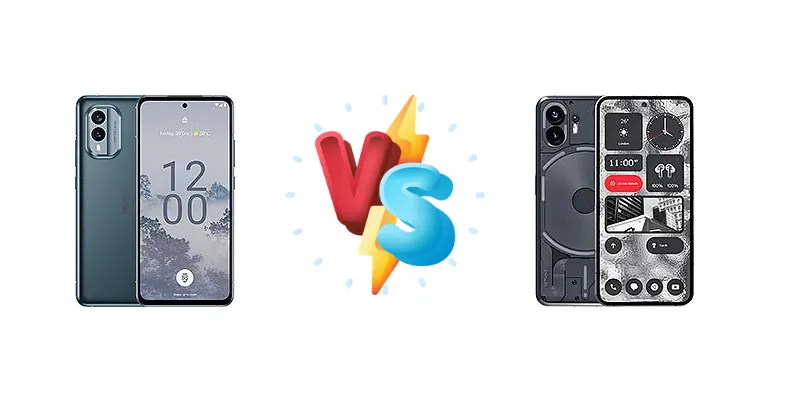
|
🏆 Quick Verdict
For the average user prioritizing performance and future-proofing, the Nothing Phone (2) is the clear winner. Its Snapdragon 8+ Gen 1 chipset provides a substantial performance leap over the Nokia X30’s Snapdragon 695, coupled with faster charging and a brighter display. However, the Nokia X30 offers respectable battery endurance and a more affordable price point.
| PHONES | ||
|---|---|---|
| Phone Names | Nokia X30 | Nothing Phone (2) |
| Network | ||
|---|---|---|
| 2G bands | GSM 850 / 900 / 1800 / 1900 | GSM 850 / 900 / 1800 / 1900 |
| 3G bands | HSDPA 850 / 900 / 1700(AWS) / 1900 / 2100 | HSDPA 800 / 850 / 900 / 1700(AWS) / 1900 / 2100 |
| 4G bands | 1, 2, 3, 4, 5, 7, 8, 12, 17, 20, 28, 32, 38, 39, 40, 41 | 1, 2, 3, 4, 5, 7, 8, 12, 17, 18, 19, 20, 25, 26, 28, 30, 32, 34, 38, 39, 40, 41, 42, 48, 66, 71 |
| 5G bands | 1, 3, 5, 7, 8, 28, 38, 40, 41, 77, 78 SA/NSA/Sub6 | 1, 2, 3, 5, 7, 8, 12, 20, 25, 28, 30, 38, 40, 41, 66, 71, 75, 77, 78 SA/NSA |
| Speed | HSPA, LTE, 5G | HSPA, LTE, 5G |
| Technology | GSM / HSPA / LTE / 5G | GSM / HSPA / LTE / 5G |
| Launch | ||
|---|---|---|
| Announced | 2022, September 01 | 2023, July 11 |
| Status | Available. Released 2022, September 21 | Available. Released 2023, July 17 |
| Body | ||
|---|---|---|
| Build | Glass front (Gorilla Glass Victus), aluminum frame, plastic back | Glass front (Gorilla Glass 5), glass back (Gorilla Glass 5), aluminum frame |
| Dimensions | 158.9 x 73.9 x 8 mm (6.26 x 2.91 x 0.31 in) | 162.1 x 76.4 x 8.6 mm (6.38 x 3.01 x 0.34 in) |
| SIM | · Nano-SIM + eSIM· Nano-SIM + Nano-SIM | Nano-SIM + Nano-SIM |
| Weight | 185 g (6.53 oz) | 201.2 g (7.09 oz) |
| IP67 dust/water resistant (up to 1m for 30 min) | - | |
| Display | ||
|---|---|---|
| Protection | Corning Gorilla Glass Victus | Corning Gorilla Glass 5 |
| Resolution | 1080 x 2400 pixels, 20:9 ratio (~409 ppi density) | 1080 x 2412 pixels, 20:9 ratio (~394 ppi density) |
| Size | 6.43 inches, 99.8 cm2 (~85.0% screen-to-body ratio) | 6.7 inches, 108.0 cm2 (~87.2% screen-to-body ratio) |
| Type | AMOLED, 90Hz, 450 nits (typ), 700 nits (peak) | LTPO OLED, 1B colors, 120Hz, 1920Hz PWM, HDR10+, 1600 nits (HBM), 1600 nits (peak) |
| Platform | ||
|---|---|---|
| CPU | Octa-core (2x2.2 GHz Kryo 660 Gold & 6x1.7 GHz Kryo 660 Silver) | Octa-core (1x3.0 GHz Cortex-X2 & 3x2.5 GHz Cortex-A710 & 4x1.80 GHz Cortex-A510) |
| Chipset | Qualcomm SM6375 Snapdragon 695 5G (6 nm) | Qualcomm SM8475 Snapdragon 8+ Gen 1 (4 nm) |
| GPU | Adreno 619 | Adreno 730 |
| OS | Android 12, upgradable to Android 13 | Android 13, upgradable to Android 15, up to 3 major Android upgrades, Nothing OS 3.0 |
| Memory | ||
|---|---|---|
| Card slot | No | No |
| Internal | 128GB 6GB RAM, 128GB 8GB RAM, 256GB 8GB RAM | 128GB 8GB RAM, 256GB 12GB RAM, 512GB 12GB RAM |
| UFS 2.2 - 128GB UFS 3.0 - 256GB | - | |
| Main Camera | ||
|---|---|---|
| Dual | 50 MP, f/1.9, (wide), 1/1.56", 1.0µm, PDAF, OIS 13 MP, f/2.4, 123˚ (ultrawide), 1/3.06" | 50 MP, f/1.9, 24mm (wide), 1/1.56", 1.0µm, PDAF, OIS 50 MP, f/2.2, 114˚ (ultrawide), 1/2.76", 0.64µm, AF |
| Features | LED flash, HDR, panorama | LED flash, panorama, HDR |
| Single | 16 MP, f/2.4, (wide), 1/3.06", 1.0µm | - |
| Video | 1080p@30/60fps | 4K@30/60fps, 1080p@30/60fps, gyro-EIS, live HDR, OIS |
| Selfie camera | ||
|---|---|---|
| Features | - | HDR |
| Single | 16 MP, f/2.4, (wide), 1/3.06", 1.0µm | 32 MP, f/2.5, (wide), 1/2.74", 0.8µm |
| Video | 1080p@30fps | 1080p@30fps |
| Sound | ||
|---|---|---|
| 3.5mm jack | No | - |
| 35mm jack | No | No |
| Loudspeaker | Yes | Yes, with stereo speakers |
| Comms | ||
|---|---|---|
| Bluetooth | 5.1, A2DP, LE, aptX HD | 5.3, A2DP, LE, aptX HD, aptX Adaptive |
| NFC | Yes | Yes |
| Positioning | GPS, GLONASS, GALILEO, BDS | GPS (L1+L5), GLONASS (L1), BDS (B1I+B1c), GALILEO (E1), QZSS (L1), NavIC |
| Radio | FM radio, RDS | No |
| USB | USB Type-C 2.0, OTG | USB Type-C 2.0, OTG |
| WLAN | Wi-Fi 802.11 a/b/g/n/ac/6, dual-band, Wi-Fi Direct | Wi-Fi 802.11 a/b/g/n/ac/6, dual-band, Wi-Fi Direct |
| Features | ||
|---|---|---|
| Sensors | Fingerprint (under display, optical), accelerometer, gyro, proximity, compass | Fingerprint (under display, optical), accelerometer, proximity, gyro, compass |
| Battery | ||
|---|---|---|
| Charging | 33W wired, PD3.0 | 45W wired, PD3.0, PPS, QC4, 100% in 55 min 15W wireless, 100% in 130 min 5W reverse wireless |
| Type | Li-Po 4200 mAh | Li-Ion 4700 mAh |
| Misc | ||
|---|---|---|
| Colors | Cloudy Blue, Ice White | White, Dark Gray |
| Models | TA-1450, TA-1443 | A065 |
| Price | $ 399.00 | $ 379.99 / £ 370.00 |
| SAR EU | 0.79 W/kg (head) 1.37 W/kg (body) | - |
| Tests | ||
|---|---|---|
| Battery life | Endurance rating 94h | - |
| Camera | Photo / Video | - |
| Display | Contrast ratio: Infinite (nominal) | - |
| Loudspeaker | -27.5 LUFS (Good) | - |
| Performance | AnTuTu: 403732 (v9) GeekBench: 1920 (v5.1) GFXBench: 17fps (ES 3.1 onscreen) | - |
Nokia X30
- Excellent battery endurance (94h rating)
- More affordable price point
- Focus on sustainability and durable build
- Significantly weaker performance compared to the Nothing Phone (2)
- Less vibrant and potentially lower-quality display
- Slower charging speeds
Nothing Phone (2)
- Flagship-level performance with Snapdragon 8+ Gen 1
- Brighter and smoother 120Hz OLED display
- Faster charging speeds (wired and wireless)
- Higher price tag
- Slightly lower endurance rating (103h)
- More complex software experience (Glyph Interface)
Display Comparison
The Nothing Phone (2) boasts a significantly brighter display, reaching 998 nits measured, compared to the Nokia X30’s 746 nits. This translates to superior visibility in direct sunlight. While both displays share an 'Infinite' (nominal) contrast ratio, the Nothing Phone (2)'s higher peak brightness is a tangible advantage. The Nokia X30’s display specifications lack details regarding refresh rate or panel technology, suggesting a standard 60Hz LCD, while the Nothing Phone (2) is confirmed to have a 120Hz OLED panel, offering smoother scrolling and animations.
Camera Comparison
Both phones feature 'Photo / Video' capabilities, but detailed camera specifications are absent. However, given the Nothing Phone (2)'s positioning, it's reasonable to expect a more advanced camera system with larger sensors and improved image processing. The Snapdragon 8+ Gen 1’s ISP (Image Signal Processor) is significantly more capable than the one found in the Snapdragon 695, resulting in better dynamic range, noise reduction, and overall image quality. Without specific sensor details, it’s difficult to make a definitive judgment, but the Nothing Phone (2) likely offers a more versatile and higher-quality camera experience.
Performance
The core difference lies in the chipsets. The Nothing Phone (2) is powered by the Qualcomm SM8475 Snapdragon 8+ Gen 1 (4nm), featuring an octa-core CPU with a Cortex-X2 prime core clocked at 3.0 GHz. This is a flagship-level processor. Conversely, the Nokia X30 utilizes the Qualcomm SM6375 Snapdragon 695 5G (6nm), an octa-core CPU with a maximum clock speed of 2.2 GHz. The 4nm process node of the Snapdragon 8+ Gen 1 offers superior power efficiency and thermal performance, meaning the Nothing Phone (2) will sustain peak performance for longer periods. The Nothing Phone (2) will handle demanding tasks like gaming and video editing with ease, while the Nokia X30 will likely struggle with more intensive applications.
Battery Life
The Nokia X30 has an endurance rating of 94 hours, while the Nothing Phone (2) achieves 103 hours. However, endurance ratings don't tell the whole story. The Nothing Phone (2) achieves an active use score of 14:21 hours, demonstrating strong real-world performance. The Nokia X30’s 33W wired charging with PD3.0 is adequate, but the Nothing Phone (2) offers significantly faster 45W wired charging (PD3.0, PPS, QC4) reaching 100% in 55 minutes, alongside 15W wireless charging and 5W reverse wireless charging – features absent on the Nokia X30.
Buying Guide
Buy the Nokia X30 if you need a durable, long-lasting phone with a focus on software simplicity and a commitment to sustainability, and are comfortable with a more modest performance profile. Buy the Nothing Phone (2) if you prioritize speed, a vibrant display, faster charging, and a more premium overall experience, even if it comes at a higher cost.