
Nokia X30 vs Motorola Edge 40 Neo: A Detailed Comparison
| Phones Images | |||||
|---|---|---|---|---|---|
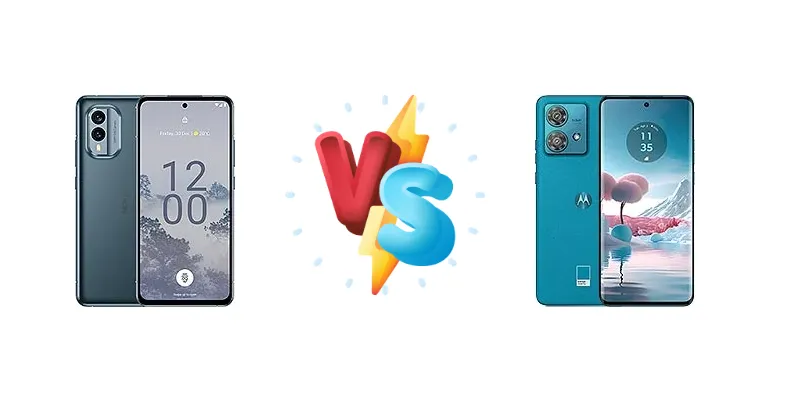
|
🏆 Quick Verdict
For the average user prioritizing display quality and charging speed, the Motorola Edge 40 Neo is the better choice. Its significantly brighter display (1073 nits vs 746 nits) and 68W fast charging offer a more modern user experience, despite slightly lower battery endurance.
| PHONES | ||
|---|---|---|
| Phone Names | Nokia X30 | Motorola Edge 40 Neo |
| Network | ||
|---|---|---|
| 2G bands | GSM 850 / 900 / 1800 / 1900 | GSM 850 / 900 / 1800 / 1900 |
| 3G bands | HSDPA 850 / 900 / 1700(AWS) / 1900 / 2100 | HSDPA 800 / 850 / 900 / 1700(AWS) / 1900 / 2100 |
| 4G bands | 1, 2, 3, 4, 5, 7, 8, 12, 17, 20, 28, 32, 38, 39, 40, 41 | 1, 2, 3, 4, 5, 7, 8, 12, 13, 17, 18, 19, 20, 25, 26, 28, 32, 38, 38, 39, 40, 41, 42, 43, 48, 66 |
| 5G bands | 1, 3, 5, 7, 8, 28, 38, 40, 41, 77, 78 SA/NSA/Sub6 | 1, 2, 3, 5, 7, 8, 20, 28, 38, 40, 41, 66, 77, 78 SA/NSA |
| Speed | HSPA, LTE, 5G | HSPA, LTE, 5G |
| Technology | GSM / HSPA / LTE / 5G | GSM / HSPA / LTE / 5G |
| Launch | ||
|---|---|---|
| Announced | 2022, September 01 | 2023, September 14 |
| Status | Available. Released 2022, September 21 | Available. Released 2023, September 14 |
| Body | ||
|---|---|---|
| Build | Glass front (Gorilla Glass Victus), aluminum frame, plastic back | Glass front (Gorilla Glass 3), plastic frame, plastic back |
| Dimensions | 158.9 x 73.9 x 8 mm (6.26 x 2.91 x 0.31 in) | 159.6 x 72 x 7.9 mm (6.28 x 2.83 x 0.31 in) |
| SIM | · Nano-SIM + eSIM· Nano-SIM + Nano-SIM | · Nano-SIM + eSIM· Nano-SIM + Nano-SIM |
| Weight | 185 g (6.53 oz) | 170 g or 172 g (6.00 oz) |
| IP67 dust/water resistant (up to 1m for 30 min) | - | |
| Display | ||
|---|---|---|
| Protection | Corning Gorilla Glass Victus | Corning Gorilla Glass 3 |
| Resolution | 1080 x 2400 pixels, 20:9 ratio (~409 ppi density) | 1080 x 2400 pixels, 20:9 ratio (~402 ppi density) |
| Size | 6.43 inches, 99.8 cm2 (~85.0% screen-to-body ratio) | 6.55 inches, 103.6 cm2 (~90.1% screen-to-body ratio) |
| Type | AMOLED, 90Hz, 450 nits (typ), 700 nits (peak) | P-OLED, 1B colors, 144Hz, HDR10+, 1300 nits (peak) |
| Platform | ||
|---|---|---|
| CPU | Octa-core (2x2.2 GHz Kryo 660 Gold & 6x1.7 GHz Kryo 660 Silver) | Octa-core (2x2.5 GHz Cortex-A78 & 6x2.0 GHz Cortex-A55) |
| Chipset | Qualcomm SM6375 Snapdragon 695 5G (6 nm) | MediaTek Dimensity 7030 (6 nm) |
| GPU | Adreno 619 | Mali-G610 MC3 |
| OS | Android 12, upgradable to Android 13 | Android 13, up to 2 major Android upgrades |
| Memory | ||
|---|---|---|
| Card slot | No | No |
| Internal | 128GB 6GB RAM, 128GB 8GB RAM, 256GB 8GB RAM | 128GB 8GB RAM, 256GB 8GB RAM, 256GB 12GB RAM |
| UFS 2.2 - 128GB UFS 3.0 - 256GB | - | |
| Main Camera | ||
|---|---|---|
| Dual | 50 MP, f/1.9, (wide), 1/1.56", 1.0µm, PDAF, OIS 13 MP, f/2.4, 123˚ (ultrawide), 1/3.06" | 50 MP, f/1.8, (wide), 1/1.55", 1.0µm, multi-directional PDAF, OIS 13 MP, f/2.2, 120˚ (ultrawide), 1/3.0", 1.12µm, PDAF |
| Features | LED flash, HDR, panorama | LED flash, HDR, panorama |
| Single | 16 MP, f/2.4, (wide), 1/3.06", 1.0µm | - |
| Video | 1080p@30/60fps | 4K@30fps, 1080p@30/60/120/240fps, gyro-EIS |
| Selfie camera | ||
|---|---|---|
| Features | - | HDR |
| Single | 16 MP, f/2.4, (wide), 1/3.06", 1.0µm | 32 MP, f/2.4, (wide), 1/3.0", 0.7µm |
| Video | 1080p@30fps | 4K@30fps, 1080p@30fps |
| Sound | ||
|---|---|---|
| 3.5mm jack | No | - |
| 35mm jack | No | No |
| Loudspeaker | Yes | Yes, with stereo speakers |
| Comms | ||
|---|---|---|
| Bluetooth | 5.1, A2DP, LE, aptX HD | 5.4, A2DP, LE |
| NFC | Yes | Yes |
| Positioning | GPS, GLONASS, GALILEO, BDS | GPS, GLONASS, GALILEO |
| Radio | FM radio, RDS | No |
| USB | USB Type-C 2.0, OTG | USB Type-C 2.0, OTG |
| WLAN | Wi-Fi 802.11 a/b/g/n/ac/6, dual-band, Wi-Fi Direct | Wi-Fi 802.11 a/b/g/n/ac/6e, tri-band, Wi-Fi Direct |
| Features | ||
|---|---|---|
| Sensors | Fingerprint (under display, optical), accelerometer, gyro, proximity, compass | Fingerprint (under display, optical), accelerometer, gyro, proximity, compass |
| Battery | ||
|---|---|---|
| Charging | 33W wired, PD3.0 | 68W wired, 50% in 15 min |
| Type | Li-Po 4200 mAh | Li-Po 5000 mAh |
| Misc | ||
|---|---|---|
| Colors | Cloudy Blue, Ice White | Black, Soothing Sea, Caneel Bay, Peach Fuzz |
| Models | TA-1450, TA-1443 | XT2307-1 |
| Price | $ 399.00 | $ 299.00 / € 168.73 / ₹ 19,900 |
| SAR EU | 0.79 W/kg (head) 1.37 W/kg (body) | - |
| Tests | ||
|---|---|---|
| Battery life | Endurance rating 94h | - |
| Camera | Photo / Video | - |
| Display | Contrast ratio: Infinite (nominal) | - |
| Loudspeaker | -27.5 LUFS (Good) | - |
| Performance | AnTuTu: 403732 (v9) GeekBench: 1920 (v5.1) GFXBench: 17fps (ES 3.1 onscreen) | - |
Nokia X30
- Exceptional battery endurance (94h)
- Focus on sustainability and software support
- Efficient Snapdragon 695 chipset
- Dimmer display (746 nits)
- Slower charging speed (33W)
Motorola Edge 40 Neo
- Brighter display (1073 nits)
- Faster charging (68W, 50% in 15 min)
- More powerful Dimensity 7030 chipset
- Shorter battery endurance (80h)
- Potentially less long-term software support
Display Comparison
The Motorola Edge 40 Neo boasts a considerably brighter display, reaching a measured 1073 nits compared to the Nokia X30’s 746 nits. This difference is immediately noticeable in outdoor visibility, making the Edge 40 Neo far superior in bright sunlight. While both utilize 6nm chipsets, the display’s brightness impacts overall power consumption. The Nokia X30’s contrast ratio is listed as ‘Infinite (nominal)’ which is typical for OLED panels, but lacks specific details on color gamut coverage. The Edge 40 Neo’s panel likely offers a wider color gamut, enhancing the viewing experience for multimedia content.
Camera Comparison
Both devices feature photo and video capabilities, but detailed camera specifications are lacking in the provided data. Without sensor size or aperture information, a direct comparison is difficult. However, given the market positioning, the Edge 40 Neo likely features a more advanced camera system with improved image processing. The inclusion of Optical Image Stabilization (OIS) on the Edge 40 Neo, a common feature in this price range, would provide a significant advantage in low-light photography and video recording. The Nokia X30’s camera is likely adequate for everyday use, but may struggle in challenging lighting conditions.
Performance
Both phones employ 6nm chipsets, but the architectures differ significantly. The Motorola Edge 40 Neo’s MediaTek Dimensity 7030 features 2x2.5 GHz Cortex-A78 cores and 6x2.0 GHz Cortex-A55 cores, while the Nokia X30 utilizes the Qualcomm Snapdragon 695 5G with 2x2.2 GHz Kryo 660 Gold and 6x1.7 GHz Kryo 660 Silver cores. The Cortex-A78 cores in the Dimensity 7030 generally offer higher single-core performance, translating to snappier app launches and smoother multitasking. While both are 5G capable, the Dimensity 7030’s integrated modem may offer slightly faster download speeds depending on network conditions. The Snapdragon 695 is known for its efficiency, potentially contributing to the X30’s longer battery life.
Battery Life
The Nokia X30 claims an impressive 94-hour endurance rating, suggesting exceptional battery life. However, the Motorola Edge 40 Neo compensates for its 80-hour rating with significantly faster charging – 68W wired, capable of reaching 50% charge in just 15 minutes. The X30’s 33W charging with PD3.0 is considerably slower. In real-world usage, the Edge 40 Neo’s active use score of 10:28h demonstrates a respectable performance, but the X30’s endurance rating suggests it will last longer between charges, particularly for users with moderate usage patterns.
Buying Guide
Buy the Nokia X30 if you value long-term software support, a focus on sustainability, and maximizing battery life above all else. Its 94-hour endurance rating is a significant advantage for users who frequently find themselves away from a charger. Buy the Motorola Edge 40 Neo if you prioritize a vibrant, bright display, rapid charging, and a more contemporary design aesthetic. It’s ideal for media consumers and those who want a phone that quickly tops up.