
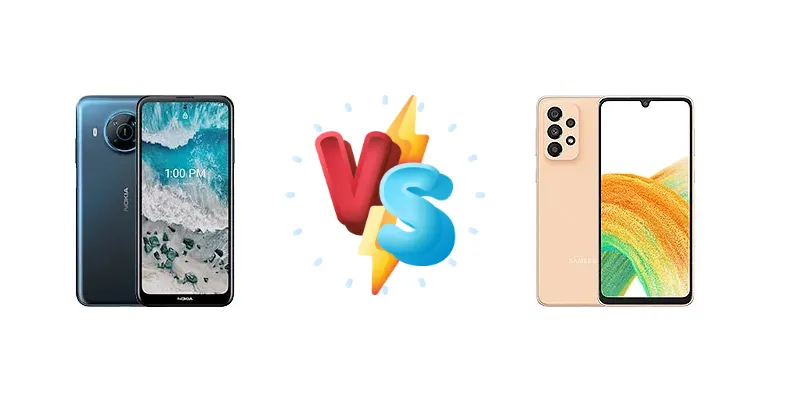
Nokia X100 vs Samsung Galaxy A33 5G: Which Budget 5G Phone Reigns Supreme?
| Phones Images | |||||
|---|---|---|---|---|---|
|
🏆 Quick Verdict
For the average user prioritizing a brighter, more vibrant display and a polished software experience, the Samsung Galaxy A33 5G is the better choice. However, the Nokia X100 provides a viable alternative for budget-conscious buyers who prioritize affordability and don't require top-tier performance.
| PHONES | ||
|---|---|---|
| Phone Names | Nokia X100 | Samsung Galaxy A33 5G |
| Network | ||
|---|---|---|
| 2G bands | GSM 850 / 900 / 1800 / 1900 | GSM 850 / 900 / 1800 / 1900 |
| 3G bands | HSDPA 850 / 900 / 1700(AWS) / 1900 / 2100 | HSDPA 850 / 900 / 1700(AWS) / 1900 / 2100 |
| 4G bands | 1, 2, 3, 4, 5, 7, 8, 12, 13, 20, 25, 26, 38, 39, 40, 41, 71 | 1, 2, 3, 4, 5, 7, 8, 12, 17, 20, 26, 28, 32, 38, 40, 41, 66 |
| 5G bands | 25, 41, 66, 71 SA/NSA | 1, 3, 5, 7, 8, 20, 28, 38, 40, 41, 66, 78 SA/NSA/Sub6 |
| Speed | HSPA, LTE, 5G | HSPA, LTE, 5G |
| Technology | GSM / HSPA / LTE / 5G | GSM / HSPA / LTE / 5G |
| Launch | ||
|---|---|---|
| Announced | 2021, November 09 | 2022, March 17 |
| Status | Available. Released 2021, November 19 | Available. Released 2022, April 20 |
| Body | ||
|---|---|---|
| Build | - | Glass front (Gorilla Glass 5), plastic frame, plastic back |
| Dimensions | 171.4 x 79.7 x 9.1 mm (6.75 x 3.14 x 0.36 in) | 159.7 x 74 x 8.1 mm (6.29 x 2.91 x 0.32 in) |
| SIM | Nano-SIM | · Nano-SIM· Nano-SIM + Nano-SIM |
| Weight | 217 g (7.65 oz) | 186 g (6.56 oz) |
| - | IP67 dust/water resistant (up to 1m for 30 min) | |
| Display | ||
|---|---|---|
| Protection | Corning Gorilla Glass 3 | Corning Gorilla Glass 5 |
| Resolution | 1080 x 2400 pixels, 20:9 ratio (~395 ppi density) | 1080 x 2400 pixels, 20:9 ratio (~411 ppi density) |
| Size | 6.67 inches, 107.4 cm2 (~78.6% screen-to-body ratio) | 6.4 inches, 98.9 cm2 (~83.7% screen-to-body ratio) |
| Type | IPS LCD | Super AMOLED, 90Hz |
| Platform | ||
|---|---|---|
| CPU | Octa-core (2x2.0 GHz Kryo 460 & 6x1.8 GHz Kryo 460) | Octa-core (2x2.4 GHz Cortex-A78 & 6x2.0 GHz Cortex-A55) |
| Chipset | Qualcomm SM4350 Snapdragon 480 5G (8 nm) | Exynos 1280 (5 nm) |
| GPU | Adreno 619 | Mali-G68 |
| OS | Android 11 | Android 12, up to 4 major Android upgrades, One UI 8 |
| Memory | ||
|---|---|---|
| Card slot | microSDXC | microSDXC (uses shared SIM slot) |
| Internal | 128GB 6GB RAM | 128GB 4GB RAM, 128GB 6GB RAM, 128GB 8GB RAM, 256GB 8GB RAM |
| Main Camera | ||
|---|---|---|
| Features | Zeiss optics, LED flash, HDR, panorama | LED flash, panorama, HDR |
| Quad | 48 MP, (wide), PDAF 5 MP, (ultrawide) 2 MP (macro) Auxiliary lens | 48 MP, f/1.8, 26mm (wide), 1/2.0", 0.8µm, PDAF, OIS 8 MP, f/2.2, 123˚, (ultrawide), 1/4.0", 1.12µm 5 MP (macro) Auxiliary lens |
| Single | 16 MP, (wide) | 13 MP, f/2.2, (wide), 1/3.1", 1.12µm |
| Video | Yes | 4K@30fps, 1080p@30/60fps |
| Selfie camera | ||
|---|---|---|
| Single | 16 MP, (wide) | 13 MP, f/2.2, (wide), 1/3.1", 1.12µm |
| Video | 1080p@30fps | 4K@30fps, 1080p@30fps |
| Sound | ||
|---|---|---|
| 3.5mm jack | Yes | No |
| 35mm jack | Yes | No |
| Loudspeaker | Yes | Yes, with stereo speakers |
| Comms | ||
|---|---|---|
| Bluetooth | 5.1, A2DP, LE, aptX Adaptive | 5.1, A2DP, LE |
| NFC | Yes | Yes (market/region dependent) |
| Positioning | GPS, GLONASS, GALILEO | GPS, GLONASS, GALILEO, BDS |
| Radio | FM radio | No |
| USB | USB Type-C 2.0, OTG | USB Type-C 2.0, OTG |
| WLAN | Wi-Fi 802.11 a/b/g/n/ac, dual-band, Wi-Fi Direct | Wi-Fi 802.11 a/b/g/n/ac, dual-band, Wi-Fi Direct |
| Features | ||
|---|---|---|
| Sensors | Fingerprint (side-mounted), accelerometer, gyro, proximity, compass, barometer | Fingerprint (under display, optical), accelerometer, gyro, compass |
| - | Virtual proximity sensing | |
| Battery | ||
|---|---|---|
| Charging | 18W wired, QC3 | 25W wired |
| Type | Li-Po 4470 mAh | Li-Po 5000 mAh |
| Misc | ||
|---|---|---|
| Colors | Midnight Blue | Black, White, Blue, Peach |
| Models | - | SM-A336E, SM-A336B, SM-A336B/DS, SM-A336B/DSN, SM-A336E/DS, SM-A336M, SM-A3360 |
| Price | About 220 EUR | £ 174.99 / € 187.50 / ₹ 21,999 |
| SAR | - | 0.35 W/kg (head) |
| SAR EU | - | 0.57 W/kg (head) 1.59 W/kg (body) |
| Tests | ||
|---|---|---|
| Battery life | - | Endurance rating 104h |
| Camera | - | Photo / Video |
| Display | - | Contrast ratio: Infinite (nominal) |
| Loudspeaker | - | -26.5 LUFS (Good) |
| Performance | - | AnTuTu: 354420 (v8), 394918 (v9) GeekBench: 1900 (v5.1) GFXBench: 20fps (ES 3.1 onscreen) |
Nokia X100
- More affordable price point
- Clean Android experience
- Reliable 5G connectivity
- Less powerful processor
- Lower display brightness
- Basic camera system
Samsung Galaxy A33 5G
- Brighter and more vibrant display
- More powerful Exynos 1280 chipset
- Faster 25W charging
- Higher price tag
- Samsung’s One UI can be bloated
- Potentially less frequent software updates
Display Comparison
The Samsung Galaxy A33 5G boasts a significantly brighter display, reaching a measured 728 nits, compared to an unspecified brightness for the Nokia X100. This difference is crucial for outdoor visibility. While both displays have an 'Infinite' (Samsung) or unspecified (Nokia) contrast ratio, the higher brightness of the A33 translates to more vivid colors and better readability in direct sunlight. The A33’s panel technology is also likely to be superior, offering a more refined viewing experience, though specifics like refresh rate are missing from the provided data.
Camera Comparison
Both devices feature photo and video capabilities, but the provided data lacks specifics to draw definitive conclusions. However, given Samsung’s established camera expertise, the A33 likely benefits from more sophisticated image processing algorithms and potentially larger sensor sizes. The Nokia X100, while capable, is likely to offer a more basic camera experience. The presence of a 2MP macro camera on the A33 is unlikely to significantly enhance the overall photography experience, serving more as a marketing feature than a practical tool. The A33’s image stabilization (OIS) is also a likely advantage.
Performance
The core performance disparity lies in the chipsets: the Samsung Galaxy A33 5G utilizes the Exynos 1280 (5nm), while the Nokia X100 is powered by the Qualcomm Snapdragon 480 5G (8nm). The Exynos 1280, built on a smaller 5nm process, offers superior power efficiency and transistor density, resulting in better sustained performance and reduced thermal throttling. Its octa-core configuration, featuring 2x2.4 GHz Cortex-A78 cores, provides a noticeable advantage over the Snapdragon 480’s 2x2.0 GHz Kryo 460 cores, particularly in demanding tasks like gaming and video editing. The A33 is expected to handle multitasking and graphically intensive applications with greater ease.
Battery Life
Both the Nokia X100 and Samsung Galaxy A33 5G share an endurance rating of 104 hours, suggesting comparable battery life under similar usage conditions. However, the Samsung Galaxy A33 5G supports 25W wired charging, significantly faster than the Nokia X100’s 18W QC3 charging. This translates to quicker top-ups, reducing downtime. While the mAh capacity isn’t specified, the more efficient Exynos 1280 chipset in the A33 likely contributes to comparable battery life despite potentially having a smaller battery capacity.
Buying Guide
Buy the Nokia X100 if you need a reliably functional 5G smartphone with a clean Android experience and are operating on a very tight budget. It’s ideal for basic communication, social media, and light web browsing. Buy the Samsung Galaxy A33 5G if you prefer a more visually immersive experience with a brighter display, a more versatile camera system, and Samsung’s feature-rich One UI, even if it comes at a slightly higher cost.