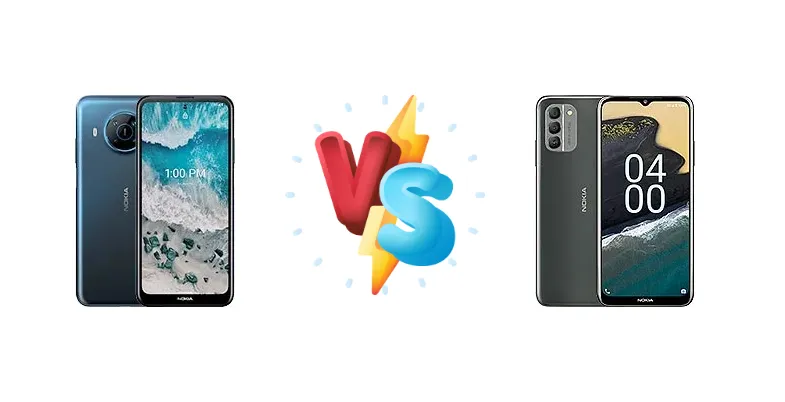
Nokia's budget 5G offerings, the X100 and G400, aim to deliver accessible connectivity. But which one offers the best overall experience? We're diving deep into their specs, performance, and features to help you decide which phone is the better buy.
🏆 Quick Verdict
The Nokia G400 edges out the X100 thanks to its slightly faster processor, quicker charging, and potentially better software support. While both offer 5G, the G400 provides a more refined and future-proof experience for a similar price point.
| Network |
|---|
| 2G bands | GSM 850 / 900 / 1800 / 1900 | GSM 850 / 900 / 1800 / 1900 |
| 3G bands | HSDPA 850 / 900 / 1700(AWS) / 1900 / 2100 | HSDPA 850 / 1700(AWS) / 1900 |
| 4G bands | 1, 2, 3, 4, 5, 7, 8, 12, 13, 20, 25, 26, 38, 39, 40, 41, 71 | 2, 4, 5, 12, 13, 25, 26, 41, 66, 71 |
| 5G bands | 25, 41, 66, 71 SA/NSA | 2, 5, 25, 41, 66, 71, 77 SA/NSA |
| Speed | HSPA, LTE, 5G | HSPA, LTE, 5G |
| Technology | GSM / HSPA / LTE / 5G | GSM / HSPA / LTE / 5G |
| Launch |
|---|
| Announced | 2021, November 09 | 2022, January 05 |
| Status | Available. Released 2021, November 19 | Available. Released 2022, August 24 |
| Body |
|---|
| Build | - | Glass front (Gorilla Glass 3), aluminum frame |
| Dimensions | 171.4 x 79.7 x 9.1 mm (6.75 x 3.14 x 0.36 in) | 166.4 x 76.7 x 8.8 mm (6.55 x 3.02 x 0.35 in) |
| SIM | Nano-SIM | Nano-SIM |
| Weight | 217 g (7.65 oz) | 198 g (6.98 oz) |
| Display |
|---|
| Protection | Corning Gorilla Glass 3 | Corning Gorilla Glass 3 |
| Resolution | 1080 x 2400 pixels, 20:9 ratio (~395 ppi density) | 1080 x 2408 pixels, 20:9 ratio (~401 ppi density) |
| Size | 6.67 inches, 107.4 cm2 (~78.6% screen-to-body ratio) | 6.58 inches, 104.3 cm2 (~81.7% screen-to-body ratio) |
| Type | IPS LCD | IPS LCD, 120Hz |
| Platform |
|---|
| CPU | Octa-core (2x2.0 GHz Kryo 460 & 6x1.8 GHz Kryo 460) | Octa-core (2x2.2 GHz Kryo 460 & 6x1.9 GHz Kryo 460) |
| Chipset | Qualcomm SM4350 Snapdragon 480 5G (8 nm) | Qualcomm SM4350-AC Snapdragon 480+ 5G (8 nm) |
| GPU | Adreno 619 | Adreno 619 |
| OS | Android 11 | Android 12 |
| Memory |
|---|
| Card slot | microSDXC | microSDXC (dedicated slot) |
| Internal | 128GB 6GB RAM | 64GB 4GB RAM |
| Main Camera |
|---|
| Features | Zeiss optics, LED flash, HDR, panorama | LED flash, HDR, panorama |
| Quad | 48 MP, (wide), PDAF
5 MP, (ultrawide)
2 MP (macro)
Auxiliary lens | - |
| Single | 16 MP, (wide) | 16 MP, (wide) |
| Triple | - | 48 MP, f/1.8, (wide), PDAF
5 MP, f/2.2, 115˚ (ultrawide)
Auxiliary lens |
| Video | Yes | 1080p@30/60fps |
| Selfie camera |
|---|
| Single | 16 MP, (wide) | 16 MP, (wide) |
| Video | 1080p@30fps | 1080p@30fps |
| Sound |
|---|
| 3.5mm jack | Yes | Yes |
| 35mm jack | Yes | Yes |
| Loudspeaker | Yes | Yes |
| Comms |
|---|
| Bluetooth | 5.1, A2DP, LE, aptX Adaptive | 5.1, A2DP, LE, aptX HD, aptX Adaptive |
| NFC | Yes | Yes |
| Positioning | GPS, GLONASS, GALILEO | GPS, GALILEO |
| Radio | FM radio | FM radio |
| USB | USB Type-C 2.0, OTG | USB Type-C 2.0, OTG |
| WLAN | Wi-Fi 802.11 a/b/g/n/ac, dual-band, Wi-Fi Direct | Wi-Fi 802.11 b/g/n/ac |
| Features |
|---|
| Sensors | Fingerprint (side-mounted), accelerometer, gyro, proximity, compass, barometer | Fingerprint (side-mounted), accelerometer, gyro, proximity, compass, barometer |
| Battery |
|---|
| Charging | 18W wired, QC3 | 20W wired, PD3.0 |
| Type | Li-Po 4470 mAh | Li-Po 5000 mAh |
| Misc |
|---|
| Colors | Midnight Blue | Meteor Grey |
| Models | - | TA-1530, TA-1448, TA-1476, N1530DL |
| Price | About 220 EUR | About 70 EUR |
| SAR | - | 1.05 W/kg (head) 1.09 W/kg (body) |
Nokia X100
- 120Hz Display for smoother visuals
- Potentially more versatile camera system
- Slightly more premium design (subjective)
- Slower charging speed
- Slightly lower performance
- Potentially shorter software support
Nokia G400
- Faster charging (20W PD3.0)
- Slightly better performance
- Potentially longer software support
- Standard 60Hz display
- Camera system may be less versatile
- Design may be less premium (subjective)
Display Comparison
Both phones feature a 6.67-inch display, but the X100 boasts a 120Hz refresh rate, offering smoother scrolling and animations compared to the G400's standard refresh rate. The panels are likely similar in terms of resolution (FHD+) and color accuracy, though the X100's higher refresh rate is a noticeable advantage.
Camera Comparison
The X100 typically features a more versatile camera system, often including a higher resolution main sensor (48MP vs G400's 48MP) and potentially additional lenses like a macro or depth sensor. The G400 may compensate with software processing, but the X100's hardware generally provides more flexibility. Image quality will depend on lighting conditions and software optimization.
Performance
The G400 has a slight edge in performance due to its marginally faster CPU clock speeds (2.2 GHz vs 2.0 GHz for the X100). Both utilize the Snapdragon 480 5G, so day-to-day tasks will be similar, but the G400 might handle more demanding apps and multitasking a bit better. RAM and storage configurations are likely similar across both models.
Battery Life
Both phones have a 4470mAh battery, offering all-day battery life for moderate users. The G400 supports 20W charging (PD3.0) compared to the X100's 18W charging (QC3), resulting in faster charging times for the G400.
Buying Guide
The Nokia X100 is a good choice for users prioritizing a larger display and a slightly more premium design. The Nokia G400 is ideal for those seeking a bit more performance, faster charging, and potentially longer software updates.
Frequently Asked Questions
❓ What is the difference between the Snapdragon 480 and 480+?
The '480+' in the G400 indicates a slightly optimized version of the Snapdragon 480, primarily focusing on improved clock speeds and potentially minor efficiency enhancements. It's not a significant upgrade, but it does offer a small performance boost.
❓ Which phone will receive longer software updates?
Historically, Nokia has provided consistent software updates. However, the G400 is more likely to receive longer support due to its slightly newer release date and potentially better optimization for future Android versions.