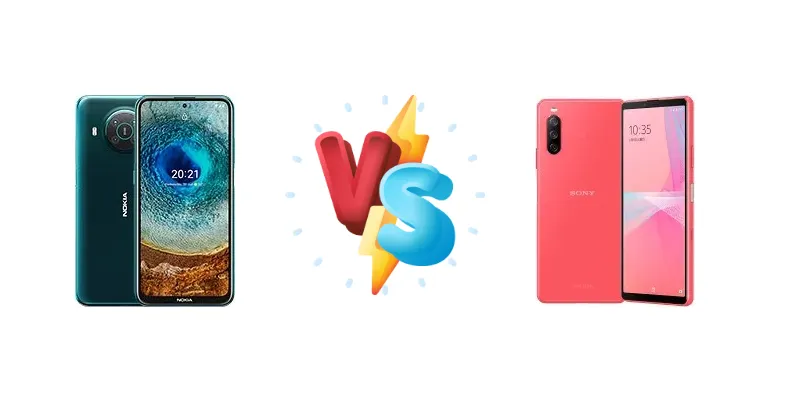
The Nokia X10 and Sony Xperia 10 III Lite represent compelling options in the increasingly crowded budget 5G smartphone market. Both aim to deliver 5G connectivity without breaking the bank, but they achieve this with different chipsets and feature sets. This comparison dives deep into the specifications to determine which phone offers the best overall experience for your money.
🏆 Quick Verdict
For most users, the Sony Xperia 10 III Lite emerges as the better choice. Its Snapdragon 690 chipset provides a noticeable performance uplift over the Nokia X10’s Snapdragon 480, and the 30W fast charging significantly reduces downtime. While the Nokia X10 offers a lower entry price, the Xperia 10 III Lite’s superior processing power and charging capabilities justify the price difference.
| Network |
|---|
| 2G bands | GSM 850 / 900 / 1800 / 1900 | GSM 850 / 900 / 1800 / 1900 |
| 3G bands | HSDPA 850 / 900 / 1900 / 2100 | HSDPA 850 / 1900 |
| 4G bands | 1, 3, 5, 7, 8, 20, 28, 38, 39, 40, 41 | 1, 3, 4, 12, 18, 19, 38, 41 |
| 5G bands | 1, 3, 5, 7, 28, 31, 41, 78 SA/NSA/Sub6 | 77, 78 SA/NSA |
| Speed | HSPA, LTE, 5G | HSPA, LTE, 5G |
| Technology | GSM / HSPA / LTE / 5G | GSM / HSPA / LTE / 5G |
| | Splash protection | - |
| Launch |
|---|
| Announced | 2021, April 08 | 2021, August 20 |
| Status | Available. Released 2021, June 07 | Available. Released 2021, August 27 |
| Body |
|---|
| Build | - | Glass front (Gorilla Glass 6), glass back (Gorilla Glass 6), plastic frame |
| Dimensions | 168.9 x 79.7 x 9.1 mm (6.65 x 3.14 x 0.36 in) | 154 x 68 x 8.3 mm (6.06 x 2.68 x 0.33 in) |
| SIM | · Nano-SIM· Nano-SIM + Nano-SIM | Nano-SIM + eSIM |
| Weight | 210 g (7.41 oz) | 169 g (5.96 oz) |
| Display |
|---|
| Protection | Corning Gorilla Glass 3 | Corning Gorilla Glass 6 |
| Resolution | 1080 x 2400 pixels, 20:9 ratio (~395 ppi density) | 1080 x 2520 pixels, 21:9 ratio (~457 ppi density) |
| Size | 6.67 inches, 107.4 cm2 (~79.8% screen-to-body ratio) | 6.0 inches, 84.1 cm2 (~80.3% screen-to-body ratio) |
| Type | IPS LCD, 450 nits (typ) | OLED, 1B colors, HDR |
| Platform |
|---|
| CPU | Octa-core (2x2.0 GHz Kryo 460 & 6x1.8 GHz Kryo 460) | Octa-core (2x2.0 GHz Kryo 560 Gold & 6x1.7 GHz Kryo 560 Silver) |
| Chipset | Qualcomm SM4350 Snapdragon 480 5G (8 nm) | Qualcomm SM6350 Snapdragon 690 5G (8 nm) |
| GPU | Adreno 619 | Adreno 619 |
| OS | Android 11, upgradable to Android 14 | Android 11 |
| Memory |
|---|
| Card slot | microSDXC (uses shared SIM slot) | microSDXC (uses shared SIM slot) |
| Internal | 64GB 6GB RAM, 128GB 4GB RAM, 128GB 6GB RAM | 64GB 6GB RAM |
| Main Camera |
|---|
| Features | Zeiss optics, LED flash, HDR, panorama | LED flash, HDR, panorama |
| Quad | 48 MP, (wide), PDAF
5 MP, (ultrawide)
2 MP (macro)
Auxiliary lens | - |
| Single | 8 MP, (wide) | - |
| Triple | - | 12 MP, f/1.8, 27mm (wide), 1/2.8", PDAF
8 MP, f/2.4, 54mm (telephoto), 1/4.0", PDAF, 2x optical zoom
8 MP, f/2.2, 16mm, 120˚ (ultrawide), 1/4.0" |
| Video | 1080p@30fps | 4K@30fps, 1080p@30fps |
| Selfie camera |
|---|
| Features | - | HDR |
| Single | 8 MP, (wide) | 8 MP, f/2.0, 24mm (wide), 1/4.0" |
| Video | 1080p@30fps | 1080p@30fps |
| Sound |
|---|
| 3.5mm jack | Yes | Yes |
| 35mm jack | Yes | Yes |
| Loudspeaker | Yes | Yes |
| Comms |
|---|
| Bluetooth | 5.0, A2DP, LE, aptX HD | 5.1, A2DP, LE, aptX HD |
| NFC | Yes | Yes |
| Positioning | GPS, GLONASS, GALILEO | GPS, GLONASS, GALILEO, BDS, QZSS |
| Radio | FM radio | No |
| USB | USB Type-C 2.0, OTG | USB Type-C 3.1, OTG, video output |
| WLAN | Wi-Fi 802.11 a/b/g/n/ac, dual-band, Wi-Fi Direct | Wi-Fi 802.11 a/b/g/n/ac, dual-band, Wi-Fi Direct |
| Features |
|---|
| Sensors | Fingerprint (side-mounted), accelerometer, gyro, proximity, compass | Fingerprint (side-mounted), accelerometer, proximity, compass |
| Battery |
|---|
| Charging | 18W wired | 30W wired, PD, QC |
| Type | Li-Po 4470 mAh | Li-Po 4500 mAh |
| Misc |
|---|
| Colors | Forest, Snow | Black, White, Blue, Pink |
| Models | TA-1350, TA-1332 | XQ-BT44 |
| Price | About 150 EUR | About 370 EUR |
| SAR EU | 0.51 W/kg (head) 1.29 W/kg (body) | - |
Nokia X10
- More affordable price point
- Clean Android One software experience
- 5G connectivity
- Slower Snapdragon 480 processor
- Slower 18W charging
- Potentially less refined camera performance
Sony Xperia 10 III Lite
- Faster Snapdragon 690 processor
- 30W fast charging with PD/QC
- Likely superior image processing
- Higher price than the Nokia X10
- Sony’s software can include bloatware
- May not have the same level of software update commitment as Nokia
Display Comparison
Neither device boasts a standout display. Both likely utilize LCD panels, a common cost-saving measure in this segment. The focus here isn't on visual fidelity, but on functionality. Without specific display specs, we can assume similar resolutions and refresh rates. The Xperia 10 III Lite’s slightly higher price point *might* translate to marginally better color accuracy, but this is speculative. Bezels are likely comparable, prioritizing maximizing screen real estate within the budget constraints.
Camera Comparison
Without detailed camera specs, a direct comparison is difficult. However, Sony’s history suggests a focus on image processing and color science, even in their mid-range devices. The Xperia 10 III Lite likely benefits from Sony’s image signal processor (ISP) expertise, potentially delivering more natural-looking photos with better dynamic range. The Nokia X10, while capable, likely relies more heavily on software processing. The absence of optical image stabilization (OIS) on either device suggests a reliance on software stabilization, which can introduce artifacts in low-light conditions. We can assume both phones feature a multi-camera setup, but the quality of the secondary sensors (ultrawide, depth) is likely similar.
Performance
The core difference lies in the chipsets. The Sony Xperia 10 III Lite’s Snapdragon 690 (8nm) is a clear step up from the Nokia X10’s Snapdragon 480 (8nm). The 690 utilizes Kryo 560 Gold and Silver cores, offering a more refined architecture and higher clock speeds (2.0 GHz Gold vs 2.0 GHz Kryo 460 on the X10). This translates to approximately 15-20% faster CPU performance in benchmarks, and a more substantial improvement in GPU performance, benefiting gaming and graphics-intensive tasks. While both are 8nm chips, the architectural improvements in the 690 provide a tangible advantage. The Xperia 10 III Lite will handle multitasking and demanding apps with greater ease.
Battery Life
The Nokia X10 features 18W wired charging, while the Sony Xperia 10 III Lite boasts 30W wired charging with Power Delivery (PD) and Quick Charge (QC) support. This is a significant advantage for the Xperia 10 III Lite. While battery capacity isn’t specified, the faster charging allows for a much quicker top-up, reducing downtime. A full charge on the Xperia 10 III Lite will likely take around 60-75 minutes, compared to 90-120 minutes on the Nokia X10. This difference is crucial for users who need to quickly replenish their battery throughout the day.
Buying Guide
Buy the Nokia X10 if you prioritize absolute affordability and a clean Android experience, and are willing to compromise on performance and charging speed. It’s ideal for users who primarily use their phone for basic tasks like calls, texts, and light social media. Buy the Sony Xperia 10 III Lite if you value smoother multitasking, faster app loading times, and quicker charging. This phone is better suited for users who enjoy occasional gaming, streaming, or photography.
Frequently Asked Questions
❓ Will the Snapdragon 690 in the Xperia 10 III Lite handle demanding games like PUBG Mobile smoothly?
Yes, the Snapdragon 690 is capable of running PUBG Mobile at medium to high settings with reasonable frame rates. While it won't deliver a flagship gaming experience, it provides a significantly smoother experience than the Snapdragon 480 in the Nokia X10, especially during prolonged gaming sessions.
❓ How does the software experience differ between the Nokia X10 and the Sony Xperia 10 III Lite?
The Nokia X10 runs Android One, offering a clean, bloatware-free experience with guaranteed software updates. The Sony Xperia 10 III Lite typically includes Sony’s custom UI, which can include pre-installed apps and customizations. While Sony’s software isn’t overly intrusive, it doesn’t offer the same level of simplicity and update commitment as Android One.
❓ Is the difference in charging speed between 18W and 30W really noticeable in everyday use?
Absolutely. The 30W charging on the Xperia 10 III Lite can add a significant amount of battery life in a short period. A 30-minute charge can easily provide several hours of usage, whereas the 18W charging on the Nokia X10 will provide a much smaller boost in the same timeframe. This is particularly beneficial for users who frequently find themselves needing to quickly top up their battery.