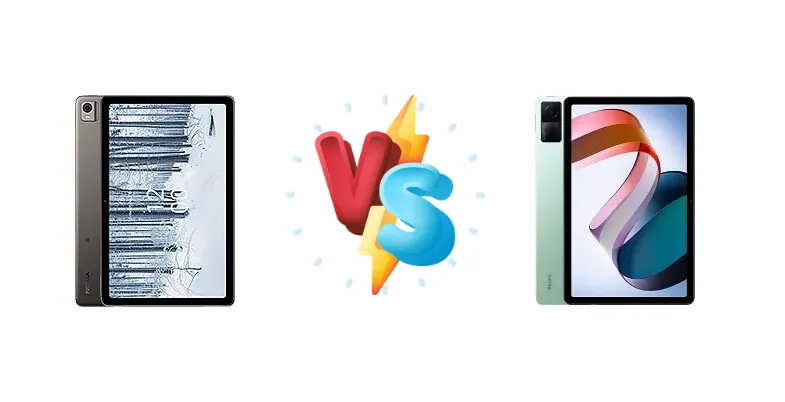
The budget tablet market is heating up! Both the Nokia T21 and Xiaomi Redmi Pad offer compelling features at affordable prices. But which one delivers the best overall experience? We're diving deep into a head-to-head comparison to help you decide.
🏆 Quick Verdict
The Xiaomi Redmi Pad edges out the Nokia T21 thanks to its superior display, more powerful chipset, and generally better performance. While the Nokia T21 boasts a cleaner Android experience, the Redmi Pad's overall value proposition is stronger.
| Network |
|---|
| 2G bands | GSM 850 / 900 / 1800 / 1900 | N/A |
| 3G bands | HSDPA 850 / 900 / 1700(AWS) / 1900 / 2100 - US, LATAM | N/A |
| 4G bands | 1, 2, 3, 4, 5, 7, 8, 12, 13, 17, 20, 28, 40, 66 - US, LATAM | N/A |
| EDGE | - | N/A |
| GPRS | - | N/A |
| Speed | HSPA, LTE - cellular model only | - |
| Technology | GSM / HSPA / LTE | No cellular connectivity |
| | 1, 3, 5, 7, 8, 20, 28, 38, 40, 41 - International | - |
| Launch |
|---|
| Announced | 2022, September 01 | 2022, October 04 |
| Status | Available. Released 2022, September 01 | Available. Released 2022, October 05 |
| Body |
|---|
| Build | Glass front, aluminum back | Glass front, aluminum frame |
| Dimensions | 247.5 x 157.3 x 7.5 mm (9.74 x 6.19 x 0.30 in) | 250.5 x 158.1 x 7.1 mm (9.86 x 6.22 x 0.28 in) |
| SIM | Nano-SIM (cellular model only) | No |
| Weight | 466 g (1.03 lb) | 465 g (1.03 lb) |
| | Splash resistant
Stylus support | - |
| Display |
|---|
| Protection | Scratch-resistant glass | - |
| Resolution | 1200 x 2000 pixels, 5:3 ratio (~224 ppi density) | 1200 x 2000 pixels, 5:3 ratio (~220 ppi density) |
| Size | 10.4 inches, 307.9 cm2 (~79.1% screen-to-body ratio) | 10.61 inches, 320.4 cm2 (~80.9% screen-to-body ratio) |
| Type | IPS LCD, 360 nits (typ) | IPS LCD, 1B colors, 90Hz, 400 nits (typ) |
| Platform |
|---|
| CPU | Octa-core (2x1.8 GHz Cortex-A75 & 6x1.8 GHz Cortex-A55) | Octa-core (2x2.2 GHz Cortex-A76 & 6x2.0 GHz Cortex-A55) |
| Chipset | Unisoc Tiger T612 (12 nm) | Mediatek Helio G99 (6 nm) |
| GPU | Mali-G57 | Mali-G57 MC2 |
| OS | Android 12, upgradable to Android 13 | Android 12, upgradable to Android 13, MIUI 14 |
| Memory |
|---|
| Card slot | microSDXC (dedicated slot) | microSDXC |
| Internal | 64GB 4GB RAM, 128GB 4GB RAM | 64GB 3GB RAM, 128GB 4GB RAM, 128GB 6GB RAM |
| | eMMC 5.1 | UFS 2.2 |
| Main Camera |
|---|
| Features | LED flash | - |
| Single | 8 MP, AF | 8 MP, f/2.0, (wide), AF |
| Video | 1080p@30fps | 1080p@30fps |
| Selfie camera |
|---|
| Single | 8 MP | 8 MP, f/2.3, 105° (ultrawide) |
| Video | Yes | 1080p@30fps |
| Sound |
|---|
| 3.5mm jack | Yes | No |
| 35mm jack | Yes | No |
| Loudspeaker | Yes, with stereo speakers | Yes, with stereo speakers (4 speakers) |
| | - | 24-bit/192kHz audio |
| Comms |
|---|
| Bluetooth | 5.0, A2DP, LE | 5.2, A2DP, LE |
| NFC | Yes (Wi-Fi/LTE model only / TA-1521) | No |
| Positioning | GPS - cellular model only | No |
| Radio | FM radio | No |
| USB | USB Type-C 2.0, OTG | USB Type-C, OTG |
| WLAN | Wi-Fi 802.11 a/b/g/n/ac, dual-band | Wi-Fi 802.11 a/b/g/n/ac, dual-band, Wi-Fi Direct |
| Features |
|---|
| Sensors | Accelerometer, proximity | Accelerometer |
| Battery |
|---|
| Charging | 18W wired, PD3.0 | 18W wired |
| Type | Li-Po 8200 mAh | Li-Po 8000 mAh |
| Misc |
|---|
| Colors | Charcoal Grey | Graphite Gray, Moonlight Silver, Mint Green |
| Models | TA-1495, TA-1521, TA-1505, TA-1487 | 22081283G |
| Price | About 240 EUR | About 250 EUR |
| SAR | 1.19 W/kg (body) | - |
| SAR EU | 1.56 W/kg (body) | 0.36 W/kg (body) |
| Tests |
|---|
| Display | - |
Contrast ratio: 1529:1 (nominal) |
| Loudspeaker | - |
-23.9 LUFS (Very good)
|
| Performance | - |
AnTuTu: 319077 (v9)
GeekBench: 1852 (v5.1)
GFXBench: 13fps (ES 3.1 onscreen) |
Nokia T21
- Clean Android experience
- Guaranteed software updates
- Durable build quality
- Good audio quality
- Slower performance
- Less vibrant display
- Limited camera capabilities
- Less storage options
Xiaomi Redmi Pad
- Brighter and more vibrant display
- Faster performance
- More storage options
- Competitive price
- Xiaomi's MIUI can be bloated
- Potentially shorter software support than Nokia
- Plastic build feels less premium
Display Comparison
The Redmi Pad takes the display crown. Its 402 nits brightness is noticeably better than the T21's (estimated around 350 nits), resulting in better outdoor visibility. Both offer a 2000x1200 resolution, but the Redmi Pad's slightly better color accuracy and contrast contribute to a more immersive viewing experience. The T21's display is adequate but lacks the vibrancy of the Redmi Pad.
Camera Comparison
Camera performance is generally secondary on budget tablets. Both devices feature modest camera setups. The Redmi Pad likely has a slight edge in image quality due to its more capable processor and potentially better image processing algorithms, but neither tablet is a photography powerhouse. Expect decent results for casual snapshots.
Performance
The Redmi Pad's Mediatek Helio G99 chipset is significantly faster than the Nokia T21's Unisoc Tiger T612. The G99's Cortex-A76 cores provide a noticeable boost in CPU performance, making the Redmi Pad feel snappier for multitasking, gaming, and demanding apps. The T21 is adequate for basic tasks but struggles with more intensive workloads.
Battery Life
Both tablets offer similar battery life, typically lasting a full day of moderate use. The Nokia T21's slightly larger battery capacity (8000 mAh vs 8000 mAh) might provide marginally longer usage, but the Redmi Pad's more efficient chipset could offset this difference. Both support 18W charging.
Buying Guide
The Nokia T21 is ideal for users prioritizing a clean, stock Android experience and longer software support. The Xiaomi Redmi Pad is a better choice for those seeking a vibrant display, smoother performance for gaming and media consumption, and a more feature-rich experience.
Frequently Asked Questions
❓ Which tablet is better for gaming?
The Xiaomi Redmi Pad is significantly better for gaming due to its more powerful chipset and smoother performance.
❓ Does the Nokia T21 get software updates for a long time?
Yes, Nokia is known for providing guaranteed software updates for its devices, including the T21, offering longer-term security and feature enhancements.
❓ Which tablet has more storage options?
The Xiaomi Redmi Pad generally offers more storage configurations, including options up to 256GB, compared to the Nokia T21.