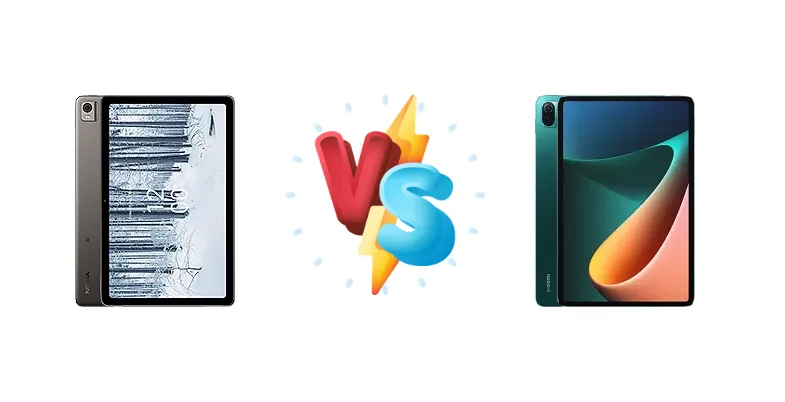
The tablet market is heating up, and two contenders vying for your attention are the Nokia T21 and the Xiaomi Pad 5. Both offer compelling features, but cater to different needs and budgets. Let's dive into a detailed comparison to help you decide which one is right for you.
🏆 Quick Verdict
The Xiaomi Pad 5 is the clear winner for most users, boasting a significantly more powerful processor, brighter display, and faster charging. The Nokia T21 offers a more budget-friendly option with a focus on durability and clean Android, but falls short in performance.
| Network |
|---|
| 2G bands | GSM 850 / 900 / 1800 / 1900 | N/A |
| 3G bands | HSDPA 850 / 900 / 1700(AWS) / 1900 / 2100 - US, LATAM | N/A |
| 4G bands | 1, 2, 3, 4, 5, 7, 8, 12, 13, 17, 20, 28, 40, 66 - US, LATAM | - |
| EDGE | - | N/A |
| GPRS | - | N/A |
| Speed | HSPA, LTE - cellular model only | - |
| Technology | GSM / HSPA / LTE | No cellular connectivity |
| | 1, 3, 5, 7, 8, 20, 28, 38, 40, 41 - International | - |
| Launch |
|---|
| Announced | 2022, September 01 | 2021, August 10 |
| Status | Available. Released 2022, September 01 | Available. Released 2021, August 10 |
| Body |
|---|
| Build | Glass front, aluminum back | Glass front, aluminum frame, plastic back |
| Dimensions | 247.5 x 157.3 x 7.5 mm (9.74 x 6.19 x 0.30 in) | 254.7 x 166.3 x 6.9 mm (10.03 x 6.55 x 0.27 in) |
| SIM | Nano-SIM (cellular model only) | No |
| Weight | 466 g (1.03 lb) | 511 g (1.13 lb) |
| | Splash resistant
Stylus support | Stylus support (magnetic) |
| Display |
|---|
| Protection | Scratch-resistant glass | - |
| Resolution | 1200 x 2000 pixels, 5:3 ratio (~224 ppi density) | 1600 x 2560 pixels, 16:10 ratio (~274 ppi density) |
| Size | 10.4 inches, 307.9 cm2 (~79.1% screen-to-body ratio) | 11.0 inches, 350.9 cm2 (~82.8% screen-to-body ratio) |
| Type | IPS LCD, 360 nits (typ) | IPS LCD, 1B colors, 120Hz, HDR10, Dolby Vision |
| Platform |
|---|
| CPU | Octa-core (2x1.8 GHz Cortex-A75 & 6x1.8 GHz Cortex-A55) | Octa-core (1x2.96 GHz Kryo 485 Gold & 3x2.42 GHz Kryo 485 Gold & 4x1.78 GHz Kryo 485 Silver) |
| Chipset | Unisoc Tiger T612 (12 nm) | Qualcomm Snapdragon 860 (7 nm) |
| GPU | Mali-G57 | Adreno 640 |
| OS | Android 12, upgradable to Android 13 | Android 11, upgradable to Android 13, MIUI 14 |
| Memory |
|---|
| Card slot | microSDXC (dedicated slot) | No |
| Internal | 64GB 4GB RAM, 128GB 4GB RAM | 128GB 6GB RAM, 256GB 6GB RAM |
| | eMMC 5.1 | UFS 3.1 |
| Main Camera |
|---|
| Features | LED flash | Dual-LED flash, HDR, panorama |
| Single | 8 MP, AF | 13 MP, f/2.0 |
| Video | 1080p@30fps | 4K@30fps, 1080p@30fps |
| Selfie camera |
|---|
| Single | 8 MP | 8 MP, f/2.0 |
| Video | Yes | 1080p@30fps |
| Sound |
|---|
| 3.5mm jack | Yes | No |
| 35mm jack | Yes | No |
| Loudspeaker | Yes, with stereo speakers | Yes, with stereo speakers (4 speakers) |
| | - | 24-bit/192kHz audio |
| Comms |
|---|
| Bluetooth | 5.0, A2DP, LE | 5.0, A2DP, LE |
| NFC | Yes (Wi-Fi/LTE model only / TA-1521) | No |
| Positioning | GPS - cellular model only | No |
| Radio | FM radio | No |
| USB | USB Type-C 2.0, OTG | USB Type-C |
| WLAN | Wi-Fi 802.11 a/b/g/n/ac, dual-band | Wi-Fi 802.11 a/b/g/n/ac, dual-band, Wi-Fi Direct |
| Features |
|---|
| Sensors | Accelerometer, proximity | Accelerometer, gyro, proximity, compass |
| Battery |
|---|
| Charging | 18W wired, PD3.0 | 33W wired, PD3.0 |
| Type | Li-Po 8200 mAh | Li-Po 8720 mAh |
| Misc |
|---|
| Colors | Charcoal Grey | Cosmic Gray, Pearl White, Green |
| Models | TA-1495, TA-1521, TA-1505, TA-1487 | 21051182G, 21051182C |
| Price | About 240 EUR | About 350 EUR |
| SAR | 1.19 W/kg (body) | - |
| SAR EU | 1.56 W/kg (body) | - |
| Tests |
|---|
| Display | - |
Contrast ratio: 1271:1 (nominal) |
| Loudspeaker | - |
-24.4 LUFS (Very good)
|
| Performance | - |
AnTuTu: 473819 (v8), 555079 (v9)
GeekBench: 2583 (v5.1)
GFXBench: 24fps (ES 3.1 onscreen) |
Nokia T21
- Clean Android experience
- Durable build quality
- Affordable price
- Good for basic tasks
- Underpowered processor
- Lower brightness display
- Slower charging
- Limited gaming capabilities
Xiaomi Pad 5
- Powerful Snapdragon 860 processor
- Bright and vibrant display
- Fast charging (33W)
- Excellent for gaming and multitasking
- Higher price point
- MIUI software (can be polarizing)
- Potentially less durable than Nokia
Display Comparison
The Xiaomi Pad 5 takes a commanding lead in the display department. Its 1271:1 contrast ratio and 478 nits brightness offer a significantly more vibrant and enjoyable viewing experience compared to the T21. While both have similar contrast ratios nominally, the Xiaomi Pad 5's brightness makes a noticeable difference. The Xiaomi Pad 5 also likely has a higher resolution, further enhancing its visual appeal.
Camera Comparison
Camera quality is generally not a primary concern for tablets, but the Xiaomi Pad 5 likely offers slightly better image quality due to its more advanced chipset and potentially better sensors. Both are unlikely to rival smartphone cameras.
Performance
Performance is where the Xiaomi Pad 5 truly shines. The Snapdragon 860 is a substantial upgrade over the Unisoc Tiger T612. Expect smoother multitasking, faster app loading times, and a much better gaming experience on the Xiaomi Pad 5. The T21 is adequate for basic tasks, but struggles with demanding applications.
Battery Life
Both tablets offer decent battery life, but the Xiaomi Pad 5's 33W charging provides a significant advantage. It will charge much faster than the Nokia T21's 18W charging. Battery capacity is likely similar, resulting in comparable usage times.
Buying Guide
The Nokia T21 is ideal for users seeking a reliable, budget-friendly tablet for basic tasks like browsing, reading, and light media consumption. The Xiaomi Pad 5 is perfect for those who want a powerful tablet for gaming, multitasking, and content creation, and appreciate a vibrant display.
Frequently Asked Questions
❓ Which tablet is better for gaming?
The Xiaomi Pad 5 is significantly better for gaming due to its powerful Snapdragon 860 processor and superior cooling.
❓ Is the Nokia T21 good for students?
The Nokia T21 is suitable for students needing a basic tablet for note-taking and research, but the Xiaomi Pad 5 offers a more versatile experience for demanding coursework.
❓ What software do these tablets run?
The Nokia T21 runs a clean version of Android, while the Xiaomi Pad 5 runs MIUI, Xiaomi's custom Android skin.