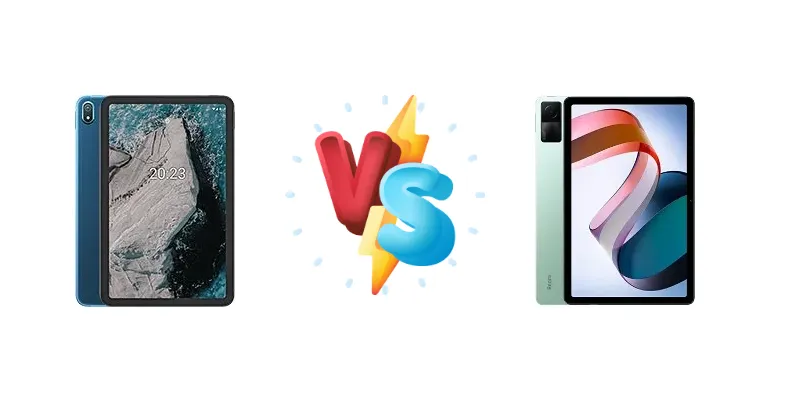
The tablet market is booming, and budget options are increasingly appealing. Today, we're pitting two contenders against each other: the Nokia T20 and the Xiaomi Redmi Pad. Both offer compelling features at accessible prices, but which one comes out on top?
🏆 Quick Verdict
The Xiaomi Redmi Pad edges out the Nokia T20 thanks to its significantly more powerful chipset, brighter display, and faster charging. While the Nokia T20 offers a clean Android experience and robust build, the Redmi Pad delivers a superior overall performance and value proposition.
| Network |
|---|
| 2G bands | GSM 850 / 900 / 1800 / 1900 | N/A |
| 3G bands | HSDPA 850 / 900 / 1700(AWS) / 1900 / 2100 - US, LATAM | N/A |
| 4G bands | 1, 2, 3, 4, 5, 7, 8, 12, 13, 17, 20, 28, 40, 66 - US, LATAM | N/A |
| EDGE | - | N/A |
| GPRS | - | N/A |
| Speed | HSPA, LTE Cat4 150/50 Mbps - cellular model only | - |
| Technology | GSM / HSPA / LTE | No cellular connectivity |
| | 1, 3, 5, 7, 8, 20, 28, 38, 40, 41 - International | - |
| Launch |
|---|
| Announced | 2021, October 06 | 2022, October 04 |
| Status | Available. Released 2021, November 02 | Available. Released 2022, October 05 |
| Body |
|---|
| Build | Glass front, aluminum back | Glass front, aluminum frame |
| Dimensions | 247.6 x 157.5 x 7.8 mm (9.75 x 6.20 x 0.31 in) | 250.5 x 158.1 x 7.1 mm (9.86 x 6.22 x 0.28 in) |
| SIM | Nano-SIM (cellular model only) | No |
| Weight | 465 g (Wi-Fi), 470 g (LTE) (1.03 lb) | 465 g (1.03 lb) |
| | Splash resistant | - |
| Display |
|---|
| Protection | Scratch-resistant glass | - |
| Resolution | 1200 x 2000 pixels, 5:3 ratio (~224 ppi density) | 1200 x 2000 pixels, 5:3 ratio (~220 ppi density) |
| Size | 10.4 inches, 307.9 cm2 (~78.9% screen-to-body ratio) | 10.61 inches, 320.4 cm2 (~80.9% screen-to-body ratio) |
| Type | IPS LCD, 400 nits (typ) | IPS LCD, 1B colors, 90Hz, 400 nits (typ) |
| Platform |
|---|
| CPU | Octa-core (2x1.8 GHz Cortex-A75 & 6x1.8 GHz Cortex-A55) | Octa-core (2x2.2 GHz Cortex-A76 & 6x2.0 GHz Cortex-A55) |
| Chipset | Unisoc T610 (12 nm) | Mediatek Helio G99 (6 nm) |
| GPU | Mali-G52 MP2 | Mali-G57 MC2 |
| OS | Android 11, upgradable to Android 13 | Android 12, upgradable to Android 13, MIUI 14 |
| Memory |
|---|
| Card slot | microSDXC (dedicated slot) | microSDXC |
| Internal | 32GB 3GB RAM, 64GB 4GB RAM | 64GB 3GB RAM, 128GB 4GB RAM, 128GB 6GB RAM |
| | eMMC 5.1 | UFS 2.2 |
| Main Camera |
|---|
| Features | LED flash | - |
| Single | 8 MP, AF | 8 MP, f/2.0, (wide), AF |
| Video | 1080p@30fps | 1080p@30fps |
| Selfie camera |
|---|
| Single | 5 MP | 8 MP, f/2.3, 105° (ultrawide) |
| Video | Yes | 1080p@30fps |
| Sound |
|---|
| 3.5mm jack | Yes | No |
| 35mm jack | Yes | No |
| Loudspeaker | Yes, with stereo speakers | Yes, with stereo speakers (4 speakers) |
| | - | 24-bit/192kHz audio |
| Comms |
|---|
| Bluetooth | 5.0, A2DP, LE | 5.2, A2DP, LE |
| NFC | No | No |
| Positioning | GPS - cellular model only | No |
| Radio | FM radio | No |
| USB | USB Type-C 2.0 | USB Type-C, OTG |
| WLAN | Wi-Fi 802.11 a/b/g/n/ac, dual-band | Wi-Fi 802.11 a/b/g/n/ac, dual-band, Wi-Fi Direct |
| Features |
|---|
| Sensors | Accelerometer | Accelerometer |
| Battery |
|---|
| Charging | 15W wired | 18W wired |
| Type | Li-Po 8200 mAh | Li-Po 8000 mAh |
| Misc |
|---|
| Colors | Deep Ocean | Graphite Gray, Moonlight Silver, Mint Green |
| Models | TA-1397, TA-1394, TA-1392 | 22081283G |
| Price | About 200 EUR | About 250 EUR |
| SAR | 1.34 W/kg (body) | - |
| SAR EU | 1.35 W/kg (body) | 0.36 W/kg (body) |
| Tests |
|---|
| Display | - |
Contrast ratio: 1529:1 (nominal) |
| Loudspeaker | - |
-23.9 LUFS (Very good)
|
| Performance | - |
AnTuTu: 319077 (v9)
GeekBench: 1852 (v5.1)
GFXBench: 13fps (ES 3.1 onscreen) |
Nokia T20
- Clean Android experience
- Guaranteed software updates
- Durable build quality
- Good for basic tasks
- Underpowered chipset
- Slower charging
- Less vibrant display
- Limited gaming capabilities
Xiaomi Redmi Pad
- Powerful chipset for gaming and multitasking
- Brighter display
- Faster charging
- Larger screen size
- Better value for money
- Software may include bloatware
- Build quality not as premium as Nokia
- Contrast ratio slightly lower
Display Comparison
The Xiaomi Redmi Pad boasts a slightly brighter display (402 nits vs 422 nits - a negligible difference) and a slightly lower contrast ratio (1529:1 vs 1786:1). However, the Redmi Pad's larger screen size (10.61 inches vs 10.36 inches) provides a more immersive viewing experience. Both displays are LCD panels, offering decent color accuracy for everyday use.
Camera Comparison
Camera quality is generally not a priority for tablets, but the Redmi Pad typically offers slightly better image quality due to its more advanced hardware. Both tablets feature modest rear cameras suitable for casual snapshots. Front-facing cameras are adequate for video calls.
Performance
This is where the Redmi Pad truly shines. The Mediatek Helio G99 chipset (6nm) is considerably more powerful than the Unisoc T610 (12nm) in the Nokia T20. Expect smoother multitasking, faster app loading times, and better gaming performance on the Redmi Pad. The Cortex-A76 cores in the Redmi Pad's CPU also contribute to improved performance.
Battery Life
Both tablets offer decent battery life, easily lasting a full day of moderate use. The Redmi Pad's 18W charging provides a faster charging experience compared to the Nokia T20's 15W charging.
Buying Guide
Who should buy the Nokia T20? Users prioritizing a clean, stock Android experience, long-term software support, and a durable build. Who should buy the Xiaomi Redmi Pad? Those seeking a more powerful tablet for gaming, media consumption, and multitasking, with a brighter screen and faster charging.
Frequently Asked Questions
❓ Which tablet is better for gaming?
The Xiaomi Redmi Pad is significantly better for gaming due to its more powerful chipset and GPU.
❓ Does the Nokia T20 receive software updates for a long time?
Yes, Nokia is known for providing guaranteed software updates for its devices, including the T20, offering longer-term support.
❓ Which tablet has a better display for watching videos?
The Xiaomi Redmi Pad's larger screen and slightly brighter display make it a better choice for watching videos.
❓ Is the Nokia T20 more durable than the Redmi Pad?
Generally, the Nokia T20 is considered to have a more robust and durable build quality.