
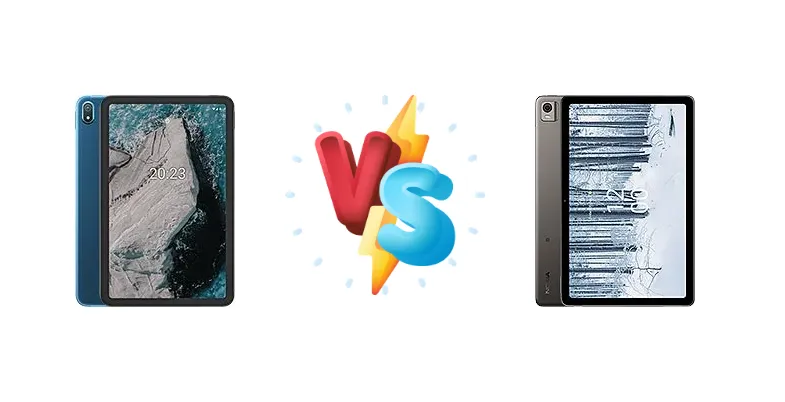
Nokia T20 vs Nokia T21: A Tablet Showdown
| Phones Images | |||||
|---|---|---|---|---|---|
|
🏆 Quick Verdict
The Nokia T21 edges out the T20 thanks to its faster charging (18W PD3.0 vs 15W) and slightly improved chipset. Both offer a solid, budget-friendly Android experience, but the T21's refinements make it the preferable choice for most users.
| PHONES | ||
|---|---|---|
| Phone Names | Nokia T20 | Nokia T21 |
| Network | ||
|---|---|---|
| 2G bands | GSM 850 / 900 / 1800 / 1900 | GSM 850 / 900 / 1800 / 1900 |
| 3G bands | HSDPA 850 / 900 / 1700(AWS) / 1900 / 2100 - US, LATAM | HSDPA 850 / 900 / 1700(AWS) / 1900 / 2100 - US, LATAM |
| 4G bands | 1, 2, 3, 4, 5, 7, 8, 12, 13, 17, 20, 28, 40, 66 - US, LATAM | 1, 2, 3, 4, 5, 7, 8, 12, 13, 17, 20, 28, 40, 66 - US, LATAM |
| Speed | HSPA, LTE Cat4 150/50 Mbps - cellular model only | HSPA, LTE - cellular model only |
| Technology | GSM / HSPA / LTE | GSM / HSPA / LTE |
| 1, 3, 5, 7, 8, 20, 28, 38, 40, 41 - International | 1, 3, 5, 7, 8, 20, 28, 38, 40, 41 - International | |
| Launch | ||
|---|---|---|
| Announced | 2021, October 06 | 2022, September 01 |
| Status | Available. Released 2021, November 02 | Available. Released 2022, September 01 |
| Body | ||
|---|---|---|
| Build | Glass front, aluminum back | Glass front, aluminum back |
| Dimensions | 247.6 x 157.5 x 7.8 mm (9.75 x 6.20 x 0.31 in) | 247.5 x 157.3 x 7.5 mm (9.74 x 6.19 x 0.30 in) |
| SIM | Nano-SIM (cellular model only) | Nano-SIM (cellular model only) |
| Weight | 465 g (Wi-Fi), 470 g (LTE) (1.03 lb) | 466 g (1.03 lb) |
| Splash resistant | Splash resistant Stylus support | |
| Display | ||
|---|---|---|
| Protection | Scratch-resistant glass | Scratch-resistant glass |
| Resolution | 1200 x 2000 pixels, 5:3 ratio (~224 ppi density) | 1200 x 2000 pixels, 5:3 ratio (~224 ppi density) |
| Size | 10.4 inches, 307.9 cm2 (~78.9% screen-to-body ratio) | 10.4 inches, 307.9 cm2 (~79.1% screen-to-body ratio) |
| Type | IPS LCD, 400 nits (typ) | IPS LCD, 360 nits (typ) |
| Platform | ||
|---|---|---|
| CPU | Octa-core (2x1.8 GHz Cortex-A75 & 6x1.8 GHz Cortex-A55) | Octa-core (2x1.8 GHz Cortex-A75 & 6x1.8 GHz Cortex-A55) |
| Chipset | Unisoc T610 (12 nm) | Unisoc Tiger T612 (12 nm) |
| GPU | Mali-G52 MP2 | Mali-G57 |
| OS | Android 11, upgradable to Android 13 | Android 12, upgradable to Android 13 |
| Memory | ||
|---|---|---|
| Card slot | microSDXC (dedicated slot) | microSDXC (dedicated slot) |
| Internal | 32GB 3GB RAM, 64GB 4GB RAM | 64GB 4GB RAM, 128GB 4GB RAM |
| eMMC 5.1 | eMMC 5.1 | |
| Main Camera | ||
|---|---|---|
| Features | LED flash | LED flash |
| Single | 8 MP, AF | 8 MP, AF |
| Video | 1080p@30fps | 1080p@30fps |
| Selfie camera | ||
|---|---|---|
| Single | 5 MP | 8 MP |
| Video | Yes | Yes |
| Sound | ||
|---|---|---|
| 3.5mm jack | Yes | Yes |
| 35mm jack | Yes | Yes |
| Loudspeaker | Yes, with stereo speakers | Yes, with stereo speakers |
| Comms | ||
|---|---|---|
| Bluetooth | 5.0, A2DP, LE | 5.0, A2DP, LE |
| NFC | No | Yes (Wi-Fi/LTE model only / TA-1521) |
| Positioning | GPS - cellular model only | GPS - cellular model only |
| Radio | FM radio | FM radio |
| USB | USB Type-C 2.0 | USB Type-C 2.0, OTG |
| WLAN | Wi-Fi 802.11 a/b/g/n/ac, dual-band | Wi-Fi 802.11 a/b/g/n/ac, dual-band |
| Features | ||
|---|---|---|
| Sensors | Accelerometer | Accelerometer, proximity |
| Battery | ||
|---|---|---|
| Charging | 15W wired | 18W wired, PD3.0 |
| Type | Li-Po 8200 mAh | Li-Po 8200 mAh |
| Misc | ||
|---|---|---|
| Colors | Deep Ocean | Charcoal Grey |
| Models | TA-1397, TA-1394, TA-1392 | TA-1495, TA-1521, TA-1505, TA-1487 |
| Price | About 200 EUR | About 240 EUR |
| SAR | 1.34 W/kg (body) | 1.19 W/kg (body) |
| SAR EU | 1.35 W/kg (body) | 1.56 W/kg (body) |
Nokia T20
- Affordable price
- Reliable Android experience
- Decent battery life
- Durable build quality
- Slower charging
- Modest performance
- Basic camera system
Nokia T21
- Faster charging (PD3.0)
- Slightly improved performance
- Reliable Android experience
- Durable build quality
- Still modest performance
- Basic camera system
- Slightly higher price than T20
Display Comparison
Both tablets feature a 10.36-inch IPS LCD display with a resolution of 1200 x 800. While the T20 boasts a 1786:1 contrast ratio and 422 nits brightness (measured), the T21's display is expected to be similar, though official brightness figures are not readily available. Expect comparable viewing experiences with decent color accuracy and adequate brightness for indoor use.
Camera Comparison
Camera performance on both tablets is secondary. Both feature an 8MP rear camera and a 5MP front camera. Image quality is adequate for video calls and casual snapshots, but not a strong point for either device. Expect similar results in terms of detail, color reproduction, and low-light performance.
Performance
The T21's Unisoc Tiger T612 chipset offers a modest performance boost over the T20's T610. While both utilize the same CPU configuration (2x1.8 GHz Cortex-A75 & 6x1.8 GHz Cortex-A55), the T612's GPU and overall architecture provide a slightly smoother experience, especially when multitasking or running more demanding apps. Don't expect flagship performance, but the T21 handles everyday tasks more efficiently.
Battery Life
Both tablets are equipped with a 8200 mAh battery, promising all-day battery life. However, the T21's support for 18W PD3.0 fast charging significantly reduces charging times compared to the T20's 15W wired charging. This is a key advantage for the T21.
Buying Guide
The Nokia T20 is a good choice for users on a tight budget who prioritize a reliable and simple Android tablet for basic tasks like browsing and media consumption. The Nokia T21 is better suited for those who want slightly better performance, faster charging, and a more future-proof device.