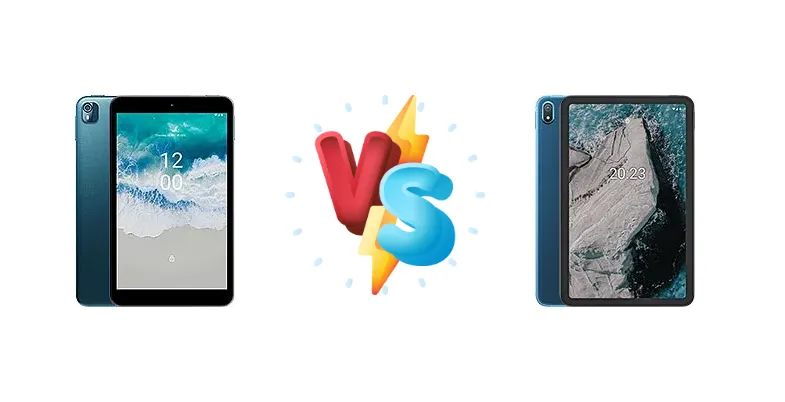
Nokia's T-series tablets offer affordable Android experiences, but choosing between the T10 and T20 can be tricky. Both aim for budget-conscious buyers, but subtle differences impact their overall value. Let's dive into a comprehensive comparison to help you decide which tablet is right for you.
🏆 Quick Verdict
The Nokia T20 edges out the T10 thanks to its slightly faster processor, brighter display, and faster charging. While both are budget-friendly, the T20 provides a more refined and future-proof experience, justifying its slightly higher price point.
| Network |
|---|
| 2G bands | GSM 850 / 900 / 1800 / 1900 | GSM 850 / 900 / 1800 / 1900 |
| 3G bands | HSDPA 850 / 900 / 2100 | HSDPA 850 / 900 / 1700(AWS) / 1900 / 2100 - US, LATAM |
| 4G bands | 1, 3, 5, 7, 8, 20, 28, 38, 40, 41 | 1, 2, 3, 4, 5, 7, 8, 12, 13, 17, 20, 28, 40, 66 - US, LATAM |
| Speed | HSPA 42.2/5.76 Mbps, LTE Cat4 150/50 Mbps | HSPA, LTE Cat4 150/50 Mbps - cellular model only |
| Technology | GSM / HSPA / LTE | GSM / HSPA / LTE |
| | - | 1, 3, 5, 7, 8, 20, 28, 38, 40, 41 - International |
| Launch |
|---|
| Announced | 2022, July 12 | 2021, October 06 |
| Status | Available. Released 2022, August 20 | Available. Released 2021, November 02 |
| Body |
|---|
| Build | Glass front, plastic back, plastic frame | Glass front, aluminum back |
| Dimensions | 208 x 123.2 x 9 mm (8.19 x 4.85 x 0.35 in) | 247.6 x 157.5 x 7.8 mm (9.75 x 6.20 x 0.31 in) |
| SIM | Nano-SIM | Nano-SIM (cellular model only) |
| Weight | 375 g (13.23 oz) | 465 g (Wi-Fi), 470 g (LTE) (1.03 lb) |
| | Splash resistant | Splash resistant |
| Display |
|---|
| Protection | - | Scratch-resistant glass |
| Resolution | 800 x 1280 pixels, 16:10 ratio (~189 ppi density) | 1200 x 2000 pixels, 5:3 ratio (~224 ppi density) |
| Size | 8.0 inches, 185.6 cm2 (~72.4% screen-to-body ratio) | 10.4 inches, 307.9 cm2 (~78.9% screen-to-body ratio) |
| Type | IPS LCD, 360 nits (typ), 450 nits (peak) | IPS LCD, 400 nits (typ) |
| Platform |
|---|
| CPU | Octa-core (2x1.6 GHz Cortex-A75 & 6x1.6 GHz Cortex-A55) | Octa-core (2x1.8 GHz Cortex-A75 & 6x1.8 GHz Cortex-A55) |
| Chipset | Unisoc T606 (12 nm) | Unisoc T610 (12 nm) |
| GPU | Mali-G57 MP1 | Mali-G52 MP2 |
| OS | Android 12, upgradable to Android 13 | Android 11, upgradable to Android 13 |
| Memory |
|---|
| Card slot | microSDXC | microSDXC (dedicated slot) |
| Internal | 32GB 3GB RAM, 64GB 4GB RAM | 32GB 3GB RAM, 64GB 4GB RAM |
| | - | eMMC 5.1 |
| Main Camera |
|---|
| Features | LED flash | LED flash |
| Single | 8 MP, 1/4.0", 1.12µm, AF | 8 MP, AF |
| Video | 1080p | 1080p@30fps |
| Selfie camera |
|---|
| Single | 2 MP, 1/5.0", 1.65µm | 5 MP |
| Video | 720p | Yes |
| Sound |
|---|
| 3.5mm jack | Yes | Yes |
| 35mm jack | Yes | Yes |
| Loudspeaker | Yes, with stereo speakers | Yes, with stereo speakers |
| Comms |
|---|
| Bluetooth | 5.0, A2DP, LE | 5.0, A2DP, LE |
| NFC | No | No |
| Positioning | GPS, GLONASS, GALILEO | GPS - cellular model only |
| Radio | No | FM radio |
| USB | USB Type-C 2.0, OTG | USB Type-C 2.0 |
| WLAN | Wi-Fi 802.11 a/b/g/n/ac, dual-band | Wi-Fi 802.11 a/b/g/n/ac, dual-band |
| Features |
|---|
| Sensors | Accelerometer, proximity | Accelerometer |
| Battery |
|---|
| Charging | 10W wired | 15W wired |
| Type | Li-Po 5250 mAh | Li-Po 8200 mAh |
| Misc |
|---|
| Colors | Ocean Blue | Deep Ocean |
| Models | TA-1503, TA-1472, TA-1462, TA-1457 | TA-1397, TA-1394, TA-1392 |
| Price | About 160 EUR | About 200 EUR |
| SAR | 1.19 W/kg (body) | 1.34 W/kg (body) |
| SAR EU | 0.27 W/kg (head) 1.57 W/kg (body) | 1.35 W/kg (body) |
Nokia T10
- Affordable price
- Durable build quality
- Stock Android experience
- Decent battery life
- Slower processor
- Dim display
- Slow charging
- Basic camera
Nokia T20
- Slightly faster performance
- Brighter and better display
- Faster charging
- Durable build quality
- Stock Android experience
- Still a budget device
- Basic camera
- Not a gaming powerhouse
Display Comparison
The Nokia T20 boasts a significant advantage with a measured 422 nits of brightness, offering a noticeably better viewing experience, especially outdoors. The 1786:1 contrast ratio also contributes to richer colors and deeper blacks. The T10's display is adequate but lacks the vibrancy and brightness of the T20. Both feature similar resolutions, but the T20's superior brightness makes a difference.
Camera Comparison
Both tablets feature modest cameras suitable for basic video calls and occasional snapshots. Image quality is generally acceptable in good lighting conditions, but don't expect stellar results. The T20 might offer a slight improvement in image processing due to its newer chipset, but the difference is minimal. Expect grainy images in low light on both.
Performance
The T20's Unisoc T610 chipset and slightly higher clock speeds (1.8 GHz vs 1.6 GHz) provide a tangible performance boost over the T10's T606. Apps launch a bit faster, and multitasking feels smoother on the T20. While neither tablet is a powerhouse, the T20 offers a more responsive and fluid user experience. Both run Android, likely with a near-stock experience.
Battery Life
Both tablets offer all-day battery life under moderate usage. However, the T20's 15W charging is a significant improvement over the T10's 10W charging, allowing for quicker top-ups. Battery capacity is likely similar (around 5000mAh), so the charging speed is the key differentiator here.
Buying Guide
The Nokia T10 is ideal for users needing a basic tablet for light tasks like web browsing, email, and media consumption. It's a great entry-level option. The Nokia T20 is better suited for those who want a slightly more responsive experience, a better display for viewing content, and faster charging – making it a better all-around choice.
Frequently Asked Questions
❓ What Android version do these tablets ship with?
Both the Nokia T10 and T20 launched with Android 11, with a promise of upgrades. Check Nokia's website for the latest software updates.
❓ Are these tablets suitable for gaming?
Neither tablet is ideal for demanding games. They can handle casual games, but performance will be limited due to the processors and integrated graphics.