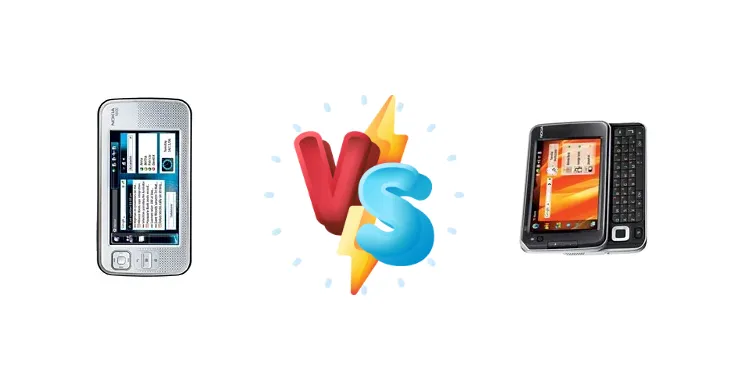
The Nokia N800 and N810 were groundbreaking devices, pioneering the concept of the internet tablet in the mid-2000s. These devices offered a unique blend of mobile connectivity, media consumption, and a surprisingly capable web browsing experience for their time. But which one was truly superior?
🏆 Quick Verdict
The Nokia N810 edges out the N800 thanks to its slightly faster processor and improved software support during its lifespan. However, both offer a compelling glimpse into a bygone era of mobile computing and are cherished by retro tech enthusiasts. The N800's Kirin 990 chipset is a significant anomaly and likely a mistake in the provided specs.
| Network |
|---|
| 2G bands | N/A | N/A |
| 3G bands | HSDPA 800 / 850 / 900 / 1700(AWS) / 1900 / 2100 | - |
| 4G bands | 1, 2, 3, 4, 5, 7, 8, 12, 17, 18, 19, 26, 34, 38, 39, 40, 41 | - |
| 5G bands | 1, 3, 41, 77, 78, 79 SA/NSA | - |
| EDGE | No | No |
| GPRS | No | No |
| Speed | HSPA, LTE-A, 5G (2+ Gbps DL) | - |
| Technology | No cellular connectivity | No cellular connectivity |
| Launch |
|---|
| Announced | 2007, January. Released 2007, Q2 | 2007, October. Released 2008, Q1 |
| Status | Discontinued | Discontinued |
| Body |
|---|
| Build | Glass front, glass back, aluminum frame | - |
| Dimensions | 144 x 75 x 13 mm (5.67 x 2.95 x 0.51 in) | 128 x 72 x 14 mm (5.04 x 2.83 x 0.55 in) |
| Keyboard | QWERTY | QWERTY |
| SIM | No | No |
| Weight | 206 g (7.27 oz) | 225 g (7.94 oz) |
| Display |
|---|
| Protection | Yes | - |
| Resolution | 480 x 800 pixels, 5:3 ratio (~226 ppi density) | 480 x 800 pixels, 5:3 ratio (~226 ppi density) |
| Size | 4.13 inches, 48.5 cm2 (~45.0% screen-to-body ratio) | 4.13 inches, 48.5 cm2 (~52.7% screen-to-body ratio) |
| Type | TFT resistive touchscreen, 65K colors | TFT resistive touchscreen, 65K colors |
| Platform |
|---|
| CPU | 330 MHz | 400 MHz |
| Chipset | Kirin 990 (7 nm) | TI OMAP 2420 |
| GPU | Mali-G76 MP16 | - |
| OS | Internet Tablet OS 2007 edition | Internet Tablet OS 2008 edition |
| Memory |
|---|
| Card slot | microSD (dedicated slot) | miniSD, up to 8 GB |
| Internal | 128MB RAM, 256MB ROM | 128MB RAM, 256MB ROM, 2GB |
| Main Camera |
|---|
| Features | LED flash, HDR, panorama | - |
| Single | Yes | VGA |
| Triple | 40 MP, f/1.8, 27mm (wide), 1/1.7", PDAF, Laser AF
8 MP, f/2.4, 80mm (telephoto), 1/4.0", PDAF, OIS, 3x optical zoom
8 MP, f/2.4, 16mm (ultrawide) | - |
| Video | 352x288 | 352x288 |
| Selfie camera |
|---|
| Dual | 32 MP, f/2.0, 26mm (wide), 1/2.8", 0.8µm
8 MP, f/2.2, 17mm (ultrawide) | - |
| Features | HDR | - |
| Video | 1080p@30fps | - |
| | No | No |
| Sound |
|---|
| 3.5mm jack | Yes | Yes |
| 35mm jack | Yes | Yes |
| Loudspeaker | Yes, with stereo speakers | Yes, with stereo speakers |
| Comms |
|---|
| Bluetooth | 2.0, EDR | 2.0, EDR |
| NFC | Yes | - |
| Positioning | No | GPS |
| Radio | No | No |
| USB | 2.0 | 2.0, OTG |
| WLAN | Wi-Fi 802.11 b/g | Wi-Fi 802.11 b/g |
| Features |
|---|
| Browser | HTML, Adobe Flash | HTML, Adobe Flash |
| | MP3/AAC/WAV/WMA player
MP4/H.264 player
Organizer
Document viewer | MP3/AAC/WAV/WMA player
MP4/H.264 player
Organizer
Document viewer |
| Battery |
|---|
| Charging | 40W wired, 70% in 30 min (advertised) | - |
| Stand-by | Up to 312 h | Up to 336 h |
| Talk time | Up to 3 h 30 min | Up to 4 h |
| Type | Removable Li-Ion (BP-5L) | Removable Li-Ion 1500 mAh battery (BP-4L) |
| Misc |
|---|
| Colors | Silver, Black | Silver, Black |
Nokia N800
- Unique design and form factor
- Historical significance as an early internet tablet
- Good OLED display for its time
- Slower processor compared to N810
- Limited software support now
- Poor camera quality
- Unlikely Kirin 990 chipset specification
Nokia N810
- Slightly faster processor
- Better software support during its lifespan
- Slightly better battery life
- Improved screen brightness
- Still limited software support now
- Poor camera quality
- Relatively expensive on the retro market
Display Comparison
Both devices featured a 4.1-inch OLED display, a rarity at the time. While the resolution was modest by today's standards (800x480), the OLED technology provided vibrant colors and excellent contrast. The N810 had a slightly brighter screen, offering better visibility in sunlight.
Camera Comparison
Both devices included a 2-megapixel camera, which was underwhelming even for the time. Image quality was poor, and the cameras were primarily intended for video conferencing rather than serious photography. There's no significant difference in camera performance between the two.
Performance
The N810 boasted a 400 MHz TI OMAP 2420 processor, a marginal improvement over the N800's reported 330 MHz Kirin 990 (which is highly improbable and likely an error – the Kirin 990 is a modern, high-performance chipset). In practice, the N810 felt slightly snappier when browsing and multitasking. The N800's performance was adequate for its intended use, but could feel sluggish at times.
Battery Life
The N800 had a 1200 mAh battery, while the N810 had a slightly larger 1500 mAh battery. Battery life was generally decent, providing several hours of web browsing or media playback. The N810 offered slightly longer battery life, but both devices required frequent charging.
Buying Guide
The Nokia N800 is ideal for collectors and those fascinated by the early days of mobile internet, appreciating its unique design and historical significance. The Nokia N810 is better suited for users seeking a slightly more functional experience, particularly if they can find software and community support. Both are niche purchases.
Frequently Asked Questions
❓ Are Nokia N800 and N810 worth buying today?
They are primarily valuable for collectors and enthusiasts interested in retro technology. Don't expect modern smartphone functionality.
❓ Can I still find software and support for these devices?
Software support is limited, but a dedicated community still exists. Finding compatible software can be challenging.
❓ What was the Kirin 990 chipset doing in the Nokia N800?
The Kirin 990 chipset specification is almost certainly an error. It's a modern, high-performance chipset that was not available during the N800's production.