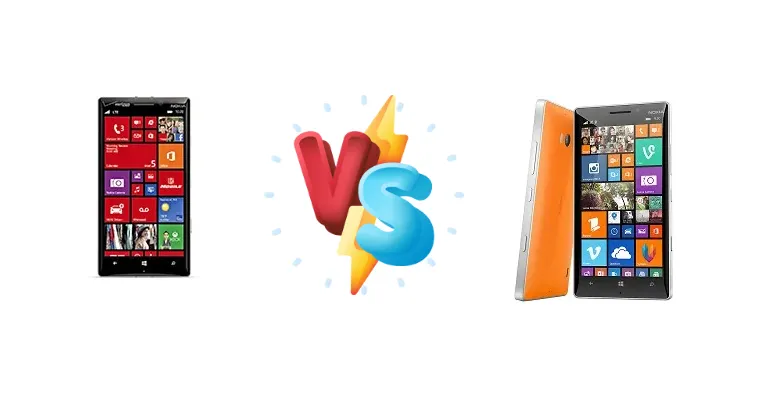
The Nokia Lumia Icon and Lumia 930 represent a golden era for Windows Phone. Both devices boasted impressive specs for their time, but subtle differences set them apart. This comparison dives deep into their features to help you decide which one holds up best today, or if either is worth considering for a retro experience.
🏆 Quick Verdict
The Lumia 930 edges out the Icon thanks to its slightly better battery life and superior display contrast, particularly in sunlight. Both offer the same powerful Snapdragon 800 chipset, but the 930's refinements make it the more compelling choice, especially if display quality is a priority.
| Network |
|---|
| 2G bands | GSM 850 / 900 / 1800 / 1900 | GSM 850 / 900 / 1800 / 1900 |
| 3G bands | HSDPA 850 / 900 / 1900 / 2100 | HSDPA 850 / 900 / 1900 / 2100 |
| 4G bands | 4, 13 | 1, 3, 7, 8, 20 |
| Speed | HSPA 21.1/5.76 Mbps, LTE Cat4 150/50 Mbps, EV-DO Rev.A 3.1 Mbps | HSPA 42.2/5.76 Mbps, LTE Cat4 150/50 Mbps |
| Technology | GSM / CDMA / HSPA / EVDO / LTE | GSM / HSPA / LTE |
| | CDMA2000 1xEV-DO | - |
| Launch |
|---|
| Announced | 2014, February. Released 2014, February | 2014, April. Released 2014, July |
| Status | Discontinued | Discontinued |
| Body |
|---|
| Dimensions | 137 x 71 x 9.8 mm (5.39 x 2.80 x 0.39 in) | 137 x 71 x 9.8 mm, 94.7 cc (5.39 x 2.80 x 0.39 in) |
| SIM | Nano-SIM | Nano-SIM |
| Weight | 167 g (5.89 oz) | 167 g (5.89 oz) |
| Display |
|---|
| Protection | Corning Gorilla Glass 3 | Corning Gorilla Glass 3 |
| Resolution | 1080 x 1920 pixels, 16:9 ratio (~441 ppi density) | 1080 x 1920 pixels, 16:9 ratio (~441 ppi density) |
| Size | 5.0 inches, 68.9 cm2 (~70.9% screen-to-body ratio) | 5.0 inches, 68.9 cm2 (~70.9% screen-to-body ratio) |
| Type | AMOLED | AMOLED |
| | ClearBlack display | ClearBlack display |
| Platform |
|---|
| CPU | Quad-core 2.2 GHz Krait 400 | Quad-core 2.2 GHz Krait 400 |
| Chipset | Qualcomm Snapdragon 800 (28 nm) | Qualcomm MSM8974 Snapdragon 800 (28 nm) |
| GPU | Adreno 330 | Adreno 330 |
| OS | Microsoft Windows Phone 8, upgradable to Microsoft Windows 10 | Microsoft Windows Phone 8.1, upgradable to Windows 10 |
| Memory |
|---|
| Card slot | No | No |
| Internal | 32GB 2GB RAM | 32GB 2GB RAM |
| | eMMC 4.5 | eMMC 4.5 |
| Main Camera |
|---|
| Features | Zeiss optics, dual-LED flash, panorama | Zeiss optics, dual-LED flash, panorama, HDR |
| Single | 20 MP, 1/1.5", 1.12µm, AF, OIS | 20 MP, f/2.4, 26mm (wide), 1/2.5", AF, OIS |
| Video | 4K@30fps (after WP8 Denim update), 1080p@30fps, stereo sound rec. | 4K@30fps (after WP8 Denim update), 1080p@30fps, stereo sound rec. |
| Selfie camera |
|---|
| Single | 1.2 MP | 1.2 MP |
| Video | 720p@30fps | 720p@30fps |
| Sound |
|---|
| 3.5mm jack | Yes | Yes |
| 35mm jack | Yes | Yes |
| Loudspeaker | Yes | Yes |
| Comms |
|---|
| Bluetooth | 4.0, A2DP, EDR, LE/ aptX after WP8 Denim update | 4.0, A2DP, EDR, LE/ aptX after WP8 Denim update |
| NFC | Yes | Yes |
| Positioning | GPS, GLONASS | GPS, GLONASS |
| Radio | FM radio | FM radio |
| USB | microUSB 2.0 | microUSB 2.0 |
| WLAN | Wi-Fi 802.11 a/b/g/n/ac, dual-band, DLNA, hotspot | Wi-Fi 802.11 a/b/g/n/ac, dual-band, DLNA, hotspot |
| Features |
|---|
| Sensors | Accelerometer, gyro, proximity, compass, sensor core | Accelerometer, gyro, proximity, compass, sensor core |
| Battery |
|---|
| Charging | Wireless (Qi) | Wireless (Qi) (market dependent) |
| Music play | Up to 75 h | Up to 75 h |
| Stand-by | Up to 432 h | Up to 432 h |
| Talk time | Up to 16 h 20 min (3G) | Up to 11 h 30 min (2G) / Up to 15 h 30 min (3G) |
| Type | Li-Ion 2420 mAh, non-removable (BV-5QW) | Li-Ion 2420 mAh, non-removable (BV-5QW) |
| Misc |
|---|
| Colors | Black, White | Bright orange, bright green, white, black, gold |
| Price | About 400 EUR | About 370 EUR |
| SAR | 0.70 W/kg (head) 0.93 W/kg (body) | 0.90 W/kg (head) 0.56 W/kg (body) |
| SAR EU | - | 0.60 W/kg (head) 0.73 W/kg (body) |
| Tests |
|---|
| Audio quality | - |
Noise -91.4dB / Crosstalk -90.3dB |
| Battery life |
Endurance rating 40h
| Endurance rating 46h |
| Camera | - |
Photo / Video |
| Display | - |
Contrast ratio: Infinite (nominal), 3.567 (sunlight) |
| Loudspeaker | - |
Voice 76dB / Noise 69dB / Ring 77dB |
Nokia Lumia Icon
- Compact and pocketable
- Wireless charging (Qi)
- Powerful Snapdragon 800 chipset
- Excellent build quality
- Slightly lower battery life than 930
- Display contrast not as impressive as 930
- Older software, limited updates
Nokia Lumia 930
- Superior display contrast, especially in sunlight
- Slightly better battery life
- Refined camera software
- Premium design
- Larger than the Icon
- Wireless charging market dependent
- Older software, limited updates
Display Comparison
Both phones feature a 5-inch OLED display, but the Lumia 930 boasts a noticeably better contrast ratio, especially in direct sunlight. The Icon's display is perfectly adequate, but the 930's is simply more vibrant and easier to view outdoors. The 930's display also generally exhibits slightly better color accuracy.
Camera Comparison
While both phones offer a 20MP PureView camera, the Lumia 930 generally produces slightly better image quality, particularly in low-light conditions. Nokia's camera software on the 930 was also more refined, offering more features and better image processing. Both cameras are capable of capturing excellent photos, but the 930 has a slight edge.
Performance
Performance is virtually identical. Both devices are powered by the Qualcomm Snapdragon 800 chipset and a 2.2 GHz Krait 400 quad-core CPU. Everyday tasks and even moderately demanding games run smoothly on both. Differences in perceived speed are likely due to software optimization rather than hardware limitations.
Battery Life
The Lumia 930 has a slightly larger battery (2520 mAh vs 2420 mAh in the Icon) and achieves a marginally better endurance rating (46h vs 40h). While the difference isn't massive, it can be noticeable over the course of a day.
Buying Guide
The Nokia Lumia Icon is ideal for enthusiasts seeking a compact, powerful Windows Phone with wireless charging. The Lumia 930 is better suited for users who prioritize a vibrant display, slightly longer battery life, and a more polished overall experience. Neither is recommended for new smartphone buyers due to age and software limitations.
Frequently Asked Questions
❓ Are these phones still receiving software updates?
No, both the Lumia Icon and Lumia 930 have reached their end of life and are no longer receiving official software updates from Microsoft. They are running older versions of Windows Phone.
❓ Can I find replacement parts for these phones?
Finding replacement parts can be challenging due to their age. However, some online retailers and repair shops may still offer certain components.