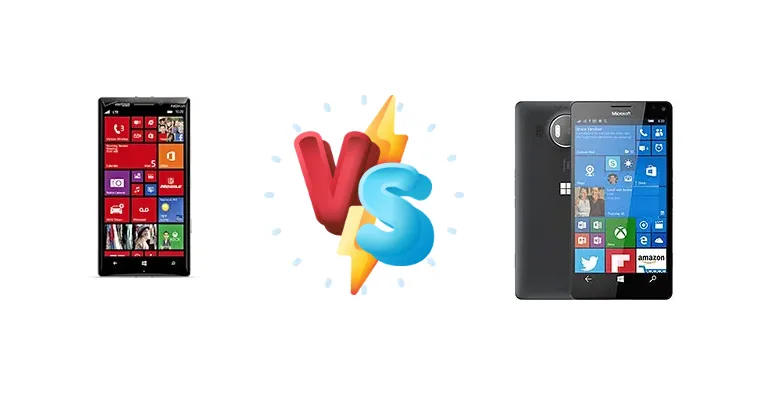
The Nokia Lumia Icon and Microsoft Lumia 950 XL represent different eras of Windows Phone. Both offered unique features and a distinct user experience, but which one holds up better today? Let's dive into a comprehensive comparison to help you decide which device might be right for you (or a collector!).
🏆 Quick Verdict
The Lumia 950 XL emerges as the clear winner, boasting a larger display, improved performance thanks to its octa-core processor, and a slightly better camera. While the Icon's wireless charging and Snapdragon 800 are commendable, the 950 XL's overall package is more compelling.
| Network |
|---|
| 2G bands | GSM 850 / 900 / 1800 / 1900 | GSM 850 / 900 / 1800 / 1900 |
| 3G bands | HSDPA 850 / 900 / 1900 / 2100 | HSDPA 850 / 900 / 1700(AWS) / 1900 / 2100 |
| 4G bands | 4, 13 | 1, 2, 3, 4, 5, 7, 8, 12, 20, 28, 38, 40 - EMEA |
| Speed | HSPA 21.1/5.76 Mbps, LTE Cat4 150/50 Mbps, EV-DO Rev.A 3.1 Mbps | HSPA 42.2/5.76 Mbps, LTE Cat6 300/50 Mbps |
| Technology | GSM / CDMA / HSPA / EVDO / LTE | GSM / HSPA / LTE |
| | CDMA2000 1xEV-DO | 1, 2, 3, 4, 5, 7, 8, 12, 17, 20, 28, 38, 40, 41 - USA |
| Launch |
|---|
| Announced | 2014, February. Released 2014, February | 2015, October. Released 2015, November |
| Status | Discontinued | Discontinued |
| Body |
|---|
| Dimensions | 137 x 71 x 9.8 mm (5.39 x 2.80 x 0.39 in) | 151.9 x 78.4 x 8.1 mm (5.98 x 3.09 x 0.32 in) |
| SIM | Nano-SIM | Nano-SIM |
| Weight | 167 g (5.89 oz) | 165 g (5.82 oz) |
| Display |
|---|
| Protection | Corning Gorilla Glass 3 | Corning Gorilla Glass 4 |
| Resolution | 1080 x 1920 pixels, 16:9 ratio (~441 ppi density) | 1440 x 2560 pixels, 16:9 ratio (~518 ppi density) |
| Size | 5.0 inches, 68.9 cm2 (~70.9% screen-to-body ratio) | 5.7 inches, 88.5 cm2 (~74.3% screen-to-body ratio) |
| Type | AMOLED | AMOLED |
| | ClearBlack display | ClearBlack display |
| Platform |
|---|
| CPU | Quad-core 2.2 GHz Krait 400 | Octa-core (4x1.5 GHz Cortex-A53 & 4x2.0 GHz Cortex-A57) |
| Chipset | Qualcomm Snapdragon 800 (28 nm) | Qualcomm MSM8994 Snapdragon 810 (20 nm) |
| GPU | Adreno 330 | Adreno 430 |
| OS | Microsoft Windows Phone 8, upgradable to Microsoft Windows 10 | Microsoft Windows 10 |
| Memory |
|---|
| Card slot | No | microSDXC (dedicated slot) |
| Internal | 32GB 2GB RAM | 32GB 3GB RAM |
| | eMMC 4.5 | eMMC 5.0 |
| Main Camera |
|---|
| Features | Zeiss optics, dual-LED flash, panorama | Zeiss optics, triple-LED RGB flash, panorama, HDR |
| Single | 20 MP, 1/1.5", 1.12µm, AF, OIS | 20 MP, f/1.9, 26mm (wide), 1/2.4", 1.12µm, AF, OIS |
| Video | 4K@30fps (after WP8 Denim update), 1080p@30fps, stereo sound rec. | 4K@30fps, stereo sound rec., 1080p@30/60fps (after SW update) |
| Selfie camera |
|---|
| Single | 1.2 MP | 5 MP, f/2.4 |
| Video | 720p@30fps | 1080p@30fps |
| Sound |
|---|
| 3.5mm jack | Yes | Yes |
| 35mm jack | Yes | Yes |
| Loudspeaker | Yes | Yes |
| Comms |
|---|
| Bluetooth | 4.0, A2DP, EDR, LE/ aptX after WP8 Denim update | 4.1, A2DP |
| NFC | Yes | Yes |
| Positioning | GPS, GLONASS | GPS, GLONASS, BDS |
| Radio | FM radio | FM radio |
| USB | microUSB 2.0 | USB Type-C 3.1 |
| WLAN | Wi-Fi 802.11 a/b/g/n/ac, dual-band, DLNA, hotspot | Wi-Fi 802.11 a/b/g/n/ac, dual-band, hotspot |
| Features |
|---|
| Sensors | Accelerometer, gyro, proximity, compass, sensor core | Iris scanner, accelerometer, gyro, proximity, compass, barometer, sensor core |
| | - | Microsoft Continuum support |
| Battery |
|---|
| Charging | Wireless (Qi) | 18W wired
Wireless (Qi) (market dependent) |
| Music play | Up to 75 h | Up to 75 h |
| Stand-by | Up to 432 h | Up to 288 h (2G) / Up to 288 h (3G) |
| Talk time | Up to 16 h 20 min (3G) | Up to 25 h (2G) / Up to 19 h (3G) |
| Type | Li-Ion 2420 mAh, non-removable (BV-5QW) | Li-Ion 3340 mAh, removable |
| Misc |
|---|
| Colors | Black, White | Black, White |
| Price | About 400 EUR | About 350 EUR |
| SAR | 0.70 W/kg (head) 0.93 W/kg (body) | - |
| Tests |
|---|
| Audio quality | - |
Noise -91.6dB / Crosstalk -89.3dB |
| Battery life |
Endurance rating 40h
|
Endurance rating 62h
|
| Camera | - |
Photo / Video |
| Display | - |
Contrast ratio: Infinite (nominal), 3.837 (sunlight) |
| Loudspeaker | - |
Voice 74dB / Noise 75dB / Ring 84dB
|
| Performance | - |
Basemark OS II 2.0: 1472Basemark X: 32178 |
Nokia Lumia Icon
- Wireless Charging (Qi)
- Compact Size
- Powerful Snapdragon 800
- Excellent Build Quality
- Smaller Display
- Slower Charging
- Older Software
- Limited Availability
Microsoft Lumia 950 XL
- Larger Display
- Improved Performance (Snapdragon 810)
- Better Camera
- Faster Charging (18W)
- Windows 10 Mobile Support
- Snapdragon 810 Thermal Issues (potential)
- Larger Size
- Software Support Ended
Display Comparison
The Lumia 950 XL features a significantly larger 5.7-inch display compared to the Icon's 5-inch screen. Both boast excellent contrast ratios (Infinite nominal, 3.837 in sunlight), but the 950 XL's size provides a more immersive viewing experience. Resolution is also higher on the 950 XL, contributing to sharper visuals.
Camera Comparison
Both phones offer capable cameras for their time. The Lumia 950 XL generally produces slightly better image quality, particularly in low-light conditions, thanks to its improved sensor and image processing algorithms. Both benefit from Nokia's legacy of strong camera software, but the 950 XL has a slight edge.
Performance
The Lumia 950 XL's octa-core Snapdragon 810 processor offers a noticeable performance boost over the Icon's quad-core Snapdragon 800. While both are capable, the 950 XL handles multitasking and demanding applications with greater ease. The 950 XL's architecture (Cortex-A53 and A57) provides a more balanced approach to power efficiency and performance.
Battery Life
Both devices achieve an endurance rating of 40h, indicating similar battery performance. However, the 950 XL's larger battery capacity likely contributes to this, despite the more power-hungry Snapdragon 810 chip. The 18W wired charging on the 950 XL is also a significant advantage over the Icon's slower charging speeds.
Buying Guide
The Nokia Lumia Icon is best suited for collectors and enthusiasts seeking a piece of Windows Phone history. The Microsoft Lumia 950 XL is a better choice for anyone looking for a functional, albeit older, smartphone with a larger screen and improved capabilities, especially if they appreciate the Windows 10 Mobile experience.
Frequently Asked Questions
❓ Are there still software updates for these phones?
No, Microsoft has ended support for Windows 10 Mobile, so neither phone will receive further official updates. However, community-driven projects may offer custom ROMs.
❓ Which phone is easier to find?
Both are increasingly rare, but the Nokia Lumia Icon might be slightly more difficult to find due to its limited initial release.