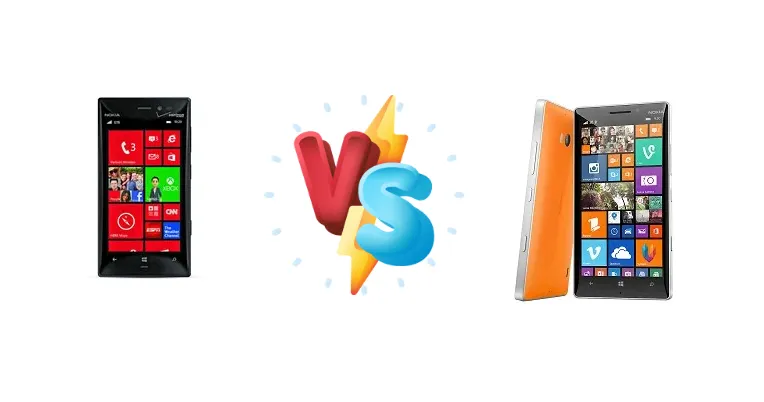
Nokia's Lumia series was a significant force in the smartphone market, particularly for Windows Phone enthusiasts. The Lumia 928 and 930 were flagship devices, but with distinct differences. This comparison dives deep into their features to help you decide which one was the better choice.
🏆 Quick Verdict
The Nokia Lumia 930 edges out the 928 thanks to its superior Snapdragon 800 chipset, brighter display, and slightly improved battery life. While the 928 remains a capable device, the 930 offers a noticeable performance and feature upgrade, making it the preferred option.
| Network |
|---|
| 2G bands | GSM 850 / 900 / 1800 / 1900 | GSM 850 / 900 / 1800 / 1900 |
| 3G bands | HSDPA 850 / 900 / 1900 / 2100 | HSDPA 850 / 900 / 1900 / 2100 |
| 4G bands | 4, 13 - Verizon | 1, 3, 7, 8, 20 |
| Speed | HSPA 42.2/5.76 Mbps, LTE Cat3 100/50 Mbps, EV-DO Rev.A 3.1 Mbps | HSPA 42.2/5.76 Mbps, LTE Cat4 150/50 Mbps |
| Technology | GSM / CDMA / HSPA / EVDO / LTE | GSM / HSPA / LTE |
| | 1, 3, 7, 8, 20 | - |
| Launch |
|---|
| Announced | 2013, April. Released 2013, May | 2014, April. Released 2014, July |
| Status | Discontinued | Discontinued |
| Body |
|---|
| Dimensions | 133 x 68.9 x 10.1 mm, 92.8 cc (5.24 x 2.71 x 0.40 in) | 137 x 71 x 9.8 mm, 94.7 cc (5.39 x 2.80 x 0.39 in) |
| SIM | Micro-SIM | Nano-SIM |
| Weight | 162 g (5.71 oz) | 167 g (5.89 oz) |
| Display |
|---|
| Protection | Corning Gorilla Glass 2 | Corning Gorilla Glass 3 |
| Resolution | 768 x 1280 pixels, 5:3 ratio (~332 ppi density) | 1080 x 1920 pixels, 16:9 ratio (~441 ppi density) |
| Size | 4.5 inches, 57.6 cm2 (~62.9% screen-to-body ratio) | 5.0 inches, 68.9 cm2 (~70.9% screen-to-body ratio) |
| Type | AMOLED | AMOLED |
| | PureMotion HD+ ClearBlack display | ClearBlack display |
| Platform |
|---|
| CPU | Dual-core 1.5 GHz Krait | Quad-core 2.2 GHz Krait 400 |
| Chipset | Qualcomm MSM8960 Snapdragon S4 Plus | Qualcomm MSM8974 Snapdragon 800 (28 nm) |
| GPU | Adreno 225 | Adreno 330 |
| OS | Microsoft Windows Phone 8, upgradable to 8.1 | Microsoft Windows Phone 8.1, upgradable to Windows 10 |
| Memory |
|---|
| Card slot | No | No |
| Internal | 32GB 1GB RAM | 32GB 2GB RAM |
| | - | eMMC 4.5 |
| Main Camera |
|---|
| Features | Carl Zeiss optics, xenon flash, panorama | Zeiss optics, dual-LED flash, panorama, HDR |
| Single | 8 MP, 1/3.2", 1.4µm, AF, OIS | 20 MP, f/2.4, 26mm (wide), 1/2.5", AF, OIS |
| Video | 1080p@30fps, stereo sound rec. | 4K@30fps (after WP8 Denim update), 1080p@30fps, stereo sound rec. |
| Selfie camera |
|---|
| Single | 1.3 MP | 1.2 MP |
| Video | 720p@30fps | 720p@30fps |
| Sound |
|---|
| 3.5mm jack | Yes | Yes |
| 35mm jack | Yes | Yes |
| Loudspeaker | Yes | Yes |
| Comms |
|---|
| Bluetooth | 4.0, A2DP, EDR, LE/ aptX after WP8 Denim update | 4.0, A2DP, EDR, LE/ aptX after WP8 Denim update |
| NFC | Yes | Yes |
| Positioning | GPS, GLONASS | GPS, GLONASS |
| Radio | No | FM radio |
| USB | microUSB 2.0 | microUSB 2.0 |
| WLAN | Wi-Fi 802.11 a/b/g/n, dual-band, DLNA, hotspot | Wi-Fi 802.11 a/b/g/n/ac, dual-band, DLNA, hotspot |
| Features |
|---|
| Sensors | Accelerometer, gyro, proximity, compass | Accelerometer, gyro, proximity, compass, sensor core |
| Battery |
|---|
| Charging | Wireless (Qi) | Wireless (Qi) (market dependent) |
| Music play | Up to 80 h | Up to 75 h |
| Stand-by | Up to 606 h (2G) / Up to 541 h (3G) | Up to 432 h |
| Talk time | Up to 11 h 40 min (2G) / Up to 16 h 20 min (3G) | Up to 11 h 30 min (2G) / Up to 15 h 30 min (3G) |
| Type | Li-Ion 2000 mAh, non-removable (BV 4-NW) | Li-Ion 2420 mAh, non-removable (BV-5QW) |
| Misc |
|---|
| Colors | Black, White | Bright orange, bright green, white, black, gold |
| Price | About 380 EUR | About 370 EUR |
| SAR | 1.44 W/kg (head) 1.38 W/kg (body) | 0.90 W/kg (head) 0.56 W/kg (body) |
| SAR EU | 0.88 W/kg (head) | 0.60 W/kg (head) 0.73 W/kg (body) |
| Tests |
|---|
| Audio quality |
Noise -82.5dB / Crosstalk -80.7dB |
Noise -91.4dB / Crosstalk -90.3dB |
| Battery life |
Endurance rating 41h
| Endurance rating 46h |
| Camera | - |
Photo / Video |
| Display | - |
Contrast ratio: Infinite (nominal), 3.567 (sunlight) |
| Loudspeaker | - |
Voice 76dB / Noise 69dB / Ring 77dB |
Nokia Lumia 928
- Compact and lightweight design
- Excellent 20MP PureView camera
- Wireless charging (Qi)
- Good battery life (41h)
- Older processor (Snapdragon S4 Plus)
- Less vibrant display compared to 930
- Limited app ecosystem (Windows Phone)
Nokia Lumia 930
- Powerful Snapdragon 800 chipset
- Brighter and more vibrant display
- Excellent 20MP PureView camera
- Wireless charging (Qi) (market dependent)
- Slightly better battery life (46h)
- Larger than the 928
- Limited app ecosystem (Windows Phone)
- Older device - potential for hardware issues
Display Comparison
The Lumia 930 boasts a slightly improved display with a reported contrast ratio of Infinite (nominal) and 3.567 (sunlight), suggesting better outdoor visibility compared to the 928. While both have similar screen sizes (around 4.5 inches), the 930's display is generally considered brighter and more vibrant. The 928's display is still good, but the 930 has a clear advantage.
Camera Comparison
Both phones feature excellent cameras for their time, utilizing a 20MP PureView sensor. However, the 930's processing capabilities, thanks to its more powerful chipset, often resulted in slightly better image quality, especially in low-light conditions. Both offer impressive image stabilization.
Performance
This is where the Lumia 930 truly shines. Its Snapdragon 800 chipset with a quad-core 2.2 GHz Krait 400 CPU is significantly faster than the 928's Snapdragon S4 Plus with a dual-core 1.5 GHz Krait processor. Expect smoother multitasking, faster app loading times, and better overall responsiveness on the 930.
Battery Life
Both devices have an endurance rating of 41-46 hours, indicating similar battery performance. While the 930 has a slightly higher rating (46h), real-world usage would likely show minimal difference. Both support wireless charging (Qi).
Buying Guide
The Nokia Lumia 928 is a good option for users seeking a reliable, compact Windows Phone with wireless charging and a decent camera, especially if found at a significantly lower price. The Nokia Lumia 930 is ideal for those prioritizing performance, a brighter display, and a more modern processor, even if it's an older device.
Frequently Asked Questions
❓ Is the Nokia Lumia 930 worth buying in 2023?
While it's an older device, the Lumia 930 still offers a decent experience for Windows Phone enthusiasts. However, consider the limited app ecosystem and potential for hardware issues due to its age.
❓ What is the difference between the Lumia 928 and 930 cameras?
Both have a 20MP PureView sensor, but the 930's more powerful processor allows for slightly better image processing and potentially better low-light performance.