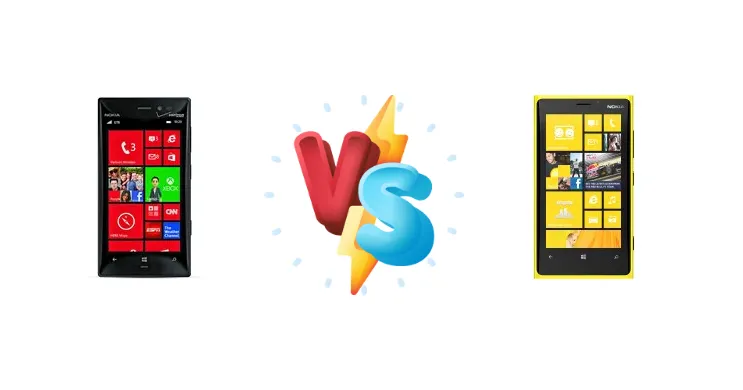
The Nokia Lumia 928 and 920 were flagship Windows Phones, representing the pinnacle of Nokia's smartphone efforts. Both offered premium designs and the Windows Phone experience, but subtle differences set them apart. This comparison dives deep into their features to help you decide which one was the better choice.
🏆 Quick Verdict
The Lumia 920 edges out the 928 thanks to its superior display visibility in sunlight and slightly better camera capabilities. While both offer excellent battery life and performance, the 920's overall package makes it the marginally better option, especially for outdoor use.
| Network |
|---|
| 2G bands | GSM 850 / 900 / 1800 / 1900 | GSM 850 / 900 / 1800 / 1900 - RM-821, RM-820 |
| 3G bands | HSDPA 850 / 900 / 1900 / 2100 | HSDPA 850 / 900 / 1900 / 2100 - RM-821, RM-820 |
| 4G bands | 4, 13 - Verizon | 1, 3, 7, 8, 20 - RM-821 |
| EDGE | - | No |
| GPRS | - | No |
| Speed | HSPA 42.2/5.76 Mbps, LTE Cat3 100/50 Mbps, EV-DO Rev.A 3.1 Mbps | HSPA 42.2/5.76 Mbps, LTE Cat3 100/50 Mbps |
| Technology | GSM / CDMA / HSPA / EVDO / LTE | GSM / HSPA / LTE |
| | 1, 3, 7, 8, 20 | 4, 17 - RM-820 (AT&T) |
| Launch |
|---|
| Announced | 2013, April. Released 2013, May | 2012, September. Released 2012, November |
| Status | Discontinued | Discontinued |
| Body |
|---|
| Dimensions | 133 x 68.9 x 10.1 mm, 92.8 cc (5.24 x 2.71 x 0.40 in) | 130.3 x 70.8 x 10.7 mm, 99 cc (5.13 x 2.79 x 0.42 in) |
| SIM | Micro-SIM | Micro-SIM |
| Weight | 162 g (5.71 oz) | 185 g (6.53 oz) |
| Display |
|---|
| Protection | Corning Gorilla Glass 2 | Corning Gorilla Glass 2 |
| Resolution | 768 x 1280 pixels, 5:3 ratio (~332 ppi density) | 768 x 1280 pixels, 5:3 ratio (~332 ppi density) |
| Size | 4.5 inches, 57.6 cm2 (~62.9% screen-to-body ratio) | 4.5 inches, 57.6 cm2 (~62.5% screen-to-body ratio) |
| Type | AMOLED | IPS LCD |
| | PureMotion HD+ ClearBlack display | PureMotion HD+ ClearBlack display |
| Platform |
|---|
| CPU | Dual-core 1.5 GHz Krait | Dual-core 1.5 GHz Krait |
| Chipset | Qualcomm MSM8960 Snapdragon S4 Plus | Qualcomm MSM8960 Snapdragon S4 Plus |
| GPU | Adreno 225 | Adreno 225 |
| OS | Microsoft Windows Phone 8, upgradable to 8.1 | Microsoft Windows Phone 8, upgradable to 8.1 |
| Memory |
|---|
| Call records | - | Yes |
| Card slot | No | No |
| Internal | 32GB 1GB RAM | 32GB 1GB RAM |
| Phonebook | - | Yes |
| Main Camera |
|---|
| Features | Carl Zeiss optics, xenon flash, panorama | Carl Zeiss optics, dual-LED flash |
| Single | 8 MP, 1/3.2", 1.4µm, AF, OIS | 8 MP, f/2.0, 26mm (wide), 1/3.0", AF, OIS |
| Video | 1080p@30fps, stereo sound rec. | 1080p@30fps |
| Selfie camera |
|---|
| Single | 1.3 MP | 1.3 MP |
| Video | 720p@30fps | 720p@30fps |
| Sound |
|---|
| 3.5mm jack | Yes | Yes |
| 35mm jack | Yes | Yes |
| Loudspeaker | Yes | Yes |
| Comms |
|---|
| Bluetooth | 4.0, A2DP, EDR, LE/ aptX after WP8 Denim update | 4.0, A2DP, EDR, LE/ aptX after WP8 Denim update |
| NFC | Yes | Yes |
| Positioning | GPS, GLONASS | GPS, A-GPS, GLONASS |
| Radio | No | FM radio |
| USB | microUSB 2.0 | microUSB 2.0 |
| WLAN | Wi-Fi 802.11 a/b/g/n, dual-band, DLNA, hotspot | Wi-Fi 802.11 a/b/g/n, dual-band, DLNA, hotspot |
| Features |
|---|
| Browser | - | No |
| Games | - | No |
| Java | - | No |
| Messaging | - | SMS |
| Sensors | Accelerometer, gyro, proximity, compass | Accelerometer, gyro, proximity, compass |
| Battery |
|---|
| Charging | Wireless (Qi) | Wireless (Qi) |
| Music play | Up to 80 h | Up to 67 h |
| Stand-by | Up to 606 h (2G) / Up to 541 h (3G) | Up to 400 h (2G) / Up to 400 h (3G) |
| Talk time | Up to 11 h 40 min (2G) / Up to 16 h 20 min (3G) | Up to 17 h (2G) / Up to 10 h (3G) |
| Type | Li-Ion 2000 mAh, non-removable (BV 4-NW) | Non-removable Li-Ion 2000 mAh battery (BP-4GW) |
| Misc |
|---|
| Colors | Black, White | Black, Gray, Red, Yellow, White |
| Price | About 380 EUR | About 210 EUR |
| SAR | 1.44 W/kg (head) 1.38 W/kg (body) | 1.08 W/kg (head) 0.91 W/kg (body) |
| SAR EU | 0.88 W/kg (head) | 0.70 W/kg (head) |
| Tests |
|---|
| Audio quality |
Noise -82.5dB / Crosstalk -80.7dB |
Noise -78.9dB / Crosstalk -75.0dB |
| Battery life |
Endurance rating 41h
|
Endurance rating 44h
|
| Camera | - |
Photo / Video |
| Display | - |
Contrast ratio: 1065:1 (nominal) / 2.107:1 (sunlight) |
| Loudspeaker | - |
Voice 61dB / Noise 64dB / Ring 65dB
|
Nokia Lumia 928
- Slightly more compact design
- Refined aesthetics
- Wireless Charging (Qi)
- Slightly weaker camera
- Lower sunlight display visibility
- Older model
Nokia Lumia 920
- Excellent sunlight display visibility
- Slightly better camera
- Wireless Charging (Qi)
- Slightly better battery life
- Larger size
- Older model
- Less compact than 928
Display Comparison
The Lumia 920 boasts a significantly better display in direct sunlight, with a contrast ratio of 2.107:1 compared to the 928's. Both have a nominal contrast ratio of 1065:1. While both are AMOLED displays, the 920's sunlight readability is a key advantage. The 928's screen is slightly smaller, which some may prefer for one-handed use.
Camera Comparison
The Lumia 920 generally has a slight edge in camera performance. While both offer Photo/Video capabilities, the 920's optics and image processing algorithms were considered slightly superior, particularly in low-light conditions. The 928's camera was still very good, but the 920 consistently produced slightly better results.
Performance
Both devices share the same Qualcomm MSM8960 Snapdragon S4 Plus chipset and dual-core 1.5 GHz Krait CPU. Performance is virtually identical in everyday tasks and app usage. Don't expect blazing-fast speeds by today's standards, but they were competent for their time.
Battery Life
Both phones offer impressive battery life, with endurance ratings of 41h and 44h respectively. The Lumia 920's slightly higher rating suggests a marginally better battery, but real-world usage will likely show minimal difference between the two.
Buying Guide
The Nokia Lumia 928 is a good choice for users prioritizing a slightly more compact design and a refined aesthetic. The Lumia 920 is ideal for those who need excellent outdoor visibility and a more robust camera system, even if it's a bit larger.
Frequently Asked Questions
❓ What operating system did these phones use?
Both the Nokia Lumia 928 and 920 ran Windows Phone 8.1.
❓ Are spare parts readily available for these phones?
Due to their age, finding genuine spare parts can be challenging. Third-party options may be available, but quality can vary.