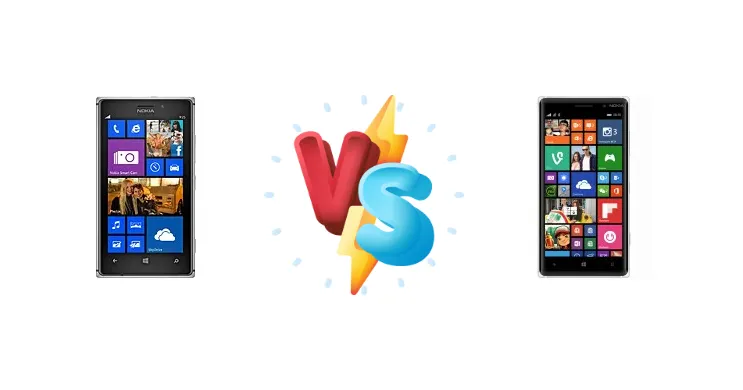
Nokia's Lumia series offered a unique blend of Windows Phone software and premium hardware. The Lumia 925 and 830 were both strong contenders, but cater to different needs. This comparison dives deep into their features to help you decide which one was the better choice.
🏆 Quick Verdict
The Lumia 925 boasts a stunning design and potentially better display contrast in ideal conditions. However, the Lumia 830 offers superior battery life, a more modern chipset, and wireless charging. For most users, the 830's practicality and longevity make it the winner.
| Network |
|---|
| 2G bands | GSM 850 / 900 / 1800 / 1900 - all versions | GSM 850 / 900 / 1800 / 1900 |
| 3G bands | HSDPA 850 / 900 / 1900 / 2100 - RM-892 | HSDPA 850 / 900 / 1900 / 2100 |
| 4G bands | 1, 3, 7, 8, 20 - RM-892 | 1, 3, 7, 8, 20 |
| Speed | HSPA 42.2/5.76 Mbps, LTE Cat3 100/50 Mbps | HSPA 42.2/5.76 Mbps, LTE Cat4 150/50 Mbps |
| Technology | GSM / HSPA / LTE | GSM / HSPA / LTE |
| | 2, 4, 5, 17 - RM-893 | 2, 4, 5, 17 - AT&T |
| Launch |
|---|
| Announced | 2013, May. Released 2013, June | 2014, September. Released 2014, September |
| Status | Discontinued | Discontinued |
| Body |
|---|
| Dimensions | 129 x 70.6 x 8.5 mm, 78 cc (5.08 x 2.78 x 0.33 in) | 139.4 x 70.7 x 8.5 mm (5.49 x 2.78 x 0.33 in) |
| SIM | Micro-SIM | Nano-SIM |
| Weight | 139 g (4.90 oz) | 150 g (5.29 oz) |
| Display |
|---|
| Protection | Corning Gorilla Glass 2 | Corning Gorilla Glass 3 |
| Resolution | 768 x 1280 pixels, 5:3 ratio (~332 ppi density) | 720 x 1280 pixels, 16:9 ratio (~294 ppi density) |
| Size | 4.5 inches, 57.6 cm2 (~63.3% screen-to-body ratio) | 5.0 inches, 68.9 cm2 (~69.9% screen-to-body ratio) |
| Type | AMOLED | IPS LCD |
| | PureMotion HD+ ClearBlack display | ClearBlack display |
| Platform |
|---|
| CPU | Dual-core 1.5 GHz Krait | Quad-core 1.2 GHz Cortex-A7 |
| Chipset | Qualcomm MSM8960 Snapdragon S4 Plus | Qualcomm Snapdragon 400 (28 nm) |
| GPU | Adreno 225 | Adreno 305 |
| OS | Microsoft Windows Phone 8, upgradable to 8.1 | Microsoft Windows Phone 8.1, upgradable to Microsoft Windows 10 |
| Memory |
|---|
| Card slot | No | microSDXC (dedicated slot) |
| Internal | 16GB 1GB RAM, 32GB 1GB RAM | 16GB 1GB RAM |
| | - | eMMC 4.5 |
| Main Camera |
|---|
| Features | Carl Zeiss optics, dual-LED flash | Zeiss optics, LED flash, panorama |
| Single | 8 MP, 1/3.0", AF, OIS | 10 MP, f/2.2, 26mm (wide), 1/3.4", AF, OIS |
| Video | 1080p@30fps | 1080p@30fps, stereo sound rec. |
| Selfie camera |
|---|
| Single | 1.3 MP | 0.9 MP |
| Video | 720p@30fps | 720p |
| Sound |
|---|
| 3.5mm jack | Yes | Yes |
| 35mm jack | Yes | Yes |
| Loudspeaker | Yes | Yes |
| Comms |
|---|
| Bluetooth | 4.0, A2DP, EDR, LE/ aptX after WP8 Denim update | 4.0, A2DP, EDR, LE, aptX |
| NFC | Yes | Yes |
| Positioning | GPS, GLONASS | GPS, GLONASS, BDS |
| Radio | FM radio | FM radio |
| USB | microUSB 2.0 | microUSB 2.0 |
| WLAN | Wi-Fi 802.11 a/b/g/n, dual-band, DLNA, hotspot | Wi-Fi 802.11 a/b/g/n, dual-band, DLNA, hotspot |
| Features |
|---|
| Sensors | Accelerometer, gyro, proximity, compass | Accelerometer, gyro, proximity, compass |
| Battery |
|---|
| Charging | - | Wireless (Qi) |
| Music play | Up to 55 h | Up to 78 h |
| Stand-by | Up to 440 h (3G) | Up to 528 h |
| Talk time | Up to 18 h 20 min (2G) / Up to 12 h 40 min (3G) | Up to 12 h 54 min (2G) / Up to 14 h 48 min (3G) |
| Type | Li-Ion 2000 mAh, non-removable (BL-4YW) | Li-Ion 2200 mAh, removable (BV-L4A) |
| Misc |
|---|
| Colors | Black, White, Gray | Orange, green, white, black, gold |
| Price | About 260 EUR | About 330 EUR |
| SAR | 1.42 W/kg (head) 1.00 W/kg (body) | 0.87 W/kg (head) 0.83 W/kg (body) |
| SAR EU | 0.81 W/kg (head) | 0.46 W/kg (head) 0.59 W/kg (body) |
| Tests |
|---|
| Audio quality |
Noise -82.5dB / Crosstalk -81.2dB |
Noise -89.7dB / Crosstalk -91.6dB |
| Battery life | - |
Endurance rating 68h
|
| Camera |
Photo / Video |
Photo / Video |
| Display |
Contrast ratio: Infinite (nominal) / 3.402:1 (sunlight) |
Contrast ratio: 1078 (nominal), 1887 (sunlight) |
| Loudspeaker |
Voice 63dB / Noise 72dB / Ring 66dB
|
Voice 65dB / Noise 66dB / Ring 78dB
|
Nokia Lumia 925
- Premium design and build quality
- Potentially better display contrast (in ideal conditions)
- Compact size
- Older processor
- Shorter battery life
- No wireless charging
- Less sunlight readability
Nokia Lumia 830
- Longer battery life
- Wireless charging
- More efficient processor
- Larger display
- Better sunlight readability
- Less premium design
- IPS display (potentially less vibrant colors)
Display Comparison
The Lumia 925 features a 4.5-inch AMOLED display with a reported 'infinite' contrast ratio (though realistically closer to 3.402:1 in sunlight). The Lumia 830 has a 5-inch IPS LCD display with a contrast ratio of 1078:1 (nominal) and 1887:1 in sunlight. While the 925's AMOLED *could* offer richer colors and deeper blacks in optimal conditions, the 830's IPS panel provides excellent viewing angles and better sunlight readability. The 830's larger screen is also a plus.
Camera Comparison
Both phones feature Photo/Video capabilities, but specifics are lacking in the provided data. Generally, the Lumia 830 is believed to have a slightly better camera due to software optimizations and potentially a better sensor, although both were capable for their time. The 830 also benefited from Nokia's imaging software.
Performance
The Lumia 925 uses a Qualcomm MSM8960 Snapdragon S4 Plus with a dual-core 1.5 GHz Krait processor. The Lumia 830 is powered by a Qualcomm Snapdragon 400 (28 nm) with a quad-core 1.2 GHz Cortex-A7 processor. The 830's quad-core architecture and newer chipset provide a noticeable performance advantage, especially in multitasking and demanding apps. The 925's older processor shows its age.
Battery Life
This is a clear win for the Lumia 830. It boasts an endurance rating of 68h, significantly outperforming the Lumia 925, which had a smaller battery and a less efficient processor. The 830's wireless charging further enhances its convenience.
Buying Guide
The Nokia Lumia 925 is ideal for users prioritizing aesthetics and a premium feel, and who don't mind frequent charging. The Nokia Lumia 830 is a better choice for those needing longer battery life, a more efficient processor, and convenient wireless charging.
Frequently Asked Questions
❓ Is the Lumia 925 worth buying now?
It depends. If you prioritize aesthetics and can live with the shorter battery life, it might be. However, finding one in good condition could be challenging, and its performance is dated.
❓ Which Lumia has better software support?
The Lumia 830 generally received longer software updates and support due to its newer hardware and later release date.