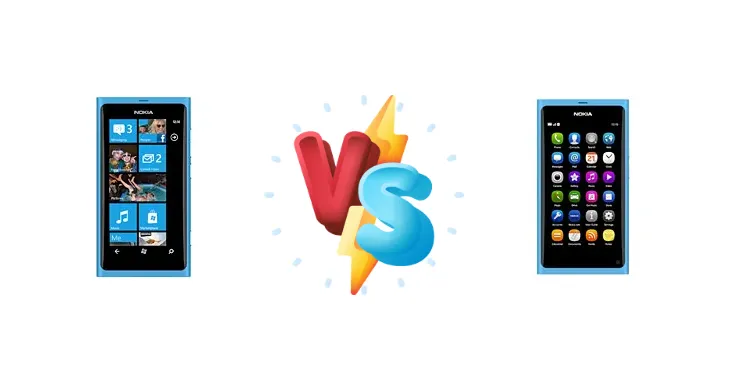
The Nokia Lumia 800 and N9 represent a fascinating era in smartphone history, showcasing Nokia's innovative designs and operating systems. Both devices hold a special place in the hearts of many, but which one truly delivers a better experience today? Let's dive into a detailed comparison to settle the debate.
🏆 Quick Verdict
The Nokia N9 edges out the Lumia 800 thanks to slightly better battery life and a more impressive sunlight readability on its display. While both offer a unique glimpse into Nokia's past, the N9's Meego OS and superior screen performance give it a slight advantage.
| Network |
|---|
| 2G bands | GSM 850 / 900 / 1800 / 1900 | GSM 850 / 900 / 1800 / 1900 |
| 3G bands | HSDPA 850 / 900 / 1900 / 2100 - RM-819 | HSDPA 850 / 900 / 1700 / 1900 / 2100 |
| Speed | HSPA 14.4/5.76 Mbps | HSPA 14.4/5.76 Mbps |
| Technology | GSM / HSPA | GSM / HSPA |
| | HSDPA 850 / 1900 / 2100 - for Canada | - |
| Launch |
|---|
| Announced | 2011, October. Released 2011, November | 2011, June. Released 2011, September |
| Status | Discontinued | Discontinued |
| Body |
|---|
| Dimensions | 116.5 x 61.2 x 12.1 mm, 76.1 cc (4.59 x 2.41 x 0.48 in) | 116.5 x 61.2 x 12.1 mm, 76 cc (4.59 x 2.41 x 0.48 in) |
| SIM | Micro-SIM | Micro-SIM |
| Weight | 142 g (5.01 oz) | 135 g (4.76 oz) |
| Display |
|---|
| Protection | Corning Gorilla Glass | Corning Gorilla Glass |
| Resolution | 480 x 800 pixels, 5:3 ratio (~252 ppi density) | 480 x 854 pixels, 16:9 ratio (~251 ppi density) |
| Size | 3.7 inches, 39.0 cm2 (~54.7% screen-to-body ratio) | 3.9 inches, 41.9 cm2 (~58.8% screen-to-body ratio) |
| Type | AMOLED | AMOLED |
| | Nokia ClearBlack display
| Anti-glare polariser |
| Platform |
|---|
| CPU | 1.4 GHz Scorpion | 1.0 GHz Cortex A8 |
| Chipset | Qualcomm MSM8255 Snapdragon S2 | TI OMAP 3630 |
| GPU | Adreno 205 | PowerVR SGX530 |
| OS | Microsoft Windows Phone 7.5 Mango, upgradable to 7.8 | MeeGo 1.2 Harmattan |
| Memory |
|---|
| Card slot | No | No |
| Internal | 16GB 512MB RAM | 16GB 1GB RAM, 64GB 1GB RAM |
| Main Camera |
|---|
| Features | Carl Zeiss optics, dual-LED flash | Carl Zeiss optics, dual-LED flash |
| Single | 8 MP, AF | 8 MP, AF |
| Video | 720p@30fps | 720p@30fps |
| Selfie camera |
|---|
| Single | - | VGA |
| | No | - |
| Sound |
|---|
| 3.5mm jack | Yes | Yes |
| 35mm jack | Yes | Yes |
| Loudspeaker | Yes | Yes |
| Comms |
|---|
| Bluetooth | 2.1, A2DP, EDR | 2.1, A2DP, EDR |
| NFC | - | Yes |
| Positioning | GPS, A-GPS | GPS, A-GPS; Ovi Maps |
| Radio | Stereo FM radio, RDS | FM radio (via third party software) |
| USB | microUSB 2.0 | microUSB 2.0 |
| WLAN | Wi-Fi 802.11 b/g/n | Wi-Fi 802.11 a/b/g/n, dual-band, Wi-Fi Direct |
| Features |
|---|
| Browser | - | WAP 2.0/xHTML, HTML5, RSS feeds |
| Sensors | Accelerometer, proximity, compass | Accelerometer, proximity, compass |
| | MP3/WAV/eAAC+/WMA player
MP4/H.264/WMV player
Document viewer/editor
Video/photo editor | SNS integration
TV-out
Dolby Digital Plus |
| Battery |
|---|
| Music play | Up to 55 h | Up to 50 h |
| Stand-by | Up to 265 h (2G) / Up to 335 h (3G) | Up to 380 h (2G) / Up to 450 h (3G) |
| Talk time | Up to 13 h (2G) / Up to 9 h 30 min (3G) | Up to 11 h (2G) / Up to 7 h (3G) |
| Type | Non-removable Li-Ion 1450 mAh battery (BV-5JW) | Non-removable Li-Ion 1450 mAh battery (BV-5JW) |
| Misc |
|---|
| Colors | Black, Cyan, Magenta, White | Black, Cyan, Magenta, Glossy white |
| Price | About 140 EUR | About 140 EUR |
| SAR | 1.27 W/kg (head) 1.08 W/kg (body) | 1.18 W/kg (head) 1.18 W/kg (body) |
| SAR EU | 0.94 W/kg (head) | 1.16 W/kg (head) |
| Tests |
|---|
| Audio quality |
Noise -87.3dB / Crosstalk -87.8dB |
Noise -90.9dB / Crosstalk -83.6dB |
| Battery life |
Endurance rating 35h
| Endurance rating 39h |
| Camera |
Photo / Video |
Photo / Video |
| Display |
Contrast ratio: Infinite (nominal) |
Contrast ratio: Infinite (nominal) / 3.069:1 (sunlight) |
| Loudspeaker |
Voice 60dB / Noise 59dB / Ring 61dB
|
Voice 61dB / Noise 58dB / Ring 66dB |
Nokia Lumia 800
- Compact and durable design
- Familiar Windows Phone OS
- Slightly faster processor
- Good color reproduction in camera
- Limited app ecosystem compared to Android/iOS
- Weaker sunlight display performance
- Older technology
Nokia N9
- Unique and premium design
- Better sunlight display readability
- Slightly longer battery life
- Interesting Meego OS (for enthusiasts)
- Meego OS is discontinued and lacks updates
- Slower processor
- Limited app availability
- Can feel sluggish at times
Display Comparison
Both phones boast a 'nominal' infinite contrast ratio, which is a marketing term more than a quantifiable measurement. However, the N9 distinguishes itself with a measured 3.069:1 contrast ratio in sunlight, indicating significantly better outdoor visibility compared to the Lumia 800, which lacks this specification. The Lumia 800's screen is generally considered adequate, but the N9's is noticeably brighter and more readable in challenging lighting conditions.
Camera Comparison
Both phones feature Photo/Video capabilities, but detailed camera specifications are lacking. General consensus suggests the Lumia 800's camera produces slightly more vibrant colors, while the N9's camera tends to be more accurate in color reproduction. Image quality on both is adequate for their time but doesn't compare to modern smartphone cameras.
Performance
The Lumia 800's Qualcomm Snapdragon S2 chipset with a 1.4 GHz Scorpion CPU provides a slightly faster processing speed than the N9's TI OMAP 3630 with a 1.0 GHz Cortex A8 CPU. However, the actual performance difference in real-world usage is minimal. Both phones can handle everyday tasks, but may struggle with demanding modern apps. The Windows Phone OS on the Lumia 800 is generally more optimized for the hardware than Meego on the N9.
Battery Life
The N9 holds a slight advantage in battery endurance, boasting a rated 39 hours compared to the Lumia 800's 35 hours. While both are respectable for their age, the N9's slightly larger battery capacity contributes to its longer runtime.
Buying Guide
The Nokia Lumia 800 is ideal for those seeking a familiar Windows Phone experience and a compact, durable device. The Nokia N9 is for enthusiasts interested in exploring the now-defunct Meego OS and appreciating a unique, premium design with a slightly better display.
Frequently Asked Questions
❓ Are apps still available for the Nokia Lumia 800?
While the Windows Phone Store is largely defunct, some legacy apps may still be accessible. However, don't expect a thriving app ecosystem.
❓ Is the Nokia N9 worth buying in 2023?
It's a niche purchase for collectors and enthusiasts interested in experiencing Meego. Don't expect modern smartphone functionality.