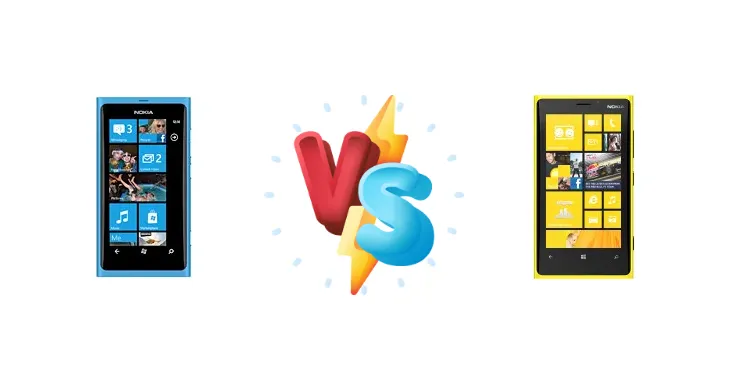
Nokia's Lumia series was a significant player in the early days of Windows Phone. The Lumia 800 and 920, while both running the same OS, offered distinct experiences. This comparison dives deep into their differences to help you understand which phone was the better choice back then, and what their legacies are today.
🏆 Quick Verdict
The Nokia Lumia 920 clearly wins. While the 800 offered a sleek design, the 920's superior display, faster processor, improved camera, wireless charging, and slightly better battery life make it the more compelling device overall. It represented a significant upgrade.
| Network |
|---|
| 2G bands | GSM 850 / 900 / 1800 / 1900 | GSM 850 / 900 / 1800 / 1900 - RM-821, RM-820 |
| 3G bands | HSDPA 850 / 900 / 1900 / 2100 - RM-819 | HSDPA 850 / 900 / 1900 / 2100 - RM-821, RM-820 |
| 4G bands | - | 1, 3, 7, 8, 20 - RM-821 |
| EDGE | - | No |
| GPRS | - | No |
| Speed | HSPA 14.4/5.76 Mbps | HSPA 42.2/5.76 Mbps, LTE Cat3 100/50 Mbps |
| Technology | GSM / HSPA | GSM / HSPA / LTE |
| | HSDPA 850 / 1900 / 2100 - for Canada | 4, 17 - RM-820 (AT&T) |
| Launch |
|---|
| Announced | 2011, October. Released 2011, November | 2012, September. Released 2012, November |
| Status | Discontinued | Discontinued |
| Body |
|---|
| Dimensions | 116.5 x 61.2 x 12.1 mm, 76.1 cc (4.59 x 2.41 x 0.48 in) | 130.3 x 70.8 x 10.7 mm, 99 cc (5.13 x 2.79 x 0.42 in) |
| SIM | Micro-SIM | Micro-SIM |
| Weight | 142 g (5.01 oz) | 185 g (6.53 oz) |
| Display |
|---|
| Protection | Corning Gorilla Glass | Corning Gorilla Glass 2 |
| Resolution | 480 x 800 pixels, 5:3 ratio (~252 ppi density) | 768 x 1280 pixels, 5:3 ratio (~332 ppi density) |
| Size | 3.7 inches, 39.0 cm2 (~54.7% screen-to-body ratio) | 4.5 inches, 57.6 cm2 (~62.5% screen-to-body ratio) |
| Type | AMOLED | IPS LCD |
| | Nokia ClearBlack display
| PureMotion HD+ ClearBlack display |
| Platform |
|---|
| CPU | 1.4 GHz Scorpion | Dual-core 1.5 GHz Krait |
| Chipset | Qualcomm MSM8255 Snapdragon S2 | Qualcomm MSM8960 Snapdragon S4 Plus |
| GPU | Adreno 205 | Adreno 225 |
| OS | Microsoft Windows Phone 7.5 Mango, upgradable to 7.8 | Microsoft Windows Phone 8, upgradable to 8.1 |
| Memory |
|---|
| Call records | - | Yes |
| Card slot | No | No |
| Internal | 16GB 512MB RAM | 32GB 1GB RAM |
| Phonebook | - | Yes |
| Main Camera |
|---|
| Features | Carl Zeiss optics, dual-LED flash | Carl Zeiss optics, dual-LED flash |
| Single | 8 MP, AF | 8 MP, f/2.0, 26mm (wide), 1/3.0", AF, OIS |
| Video | 720p@30fps | 1080p@30fps |
| Selfie camera |
|---|
| Single | - | 1.3 MP |
| Video | - | 720p@30fps |
| | No | - |
| Sound |
|---|
| 3.5mm jack | Yes | Yes |
| 35mm jack | Yes | Yes |
| Loudspeaker | Yes | Yes |
| Comms |
|---|
| Bluetooth | 2.1, A2DP, EDR | 4.0, A2DP, EDR, LE/ aptX after WP8 Denim update |
| NFC | - | Yes |
| Positioning | GPS, A-GPS | GPS, A-GPS, GLONASS |
| Radio | Stereo FM radio, RDS | FM radio |
| USB | microUSB 2.0 | microUSB 2.0 |
| WLAN | Wi-Fi 802.11 b/g/n | Wi-Fi 802.11 a/b/g/n, dual-band, DLNA, hotspot |
| Features |
|---|
| Browser | - | No |
| Games | - | No |
| Java | - | No |
| Messaging | - | SMS |
| Sensors | Accelerometer, proximity, compass | Accelerometer, gyro, proximity, compass |
| | MP3/WAV/eAAC+/WMA player
MP4/H.264/WMV player
Document viewer/editor
Video/photo editor | - |
| Battery |
|---|
| Charging | - | Wireless (Qi) |
| Music play | Up to 55 h | Up to 67 h |
| Stand-by | Up to 265 h (2G) / Up to 335 h (3G) | Up to 400 h (2G) / Up to 400 h (3G) |
| Talk time | Up to 13 h (2G) / Up to 9 h 30 min (3G) | Up to 17 h (2G) / Up to 10 h (3G) |
| Type | Non-removable Li-Ion 1450 mAh battery (BV-5JW) | Non-removable Li-Ion 2000 mAh battery (BP-4GW) |
| Misc |
|---|
| Colors | Black, Cyan, Magenta, White | Black, Gray, Red, Yellow, White |
| Price | About 140 EUR | About 210 EUR |
| SAR | 1.27 W/kg (head) 1.08 W/kg (body) | 1.08 W/kg (head) 0.91 W/kg (body) |
| SAR EU | 0.94 W/kg (head) | 0.70 W/kg (head) |
| Tests |
|---|
| Audio quality |
Noise -87.3dB / Crosstalk -87.8dB |
Noise -78.9dB / Crosstalk -75.0dB |
| Battery life |
Endurance rating 35h
|
Endurance rating 44h
|
| Camera |
Photo / Video |
Photo / Video |
| Display |
Contrast ratio: Infinite (nominal) |
Contrast ratio: 1065:1 (nominal) / 2.107:1 (sunlight) |
| Loudspeaker |
Voice 60dB / Noise 59dB / Ring 61dB
|
Voice 61dB / Noise 64dB / Ring 65dB
|
Nokia Lumia 800
- Compact and lightweight design
- Good build quality
- Decent performance for its time
- Outdated processor
- Inferior display
- Less impressive camera
- No wireless charging
Nokia Lumia 920
- Superior display (especially in sunlight)
- Faster processor
- Excellent camera with PureView technology
- Wireless charging
- Slightly better battery life
- Larger and heavier than the 800
- Design less sleek than the 800 (subjective)
Display Comparison
The Lumia 920 boasts a significantly better display. While the 800's 'infinite' contrast ratio is a marketing term and likely not accurately measurable, the 920's 1065:1 contrast ratio is a tangible improvement. More importantly, the 920's display shines in direct sunlight with a remarkable 2.107:1 contrast ratio, a feature completely absent in the 800. Colors are more vibrant and viewing angles are better on the 920.
Camera Comparison
The Lumia 920's camera was a major upgrade. While both phones offer Photo/Video capabilities, the 920 features a larger sensor and improved optics, resulting in better low-light performance, more detail, and overall superior image quality. Nokia's PureView technology was a key differentiator.
Performance
The Lumia 920's Snapdragon S4 Plus with a dual-core 1.5 GHz Krait processor provides a noticeable performance boost over the 800's single-core 1.4 GHz Scorpion processor. Apps launch faster, multitasking is smoother, and the overall user experience feels more responsive on the 920. The 920's chipset also benefits from architectural improvements.
Battery Life
Both phones offer a rated endurance of 35h/44h, but in real-world usage, the 920's slightly larger battery and more efficient processor contribute to slightly better battery life. The addition of wireless charging on the 920 also adds to its convenience.
Buying Guide
The Nokia Lumia 800 is a nostalgic choice for those who appreciate its compact design and simpler experience. It's suitable for collectors or those seeking a basic Windows Phone experience. The Nokia Lumia 920 is ideal for anyone who wants a more modern smartphone experience with a better camera, faster performance, and convenient wireless charging, even considering its age.
Frequently Asked Questions
❓ Was the Nokia Lumia 920 worth the upgrade over the Lumia 800?
Absolutely. The 920 offered significant improvements in display quality, performance, and camera capabilities, making it a worthwhile upgrade for most users.
❓ Are these phones still usable today?
Yes, but with caveats. They run older versions of Windows Phone, which are no longer officially supported. However, community-developed custom ROMs can extend their functionality, though with potential risks. They are primarily collector's items now.