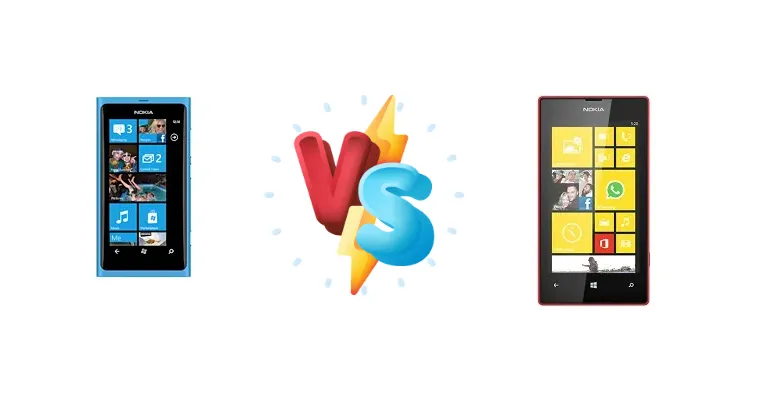
Nokia's Lumia series offered compelling Windows Phone experiences, particularly in the budget segment. The Lumia 800 was an early flagship, while the Lumia 520 aimed for maximum affordability. But which phone holds up better today? Let's dive into a detailed comparison.
🏆 Quick Verdict
The Nokia Lumia 520 emerges as the winner, primarily due to its significantly longer battery life and lower price point. While the 800 boasts a potentially better display contrast (though 'infinite' is misleading) and a slightly faster processor, the 520's practicality and endurance outweigh those advantages for most users.
| Network |
|---|
| 2G bands | GSM 850 / 900 / 1800 / 1900 | GSM 850 / 900 / 1800 / 1900 - all versions |
| 3G bands | HSDPA 850 / 900 / 1900 / 2100 - RM-819 | HSDPA 900 / 2100 - RM-914 |
| Speed | HSPA 14.4/5.76 Mbps | HSPA 21.1/5.76 Mbps |
| Technology | GSM / HSPA | GSM / HSPA |
| | HSDPA 850 / 1900 / 2100 - for Canada | HSDPA 850 / 1700 / 1900 / 2100 - RM-917 |
| Launch |
|---|
| Announced | 2011, October. Released 2011, November | 2013, February. Released 2013, April |
| Status | Discontinued | Discontinued |
| Body |
|---|
| Build | - | Glass front, plastic back, plastic frame |
| Dimensions | 116.5 x 61.2 x 12.1 mm, 76.1 cc (4.59 x 2.41 x 0.48 in) | 119.9 x 64 x 9.9 mm, 75.7 cc (4.72 x 2.52 x 0.39 in) |
| SIM | Micro-SIM | Micro-SIM |
| Weight | 142 g (5.01 oz) | 124 g (4.37 oz) |
| Display |
|---|
| Protection | Corning Gorilla Glass | Scratch-resistant glass |
| Resolution | 480 x 800 pixels, 5:3 ratio (~252 ppi density) | 480 x 800 pixels, 5:3 ratio (~233 ppi density) |
| Size | 3.7 inches, 39.0 cm2 (~54.7% screen-to-body ratio) | 4.0 inches, 45.5 cm2 (~59.3% screen-to-body ratio) |
| Type | AMOLED | IPS LCD |
| | Nokia ClearBlack display
| - |
| Platform |
|---|
| CPU | 1.4 GHz Scorpion | Dual-core 1.0 GHz |
| Chipset | Qualcomm MSM8255 Snapdragon S2 | Qualcomm MSM8227 |
| GPU | Adreno 205 | Adreno 305 |
| OS | Microsoft Windows Phone 7.5 Mango, upgradable to 7.8 | Microsoft Windows Phone 8, upgradable to 8.1 |
| Memory |
|---|
| Card slot | No | microSDXC (dedicated slot) |
| Internal | 16GB 512MB RAM | 8GB 512MB RAM |
| Main Camera |
|---|
| Features | Carl Zeiss optics, dual-LED flash | - |
| Single | 8 MP, AF | 5 MP, f/2.4, 28mm (wide), 1/4.0", AF |
| Video | 720p@30fps | 720p@30fps |
| Sound |
|---|
| 3.5mm jack | Yes | Yes |
| 35mm jack | Yes | Yes |
| Loudspeaker | Yes | Yes |
| Comms |
|---|
| Bluetooth | 2.1, A2DP, EDR | 4.0, A2DP, LE/ aptX after WP8 Denim update |
| NFC | - | No |
| Positioning | GPS, A-GPS | GPS, GLONASS |
| Radio | Stereo FM radio, RDS | FM Radio |
| USB | microUSB 2.0 | microUSB 2.0 |
| WLAN | Wi-Fi 802.11 b/g/n | Wi-Fi 802.11 b/g/n, hotspot |
| Features |
|---|
| Sensors | Accelerometer, proximity, compass | Accelerometer, proximity |
| | MP3/WAV/eAAC+/WMA player
MP4/H.264/WMV player
Document viewer/editor
Video/photo editor | - |
| Battery |
|---|
| Music play | Up to 55 h | Up to 61 h |
| Stand-by | Up to 265 h (2G) / Up to 335 h (3G) | Up to 360 h (3G) |
| Talk time | Up to 13 h (2G) / Up to 9 h 30 min (3G) | Up to 14 h 40 min (2G) / Up to 9 h 40 min (3G) |
| Type | Non-removable Li-Ion 1450 mAh battery (BV-5JW) | Li-Ion 1430 mAh, removable (BL-5J) |
| Misc |
|---|
| Colors | Black, Cyan, Magenta, White | Yellow, red, cyan, white/black |
| Price | About 140 EUR | About 70 EUR |
| SAR | 1.27 W/kg (head) 1.08 W/kg (body) | 0.77 W/kg (head) |
| SAR EU | 0.94 W/kg (head) | 1.09 W/kg (head) |
| Tests |
|---|
| Audio quality |
Noise -87.3dB / Crosstalk -87.8dB |
Noise -82.3dB / Crosstalk -81.8dB |
| Battery life |
Endurance rating 35h
|
Endurance rating 49h
|
| Camera |
Photo / Video |
Photo / Video |
| Display |
Contrast ratio: Infinite (nominal) |
Contrast ratio: 834:1 (nominal) / 1.161:1 (sunlight) |
| Loudspeaker |
Voice 60dB / Noise 59dB / Ring 61dB
|
Voice 68dB / Noise 69dB / Ring 66dB
|
Nokia Lumia 800
- Slightly faster processor
- Potentially better display contrast (though questionable)
- More premium build quality (subjective)
- Shorter battery life
- Higher price (originally)
- Outdated hardware
Nokia Lumia 520
- Significantly longer battery life
- Lower price
- Good sunlight visibility
- Reliable performance
- Slower processor
- Basic camera
- Less premium feel
Display Comparison
The Lumia 800's display is listed with an 'infinite' contrast ratio, which is a marketing term and not a standard measurement. In reality, it likely offered good contrast but not exceptional. The Lumia 520, with a measured 834:1 contrast ratio (and impressive 1.161:1 in sunlight), provides a more quantifiable and arguably better viewing experience, especially outdoors. Colors were generally vibrant on both, typical of the Windows Phone platform.
Camera Comparison
Both phones featured basic camera setups suitable for casual photography. Image quality was decent in good lighting conditions, but struggled in low light. The Lumia 800's camera might have had a slight edge in detail due to potentially better optics, but the difference was minimal. Video recording capabilities were standard for the time.
Performance
The Lumia 800's Qualcomm MSM8255 Snapdragon with a 1.4 GHz Scorpion CPU offered a slight edge in raw processing power. However, Windows Phone's efficient OS meant both phones felt reasonably responsive for everyday tasks. The Lumia 520's dual-core 1.0 GHz processor, while slower on paper, was well-optimized for its hardware, resulting in a smooth user experience. Gaming performance was limited on both devices.
Battery Life
This is where the Lumia 520 truly shines. Its endurance rating of 49 hours significantly surpasses the Lumia 800's 35 hours. This translates to noticeably longer battery life for the 520, making it a more practical choice for users who prioritize longevity.
Buying Guide
The Nokia Lumia 800 is for those seeking a slightly more premium feel and potentially better display quality (though this is debatable given the 'infinite' contrast claim). The Lumia 520 is ideal for budget-conscious users prioritizing battery life and a reliable, functional smartphone experience.
Frequently Asked Questions
❓ Is the 'infinite' contrast ratio on the Lumia 800 a real value?
No, 'infinite' contrast ratio is a marketing term and not a measurable value. It suggests high contrast but doesn't provide a concrete figure.
❓ Which phone is better for gaming?
Neither phone is particularly suited for demanding games. The Lumia 800's slightly faster processor gives it a marginal advantage, but both struggle with modern titles.