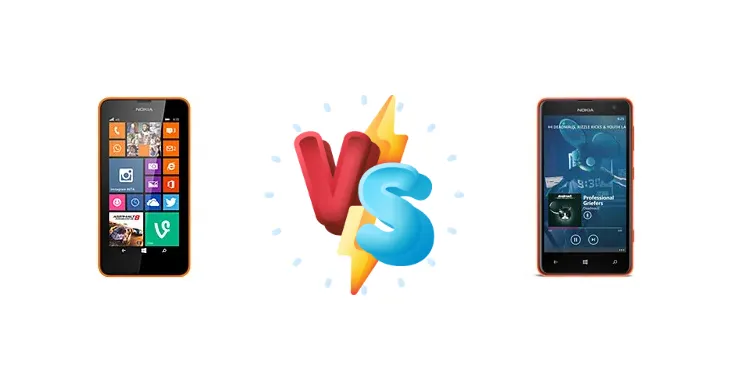
Nokia's Lumia series offered compelling budget Windows Phones. The Lumia 635 and 625 were popular choices, but which one reigns supreme? This comprehensive comparison dives deep into their specs, performance, and features to help you decide.
🏆 Quick Verdict
The Lumia 635 edges out the 625 thanks to its quad-core processor and slightly better sunlight display contrast. While both offer solid value, the 635's improved performance makes it the preferable choice for smoother multitasking and a more responsive experience.
| Network |
|---|
| 2G bands | GSM 850 / 900 / 1800 / 1900 | GSM 850 / 900 / 1800 / 1900 |
| 3G bands | HSDPA 850 / 900 / 2100 - RM-974 | HSDPA 850 / 900 / 2100 |
| 4G bands | 3, 7, 20 - RM-974 | 3, 7, 20 |
| Speed | HSPA 42.2/5.76 Mbps, LTE Cat3 100/50 Mbps | HSPA 42.2/5.76 Mbps, LTE Cat3 100/50 Mbps |
| Technology | GSM / HSPA / LTE | GSM / HSPA / LTE |
| | 2, 4, 5, 7, 17 - RM-975 | - |
| Launch |
|---|
| Announced | 2014, April. Released 2014, June | 2013, July. Released 2013, August |
| Status | Discontinued | Discontinued |
| Body |
|---|
| Dimensions | 129.5 x 66.7 x 9.2 mm, 78.5 cc (5.10 x 2.63 x 0.36 in) | 133.3 x 72.3 x 9.2 mm, 87.6 cc (5.25 x 2.85 x 0.36 in) |
| SIM | Micro-SIM | Micro-SIM |
| Weight | 134 g (4.73 oz) | 159 g (5.61 oz) |
| Display |
|---|
| Protection | Corning Gorilla Glass 3 | Corning Gorilla Glass 2 |
| Resolution | 480 x 854 pixels, 16:9 ratio (~221 ppi density) | 480 x 800 pixels, 5:3 ratio (~199 ppi density) |
| Size | 4.5 inches, 54.3 cm2 (~62.9% screen-to-body ratio) | 4.7 inches, 62.9 cm2 (~65.2% screen-to-body ratio) |
| Type | IPS LCD | IPS LCD |
| | ClearBlack display | - |
| Platform |
|---|
| CPU | Quad-core 1.2 GHz Cortex-A7 | Dual-core 1.2 GHz Krait |
| Chipset | Qualcomm Snapdragon 400 (28 nm) | Qualcomm MSM8930 Snapdragon 400 (28 nm) |
| GPU | Adreno 305 | Adreno 305 |
| OS | Microsoft Windows Phone 8.1 | Microsoft Windows Phone 8, upgradable to 8.1 |
| Memory |
|---|
| Card slot | microSDXC (dedicated slot) | microSDXC (dedicated slot) |
| Internal | 8GB 512MB 8GB 1GB RAM | 8GB 512MB RAM |
| | eMMC 4.5 | eMMC 4.5 |
| Main Camera |
|---|
| Features | Panorama | LED flash |
| Single | 5 MP, 1/4.0", AF | 5 MP, f/2.4, 28mm (wide), 1/4.0", AF |
| Video | 720p@30fps | 1080p@30fps |
| Selfie camera |
|---|
| Single | - | VGA |
| | No | - |
| Sound |
|---|
| 3.5mm jack | Yes | Yes |
| 35mm jack | Yes | Yes |
| Loudspeaker | Yes | Yes |
| Comms |
|---|
| Bluetooth | 4.0, A2DP, LE/ aptX after WP8 Denim update | 4.0, A2DP, LE/ aptX after WP8 Denim update |
| NFC | No | No |
| Positioning | GPS, GLONASS | GPS, GLONASS |
| Radio | FM radio | FM radio |
| USB | microUSB 2.0 | microUSB 2.0 |
| WLAN | Wi-Fi 802.11 b/g/n, DLNA, hotspot | Wi-Fi 802.11 b/g/n, hotspot |
| Features |
|---|
| Sensors | Accelerometer, sensor core | Accelerometer, proximity |
| Battery |
|---|
| Music play | Up to 58 h | Up to 90 h |
| Stand-by | Up to 648 h | Up to 552 h |
| Talk time | Up to 12 h (2G) / Up to 14 h (3G) | Up to 24 h (2G) / Up to 15 h 10 min (3G) |
| Type | Li-Ion 1830 mAh, removable (BL-5H) | Li-Ion 2000 mAh, non-removable (BP-4GWA) |
| Misc |
|---|
| Colors | Bright Orange, bright green, bright yellow, white, black | Orange, Bright green, Yellow, Black and white |
| Models | - | RM-943, RM-941 |
| Price | About 110 EUR | About 160 EUR |
| SAR | 0.97 W/kg (head) 0.77 W/kg (body) | 0.66 W/kg (head) 0.50 W/kg (body) |
| SAR EU | 0.75 W/kg (head) 0.79 W/kg (body) | 0.95 W/kg (head) 0.52 W/kg (body) |
| Tests |
|---|
| Audio quality | - |
Noise -90.3dB / Crosstalk -82.5dB |
| Battery life |
Endurance rating 66h
| - |
| Camera | - |
Photo / Video |
| Display |
Contrast ratio: 771:1 (nominal), 2.056 (sunlight) |
Contrast ratio: 1205:1 (nominal) / 1.371:1 (sunlight) |
| Loudspeaker |
Voice 68dB / Noise 65dB / Ring 75dB
|
Voice 65dB / Noise 64dB / Ring 68dB |
Nokia Lumia 635
- Quad-core processor for better performance
- Excellent sunlight display contrast
- Longer battery life (claimed)
- Slightly more modern design
- Camera performance is average
- Limited storage (typically 8GB)
- Windows Phone OS is discontinued
Nokia Lumia 625
- More affordable
- Good display contrast (nominal)
- Compact and lightweight
- Dual-core processor - slower performance
- Weaker sunlight display contrast
- Shorter battery life
- Windows Phone OS is discontinued
Display Comparison
Both phones feature a 4.3-inch display, but the Lumia 625 boasts a superior nominal contrast ratio of 1205:1 compared to the 635's 771:1. However, the 635 shines in direct sunlight with a contrast ratio of 2.056, significantly better than the 625's 1.371:1. This means the 635 is more viewable outdoors.
Camera Comparison
Both devices feature a 5MP main camera and a front-facing camera. Image quality is comparable, though the 635 might offer slightly improved image processing due to its more powerful chipset. Video recording capabilities are similar on both.
Performance
The Lumia 635 holds a clear advantage here. It's powered by a Qualcomm Snapdragon 400 quad-core 1.2 GHz Cortex-A7 processor, offering noticeably better performance than the Lumia 625's dual-core 1.2 GHz Krait processor. Expect smoother app loading and multitasking on the 635.
Battery Life
The Lumia 635 claims an impressive endurance rating of 66 hours, significantly higher than what was typically observed for the Lumia 625. While real-world usage varies, the 635 generally provides longer battery life.
Buying Guide
The Nokia Lumia 635 is ideal for users prioritizing performance and a slightly better outdoor display. The Lumia 625 is a good option for those seeking a slightly more affordable device and are less concerned with raw processing power.
Frequently Asked Questions
❓ Are the Nokia Lumia 635 and 625 still receiving software updates?
No, both devices have reached their end of life and are no longer receiving official software updates from Microsoft or Nokia.
❓ Which phone is better for gaming?
The Nokia Lumia 635 is significantly better for gaming due to its quad-core processor and improved performance.
❓ Can I expand the storage on either phone?
Yes, both phones support microSD cards for storage expansion, up to a certain limit (typically 32GB).